English
  Spanish
State Law Firm | Sherman Oaks, California
Sherman Oaks Truck Accident Lawyer
After a commercial truck crash, the vehicle, operator, and trip records can matter as much as the collision report. State Law Firm helps injured people review evidence, responsibility, and next steps from our Sherman Oaks office.
Free initial consultation
Commercial truck injury claims
Operator and evidence review
Sherman Oaks office
Start with the crash date, location, investigating agency, and any truck or company identifiers you have. Preserve original recordings and tell the team where the vehicles are stored. You can request a consultation before every record is available; report requests and insurance discussions do not replace legal deadlines.
Truck Injury Claims, With a Sherman Oaks Starting Point
A collision with a tractor-trailer, delivery truck, or other commercial vehicle can leave questions that a vehicle-exchange sheet does not answer. Who operated the truck? Was the trailer owned by someone else? Which company holds the trip records? State Law Firm helps injured people sort out those questions from our Sherman Oaks office, starting with the actual vehicles, route, and evidence.
The review is not based on the size of the truck alone. A passenger-car occupant, pedestrian, cyclist, or injured truck driver may face different liability and insurance issues. Tell the team whether you were working at the time, what you personally observed, and which records you already have. You do not need to finish investigating the crash before requesting a consultation.
Describe the Road and the Movement
In Sherman Oaks, freeway travel near the US-101/I-405 interchange and surface-street activity around Ventura and Sepulveda Boulevards can create very different evidence questions. The City’s community-planning information describes the area’s residential and commercial setting. It is background, not proof that a particular road or business caused your collision.
For a freeway crash, identify the direction, nearest exit, lane, and whether traffic was merging, braking, or already stopped. For a delivery or turning incident, describe the driveway, curb, crosswalk, loading activity, and where each road user was positioned. Photographs of the wider approach may explain details that a close-up of damaged vehicles cannot.
Stay out of active traffic and follow emergency responders’ directions. Seek appropriate medical attention and call 911 for an emergency. A safe witness contact or an existing recording can be useful; entering a roadway, following a truck, or trying to recreate a collision is not required to begin a claim review.
Identify the Operator, Vehicle, and Trip
A company name painted on a trailer is a starting point, not a conclusion about legal responsibility. A tractor, trailer, operator, employer, and delivery customer may have different roles. Preserve information already available to you rather than guessing that every business named on the paperwork is responsible.
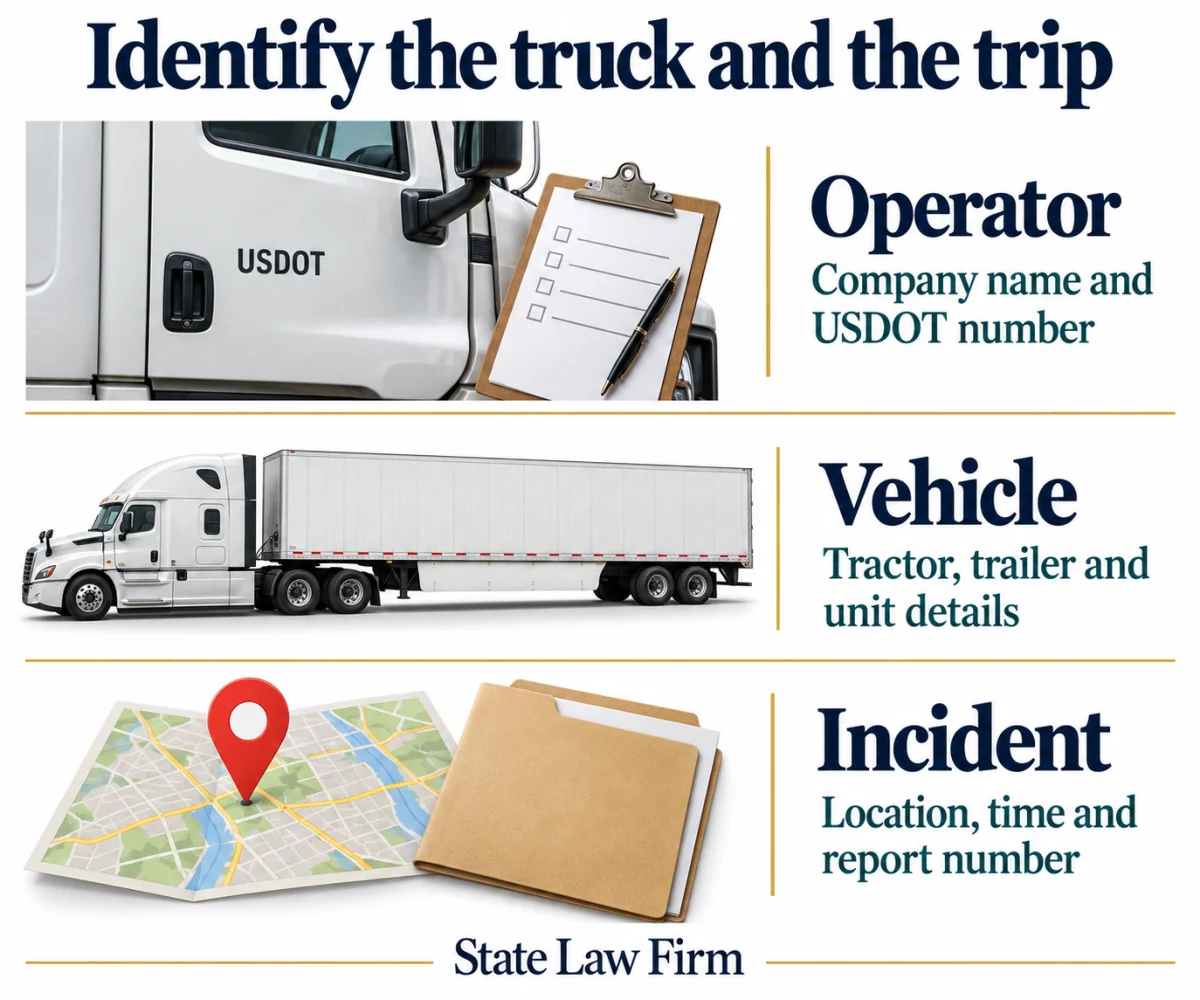
- Operator: company name, driver information, and any USDOT or other carrier identifier visible in safely obtained photographs or records.
- Vehicle: tractor and trailer plates, unit numbers, vehicle type, and the location where the vehicles were taken after the crash.
- Incident: date, time, exact location, investigating agency, and collision or incident number.
- Trip: delivery, dispatch, rental, or work information you lawfully possess. Do not access another person’s account or a company’s systems.
For a hired driver or owner-operator, employment and contract documents may help explain who directed the trip or maintained the equipment. Vehicle ownership, insurance, and responsibility need separate review. The goal is to identify the right records and parties, not to add every associated company to a claim.
Different Truck Records Answer Different Questions
There is no universal truck recording that automatically proves fault. Available systems depend on the vehicle, operator, equipment, and applicable rules. Counsel may need preservation requests and appropriately qualified assistance to identify and obtain relevant material.
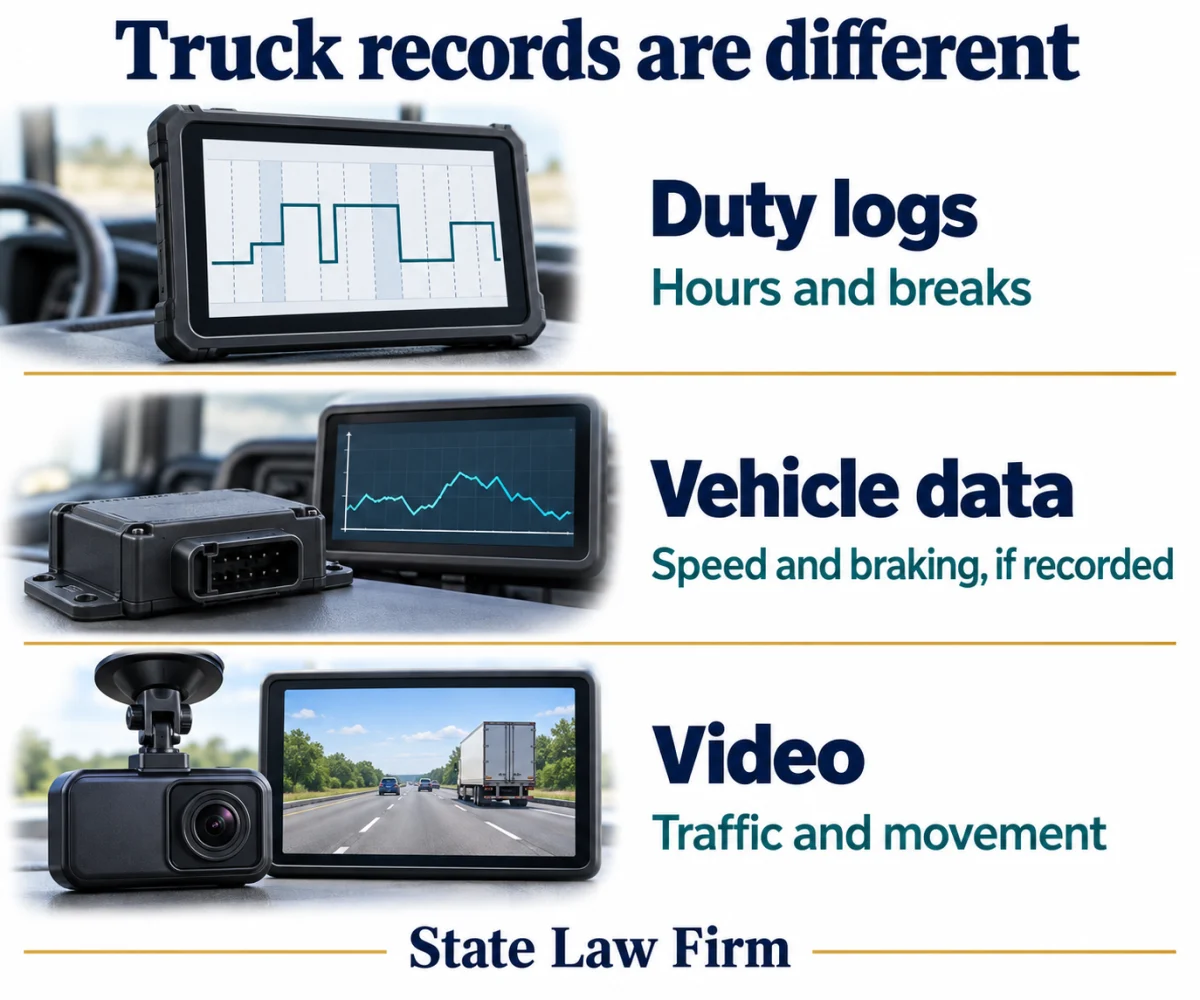
- Duty records: logs and supporting documents can help examine a driver’s work and rest history. An electronic logging device is not interchangeable with a crash-event recorder.
- Vehicle data: some systems may store speed, braking, or other operating information, but the available fields, time period, and interpretation vary.
- Video: original dashcam or nearby-camera footage may show traffic movement and visibility. Keep the full original, not only a shortened clip.
- Condition and load records: inspection, repair, maintenance, and cargo documents may help test a specific defect or loading theory.
FMCSA’s duty-record guidance describes a six-month retention requirement for the records it covers. That is not a deadline for an injured person to wait, and it does not mean every camera, vehicle-data system, or other record remains available that long. Promptly discuss preservation and keep your own originals. Our evidence-preservation resource explains related concerns.
Inspection duties and written-report requirements are also different questions. FMCSA’s pre-trip guidance does not require a written pre-trip report under the particular federal provision it addresses. The applicable vehicle, operation, rules, and any reported defect must be examined before treating the absence of a specific form as proof of a violation.
Responsibility Must Follow the Evidence
A truck investigation may examine a driver’s actions, a carrier’s practices, maintenance work, cargo handling, another road user’s conduct, or an alleged product defect. These are possibilities to investigate, not automatic findings. The relevant relationships, legal duties, cause of the collision, and documented injuries determine which issues matter.
A turning crash needs a different reconstruction from a rear-end impact or a loss of trailer control. For additional background, see our resources on wide-turn truck accidents, jackknife collisions, and underride incidents. These resources do not determine the cause of an individual crash.
If you were driving the truck for work, tell the team about that work relationship. An employment-related benefit claim and a possible claim against another responsible party can involve different rules. Do not assume that the insurance information exchanged at the scene identifies every potentially relevant policy or claim.
Police Reports, DMV Reporting, and Insurance Are Separate
First identify the agency that investigated. For an LAPD report, use the LAPD traffic-report instructions. Some reports cannot be released through its online route. For a CHP-investigated collision, see the CHP 190 request process. CHP does not provide another police department’s report. Preserve the agency and report number even while the final report is pending.
The California DMV’s SR-1 instructions require reporting within 10 days when someone is injured or killed, or property damage exceeds $1,000. This is separate from police and insurance reporting. Confirm who will submit any required SR-1 rather than assuming an officer or insurer has already done it.
Insurance notice, requests for statements, medical authorizations, and proposed releases deserve their own review. Keep correspondence and deadlines, answer factual questions accurately, and ask what a requested document covers before signing. A consultation can address these requests without promising a particular settlement or claim timetable.
Document the Injury and Check Deadlines Early
Keep medical records, bills, treatment-related receipts, wage information, and a factual account of how the injury affects daily activities. Tell the team about ongoing symptoms, prior relevant conditions, and missed work rather than trying to estimate a claim value from another person’s result. What may be recoverable depends on the evidence and applicable law.
California’s general personal-injury lawsuit limitation is two years under Code of Civil Procedure section 335.1, subject to case-specific rules and exceptions. Where a public entity is involved, Government Code section 911.2 generally requires an injury-related administrative claim within six months of accrual, with separate lawsuit requirements. Report requests and insurance discussions do not substitute for meeting applicable legal deadlines.
Meet the Attorneys

Eddie Tehrani
Eddie Tehrani founded State Law Firm after working in Los Angeles law offices handling personal injury and civil litigation. Review his background and discuss the firm’s approach to your truck injury questions.

Arnold Gross
Arnold Gross’s firm biography describes personal injury trial work and mediation and arbitration experience. His professional background is available on the firm’s attorney page.
Visit or Contact Our Sherman Oaks Office
State Law Firm’s office is at 15490 Ventura Blvd #205, Sherman Oaks, CA 91403. Call (877) 659-9223 or contact the team to arrange an initial consultation. Confirm meeting arrangements before traveling; review Locations for office details.
This page serves as the firm’s Sherman Oaks truck practice resource. For other legal matters, see our practice areas. Local truck resources for other communities remain linked below; each should be read in light of the actual crash location and circumstances.
Frequently Asked Questions
Can I start before the collision report is available?
Yes. Provide the date, location, agency, and report number if known. The team can discuss missing information, preservation concerns, and deadlines while you wait for a report.
Does every truck have a black box that proves what happened?
No. Trucks may have different recording systems, and some data may not exist or remain available. Duty logs, operating data, and video answer different questions and need careful interpretation.
Is the company named on the trailer automatically responsible?
No. Preserve the name and identifying details, but the operator, vehicle owner, employer, and other parties may have different relationships. Responsibility depends on the facts and applicable legal duties.
Does a police report replace a required DMV SR-1?
No. DMV reporting is separate. Check the DMV’s current instructions and confirm whether the crash meets its injury, death, or property-damage criteria and who is handling the submission.
Can a commercial driver request a consultation?
Yes. Explain your work status, the vehicles involved, and any employer or insurer communication. Work-related benefits and possible third-party claims need separate assessment; no particular claim or coverage is assumed.
What does the initial consultation cost?
State Law Firm offers a free initial consultation. Ask about the scope of representation, any fee agreement, and case costs before hiring the firm. A consultation does not guarantee acceptance of a case or a particular outcome.
Request a Truck Accident Consultation
Share the crash date, location, truck or company information, and any time-sensitive request you have received. Use the consultation form or call (877) 659-9223. Avoid sending sensitive records until the team explains a suitable way to provide them.
This page provides general information, not legal advice for a particular situation. Contacting the firm does not by itself create an attorney-client relationship.
Related legal resources: Truck Accident Lawyers – Stockton, CA, Truck Accident Attorneys in Santa Clarita, CA, Truck Accident Lawyers in San Ramon, CA: Serious Representation for Serious Crashes, Torrance truck accident lawyer, Free consultation.
For a claim connected with Manhattan Beach, see our Manhattan Beach Truck Accident Lawyer page for location-specific evidence and consultation information.