English
  Spanish
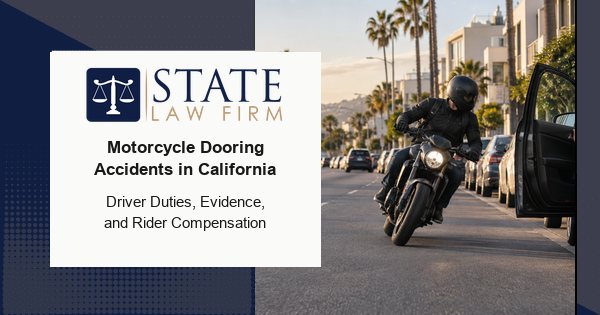
In California, a driver or passenger generally may not open a vehicle door on the side available to moving traffic unless doing so is reasonably safe and will not interfere with traffic. When a door opens into a motorcyclist’s path, California Vehicle Code section 22517 can become central evidence of fault. The rider still needs proof showing how the collision happened, who opened the door, and how the crash caused the claimed injuries and losses.
Motorcycle dooring cases can involve a direct impact with the door, an evasive crash, or a secondary collision with another vehicle. Prompt photographs, video, witnesses, vehicle inspections, medical records, and insurance information can help connect the full sequence.
What Is a Motorcycle Dooring Accident?
A motorcycle dooring accident occurs when someone opens or leaves open a vehicle door in the path of an approaching rider. It may happen beside curbside parking, in stopped traffic, near passenger pickup zones, or while a motorcycle is lawfully moving between lanes.
The motorcycle does not have to strike the door for a claim to exist. A rider may brake, swerve, lose control, or collide with another vehicle while trying to avoid the obstruction. The evidence must show that the opened door contributed to the crash and resulting harm.
What Duty Does California Law Place on the Person Opening the Door?
California Vehicle Code section 22517 applies to any person, not only the driver. It prohibits opening a vehicle door on the side available to moving traffic unless the movement is reasonably safe and can be made without interfering with traffic. It also prohibits leaving such a door open longer than necessary to load or unload passengers.
The California DMV similarly tells motorists to check for motorcyclists before opening a door next to traffic. A reasonable safety check may include looking in mirrors, checking the adjacent lane and blind spot, and waiting until an approaching rider has passed.
A violation can be important evidence of negligence, but a citation does not automatically decide the entire civil case. The parties may still dispute whether the door was on the side available to moving traffic, whether it interfered with the motorcycle, whether the rider could reasonably react, and what injuries the incident caused.
Who May Be Liable for a Motorcycle Dooring Crash?
The person who opened the door is often the main focus. Depending on the facts, other people or entities may also be relevant:
- A driver: for opening the driver’s door or directing a passenger to exit into traffic without a safe check.
- A passenger: because section 22517 applies to any person who opens the door.
- An employer: when an employee caused the incident while acting within the scope of employment.
- A rideshare or commercial operator: when a pickup, drop-off, work assignment, or applicable insurance policy is involved.
- Another road user: if a separate unsafe maneuver contributed to the rider’s evasive crash or secondary impact.
Vehicle ownership alone does not answer every liability question. The claimant should identify the person who actually opened the door, why the vehicle was stopped, whether the trip was personal or commercial, and which insurance policies may apply.
Does Lane Splitting Make the Motorcyclist at Fault?
No automatic rule makes a motorcyclist at fault merely because the rider was moving between lanes. California recognizes lane splitting, but legality does not mean every manner of lane splitting is reasonable under every condition. Investigators may examine traffic speed, the motorcycle’s speed, visibility, lane position, available space, and whether the rider had time to perceive the opening door.
California’s comparative-fault rules allow responsibility to be divided when more than one person’s conduct contributed. Any allocation should be based on the actual evidence. The fact that a motorcycle was lane splitting does not erase the separate duty imposed on a person opening a vehicle door.
What Evidence Can Prove How the Dooring Happened?
Dooring claims can become one person’s account against another unless evidence is preserved quickly. Useful evidence may include:
- helmet-camera, motorcycle-camera, dashcam, traffic-camera, business, or residential video;
- wide and close photographs of the door, motorcycle, lane, curb, parking position, debris, scrape marks, and final resting positions;
- witness names, contact information, and contemporaneous statements;
- 911 audio, dispatch records, police reports, and body-camera footage when obtainable;
- paint transfer, hinge damage, door-edge damage, motorcycle damage, and damaged riding gear;
- statements made by the driver, passenger, rider, or nearby witnesses;
- rideshare app records, delivery records, work assignments, or passenger receipts when relevant;
- vehicle ownership and insurance records; and
- medical records documenting symptoms, examination findings, treatment, restrictions, and follow-up care.
Video systems may overwrite footage. A preservation request should identify the correct location, date, time range, and camera owner. Keep original recordings and metadata rather than relying only on an edited clip or social-media upload.
How Can Door and Motorcycle Damage Help Reconstruct the Collision?
The location and direction of damage may help test competing accounts. A bent door edge, damaged hinge, paint transfer, impact marks on the motorcycle, and scrapes on the roadway can indicate relative positions and movement. Torn gloves, helmet marks, and damaged clothing may also document contact points.
Damage must be interpreted cautiously. Steering, braking, a secondary impact, repairs, vehicle movement after the incident, and photographs taken from misleading angles can affect the apparent pattern. In a serious or disputed case, preserving the vehicles for a qualified inspection may be more useful than relying on repair estimates alone.
What Should an Injured Rider Do After a Dooring Accident?
- Move out of traffic if it is safe. Call 911 when someone may be injured or the location remains hazardous.
- Identify the door opener. Record the driver, passenger, vehicle owner, plate, insurance information, and any employer or rideshare connection.
- Photograph the complete scene. Include the open door, parking location, traffic lane, motorcycle, riding gear, debris, signs, and nearby cameras.
- Locate witnesses and video. Ask nearby motorists, businesses, and residents whether they observed or recorded the event.
- Seek appropriate medical care. Accurately describe the impact, fall, symptoms, and any change in condition.
- Preserve physical and digital evidence. Do not repair the motorcycle, discard gear, or overwrite original recordings before documenting them.
- Report the claim accurately. Follow applicable reporting and policy requirements without guessing about distance, speed, or legal fault.
What Compensation May Be Available?
Depending on the facts and available coverage, a rider may seek legally recoverable losses such as reasonable medical expenses, lost income, reduced earning capacity, pain, physical limitations, motorcycle repair or replacement, damaged gear, and other established harm. A family may have different claims if the collision is fatal.
There is no dependable average settlement for a dooring accident. The value of a claim depends on injury evidence, causation, treatment, future limitations, income proof, comparative fault, insurance coverage, policy limits, and the credibility of the liability evidence.
When May Legal Review Be Useful?
Legal review may be useful when the driver and passenger deny opening the door, video is at risk of deletion, the rider was lane splitting, a rideshare or employer is involved, injuries are significant, or an insurer argues that the motorcyclist should have avoided the crash. Counsel can help preserve evidence, identify potentially applicable policies, coordinate inspections, and present the liability and medical evidence together.
State Law Firm represents people injured in California motorcycle collisions. To discuss a disputed dooring claim, call (877) 659-9223 or contact the firm for a consultation.
Frequently Asked Questions
Can a passenger be responsible for opening a door into a motorcycle?
Yes. Vehicle Code section 22517 applies to any person who opens a door on the side available to moving traffic, not only the vehicle’s driver.
What if the motorcycle never hit the open door?
A direct door impact is not always required. Evidence may support a claim if the opened door caused a reasonable evasive maneuver, loss of control, or secondary collision.
Does a police report prove who was at fault?
A report can document statements, scene observations, witnesses, and citations, but it does not necessarily resolve every issue of civil liability or admissibility.
Can helmet-camera footage help?
Yes. Original footage may show traffic speed, lane position, when the door began opening, and the rider’s reaction. Preserve the complete file and surrounding sequence.
What if the car was stopped in traffic rather than parked?
Section 22517 may still be relevant when a door on the side available to moving traffic is opened unsafely. The precise vehicle position and traffic conditions matter.
Can fault be shared in a motorcycle dooring case?
It can. California comparative-fault principles may reduce a recovery if evidence shows the rider or another person also contributed, but shared fault does not necessarily eliminate the claim.
This article provides general information and is not legal advice. Reading it or contacting State Law Firm does not create an attorney-client relationship. Rights, coverage, and deadlines depend on the facts.