English
  Spanish
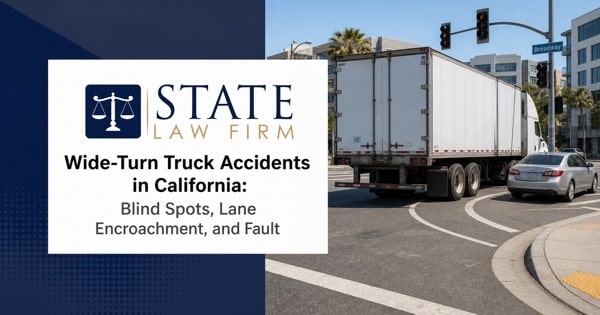
A wide-turn truck accident can happen when a commercial driver moves left before turning right, crosses into another lane, or allows the trailer to track inside the path of the cab. A nearby driver, bicyclist, or pedestrian may be sideswiped, squeezed against a curb, or pulled beneath the trailer. In California, fault depends on whether each person used reasonable care and whether the truck driver made and signaled the maneuver safely.
Direct answer: A commercial truck driver may be liable for a wide-turn crash when an unsafe turn, inadequate lookout, improper lane position, or missing signal causes the collision. The trucking company or another business may also share responsibility. Evidence such as video, vehicle data, photographs, witness accounts, and company records can help reconstruct the entire turn.
These cases are rarely resolved by one fact, such as which vehicle was closest to the truck. Investigators must consider the truck’s size, the driver’s blind spots, the trailer’s path, surrounding traffic, and what each road user could reasonably see and do.
What Is a Truck Wide-Turn Accident?
A wide-turn accident occurs when a large truck needs more roadway space to complete a turn and its path conflicts with another road user. The most familiar example is a tractor-trailer that swings left before making a right turn. A driver beside the truck may believe the truck is changing lanes or continuing straight, then become trapped when the truck turns across the vehicle’s path.
The cab and trailer do not follow identical paths. During a turn, the trailer’s rear wheels generally travel inside the arc of the tractor’s front wheels. This is often called off-tracking. The difference can place the trailer closer to a curb, bicycle lane, sidewalk corner, or vehicle than the cab appeared to be.
Wide-turn collisions may include:
- A right-turn squeeze-play crash involving a vehicle beside the truck
- A sideswipe when the truck crosses a lane line
- A collision with a bicyclist or motorcyclist near the curb
- A pedestrian impact at or near a crosswalk
- A trailer striking a stopped vehicle while completing the turn
- A secondary crash caused by another driver braking or swerving to avoid the truck
Why Do Commercial Trucks Need Extra Turning Space?
Commercial trucks are longer, wider, and less maneuverable than passenger vehicles. The driver’s seating position and the length of the tractor-trailer combination can also create significant areas that are difficult to see. The Federal Motor Carrier Safety Administration advises truck and bus drivers to signal early, monitor mirrors throughout a turn, and account for vehicles, bicyclists, and pedestrians that may be in blind spots.
A truck may need to begin a right turn farther from the curb than a car would. That physical need does not give the driver permission to disregard surrounding traffic. The driver must plan the maneuver, control the truck, observe the area, and wait when the turn cannot be completed safely.
Vehicle configuration matters. A long semi-trailer may off-track differently from a box truck, dump truck, tanker, bus, or truck pulling multiple units. The roadway also matters. Narrow lanes, tight corners, parked cars, construction, bike lanes, and heavy pedestrian traffic may increase the care required.
How Do Blind Spots and Lane Encroachment Cause These Crashes?
Large trucks have blind spots around the front, rear, and sides of the vehicle. The area along the passenger side can be especially important during a right turn. Mirrors and other safety equipment can improve visibility, but they do not replace a careful lookout.
Lane encroachment occurs when part of the truck enters or occupies another lane during the maneuver. Encroachment may be necessary on some roads, but it must still be performed safely. A driver who moves left without an adequate warning can create an ambiguous situation for a motorist behind or beside the truck. A driver who turns too sharply may send the trailer over the curb or into a bike lane.
Common contributing factors include:
- Failing to check mirrors before and throughout the turn
- Starting the turn from an unsafe position
- Turning without enough clearance
- Using a late, missing, or confusing turn signal
- Failing to notice a smaller vehicle or bicyclist in a blind spot
- Entering an intersection too quickly
- Distraction, fatigue, impairment, or inadequate training
- Choosing a route that the vehicle cannot safely navigate
What Is a Right-Turn Squeeze-Play Accident?
A squeeze-play accident happens when a truck turns right while another road user is between the truck and the curb or otherwise inside the trailer’s turning path. As the trailer off-tracks, the available space narrows. A passenger vehicle may be sideswiped or pushed toward the curb. A bicyclist, motorcyclist, or pedestrian may have little room to escape.
The truck driver is not automatically at fault in every squeeze-play crash, and the smaller vehicle is not automatically at fault merely because it was beside the truck. Important questions include:
- Was the truck’s right-turn signal operating and visible?
- Did the truck move left in a way that suggested a lane change?
- Where was each vehicle when the signal began?
- Was the smaller vehicle already established in a lawful lane?
- Did either driver accelerate into a narrowing gap?
- What could the truck driver see in the mirrors?
- Were bike-lane, crosswalk, or intersection rules involved?
Those facts help distinguish a foreseeable blind-spot conflict from a sudden action the truck driver could not reasonably avoid.
Who Is at Fault in a California Wide-Turn Truck Accident?
California negligence law generally asks whether a person failed to use reasonable care and whether that failure was a substantial factor in causing harm. Traffic rules can provide important evidence, but investigators should evaluate the whole maneuver rather than assume fault from the point of impact alone.
California Vehicle Code sections 22100, 22107, and 22108 address turning position, safe roadway movements, and turn signals. Among other requirements, a driver generally may not turn or move right or left on a roadway unless the movement can be made with reasonable safety. When another vehicle may be affected, the driver must give an appropriate signal. A turn signal generally must be given continuously during the last 100 feet before the turn.
Section 22100 generally requires a right turn to be made as close as practicable to the right-hand curb or edge, subject to marked-lane and other statutory provisions. Applying that rule to a large truck can be fact-specific because the vehicle may need additional space. The key question is not simply whether the truck swung wide, but whether the driver positioned and operated it with reasonable care under the circumstances.
California follows a pure comparative-fault system. If more than one person contributed to the collision, responsibility may be divided by percentage. An injured person is not necessarily barred from recovery because they share some fault, although their recovery may be reduced according to their assigned share.
When May the Commercial Driver or Trucking Company Be Responsible?
The driver may be responsible for conduct such as failing to keep a proper lookout, turning from an unsafe position, failing to signal, misjudging clearance, or violating a traffic rule. Depending on the evidence, other parties may also be involved.
The trucking company
A trucking company may be responsible for an employee driver’s negligence when the driver was acting within the scope of employment. Separate company conduct may also matter, such as deficient training, unsafe routing, negligent vehicle maintenance, or retaining a driver despite known safety concerns. These theories require proof and should not be assumed from the fact that a commercial truck was involved.
A broker, shipper, contractor, or vehicle owner
Commercial transportation arrangements can involve multiple businesses. Contracts, dispatch records, ownership documents, and the parties’ actual control may help determine who was responsible for the driver, vehicle, route, or load. The company name displayed on the truck may not identify every potentially responsible party.
A maintenance provider or manufacturer
If defective steering, brakes, mirrors, cameras, warning devices, or another vehicle component contributed to the crash, maintenance and product evidence may require review. Component evidence should be preserved before the truck is repaired or returned to service.
These issues are one reason a wide-turn collision may require a different investigation from an ordinary two-car crash. State Law Firm’s truck accident practice page explains additional issues that can arise in commercial-vehicle claims.
Can the Other Road User Share Fault?
Yes. A driver, bicyclist, or other road user may share responsibility if their own unreasonable conduct helped cause the crash. Examples may include attempting to pass a clearly signaling truck on the right, entering a lane unlawfully, speeding into a closing space, or driving while distracted.
Shared fault should be based on evidence, not assumptions about where a smaller vehicle was found after impact. A truck’s turn can move both vehicles and alter the final scene. Skid marks, scrape patterns, debris, video, and vehicle data may provide a more reliable account of the sequence.
Insurers may focus on a single fact that favors their position. A complete analysis should consider whether the signal was visible, when each road user entered the area, whether the truck changed lanes before turning, and whether the driver continued after the smaller vehicle should have appeared in a mirror.
What Evidence Can Prove How the Turn Happened?
Evidence can disappear quickly after a commercial truck crash. Video may be overwritten, vehicles may be repaired, and witnesses may become harder to locate. Useful evidence may include:
- Scene photographs and video: lane markings, traffic controls, curb damage, debris, tire marks, visibility, and the final vehicle positions.
- Vehicle damage: scrape direction, impact height, crush patterns, paint transfer, and damage along the truck or trailer.
- Surveillance and dash-camera footage: nearby businesses, buses, homes, traffic cameras, and involved vehicles may have recorded the turn.
- Witness statements: neutral witnesses may describe the signal, truck position, speed, or sequence of movement.
- Electronic and telematics data: some trucks record speed, braking, steering, location, or other operational information.
- Driver and company records: logs, dispatch messages, training files, qualification records, inspection documents, and route instructions may be relevant.
- Police and incident records: reports can identify people and observations, though a report does not necessarily decide civil liability.
- Medical records: prompt documentation can connect the collision to reported symptoms, diagnoses, treatment, and functional limitations.
A preservation letter can notify relevant parties to retain specific evidence. The appropriate recipients and requests depend on the businesses, vehicles, and technology involved. Comparing a commercial truck collision with a noncommercial crash can also clarify why company and regulatory records may matter. See State Law Firm’s guide to commercial versus noncommercial vehicle accidents.
What Should You Do After a Wide-Turn Truck Accident?
- Prioritize safety and medical care. Call 911 when emergency assistance is needed. Seek appropriate evaluation, especially when symptoms develop or worsen after the crash.
- Report the collision. Cooperate with law enforcement and provide accurate facts without guessing about speed, distance, or fault.
- Document the scene if it is safe. Photograph the truck, trailer, company markings, license plates, lane lines, intersection, damage, and surroundings.
- Collect identifying information. Obtain the driver’s information, employer or carrier name, insurance details, witness contacts, and any vehicle or trailer numbers.
- Preserve your records. Keep photographs, damaged property, medical documents, receipts, work-loss information, and communications with insurers.
- Avoid speculating. A brief recorded statement can overlook blind spots, off-tracking, or company evidence that is not yet available.
California filing deadlines and notice requirements depend on the claim. Claims involving a public entity can have much shorter administrative deadlines than ordinary personal injury lawsuits. A person should not assume that an insurance discussion extends the applicable deadline.
When Is Early Legal Review Particularly Useful?
Early legal review may be useful when injuries are serious, fault is disputed, a bicyclist or pedestrian was involved, multiple companies may control the truck, or important electronic and video evidence could be lost. It may also help when an insurer claims the injured person entered the truck’s blind spot without examining how the driver signaled, positioned the vehicle, or monitored the turn.
An attorney can evaluate the roadway rules, identify potentially responsible parties, request preservation of evidence, and assess available insurance coverage. This does not mean every wide-turn crash requires litigation. The goal is to understand the facts and preserve options before evidence or deadlines become a problem.
State Law Firm assists injured people with California truck accident claims. A consultation can help determine whether the firm may be able to assist and what evidence should be addressed next. Every matter depends on its own facts, and prior outcomes do not guarantee a particular result.
Frequently Asked Questions About Wide-Turn Truck Accidents
Is a truck driver always at fault for making a wide right turn?
No. Large trucks may need extra space to turn, and fault depends on how the maneuver was planned, signaled, and performed. The conduct of other road users may also be considered.
Who is at fault if a truck turns right from the left lane?
There is no automatic answer. Investigators should examine the lane markings, truck configuration, signal timing, surrounding traffic, and whether the movement was reasonably safe under California law.
Can a trucking company be liable for a driver’s wide-turn crash?
Potentially. A company may be responsible for an employee driver’s negligence within the scope of employment. Its own training, routing, hiring, retention, or maintenance conduct may also be relevant when supported by evidence.
What if I was beside the truck when it began turning?
Your position is important but does not alone decide fault. Evidence should establish when you entered the area, whether the truck was signaling, how the truck moved before turning, and what the driver could see.
What evidence is most important in a squeeze-play accident?
Video, scene photographs, vehicle damage, witness statements, electronic truck data, driver records, and company documents can be especially useful. The most valuable evidence depends on the disputed facts.
How long do I have to file a California truck accident claim?
The deadline depends on the parties and claims involved, and exceptions may apply. Public-entity claims can require much earlier action. A qualified attorney can evaluate the specific deadline rather than relying on a general rule.