English
  Spanish
State Law Firm | Serving Santa Clarita, California
Santa Clarita Truck Accident Attorneys
A truck collision on I-5, SR-14, or a local delivery route can raise questions about several vehicles, companies, and insurers. State Law Firm helps injured people in Santa Clarita review the evidence and discuss their options from our Sherman Oaks office.
Free initial consultation
Truck collision review
Vehicle and trip evidence
Sherman Oaks office
Keep the collision date, route and direction, truck markings, responding agency, and incident number if available. Preserve original photos and messages. You can request a consultation before the report is ready; mention work-related injuries, public entities, and deadlines promptly.
A Starting Point After a Santa Clarita Truck Collision
After a collision with a semi-truck, delivery vehicle, or other commercial truck, you may have several company names but few clear answers. The driver, carrier, trailer owner, and insurer may not be the same business. State Law Firm helps injured people in Santa Clarita organize the facts, identify records to pursue, and discuss the next steps for a potential injury claim.
You do not need a completed report or the trucking company’s entire file before contacting us. Start with the date, exact location, and what you already know. Call (877) 659-9223 or request a free consultation. Our truck accident practice page provides broader information about commercial-vehicle claims.
I-5, SR-14, and Local Delivery Routes Need Different Details
For a crash near the I-5/SR-14 interchange, distinguish the freeway mainline from a connector, ramp, or separate truck roadway. Note the route, direction, lane, and nearest exit or landmark you can identify. A description such as “near Newhall Pass” may cover several possible locations; details from the responding officer, towing paperwork, or original photographs can help narrow it down.
Metro’s I-5 North County Enhancements project covers the corridor between the SR-14 interchange and the area south of Parker Road in Castaic, including truck-lane and ramp-related improvements. The project page is useful context, not proof of the lane arrangement or construction conditions on the date of your collision. Preserve any observations of temporary markings, barriers, lane shifts, or warning signs without assuming that construction caused the crash.
A delivery-truck collision on a Santa Clarita surface street raises different questions. Record the street address and whether the vehicle was turning into a driveway, backing from a loading area, parked for a delivery, or traveling through an intersection. An incident at a business entrance should not be described simply as a freeway crash because the truck had recently exited I-5.
Pinpoint the Location and Identify the Truck
Attend to safety and medical needs first. Call 911 for an emergency and follow responders’ directions. Do not enter traffic, climb onto a truck, open cargo, or follow a departing vehicle to obtain information. Use records already available or details that can be collected safely.
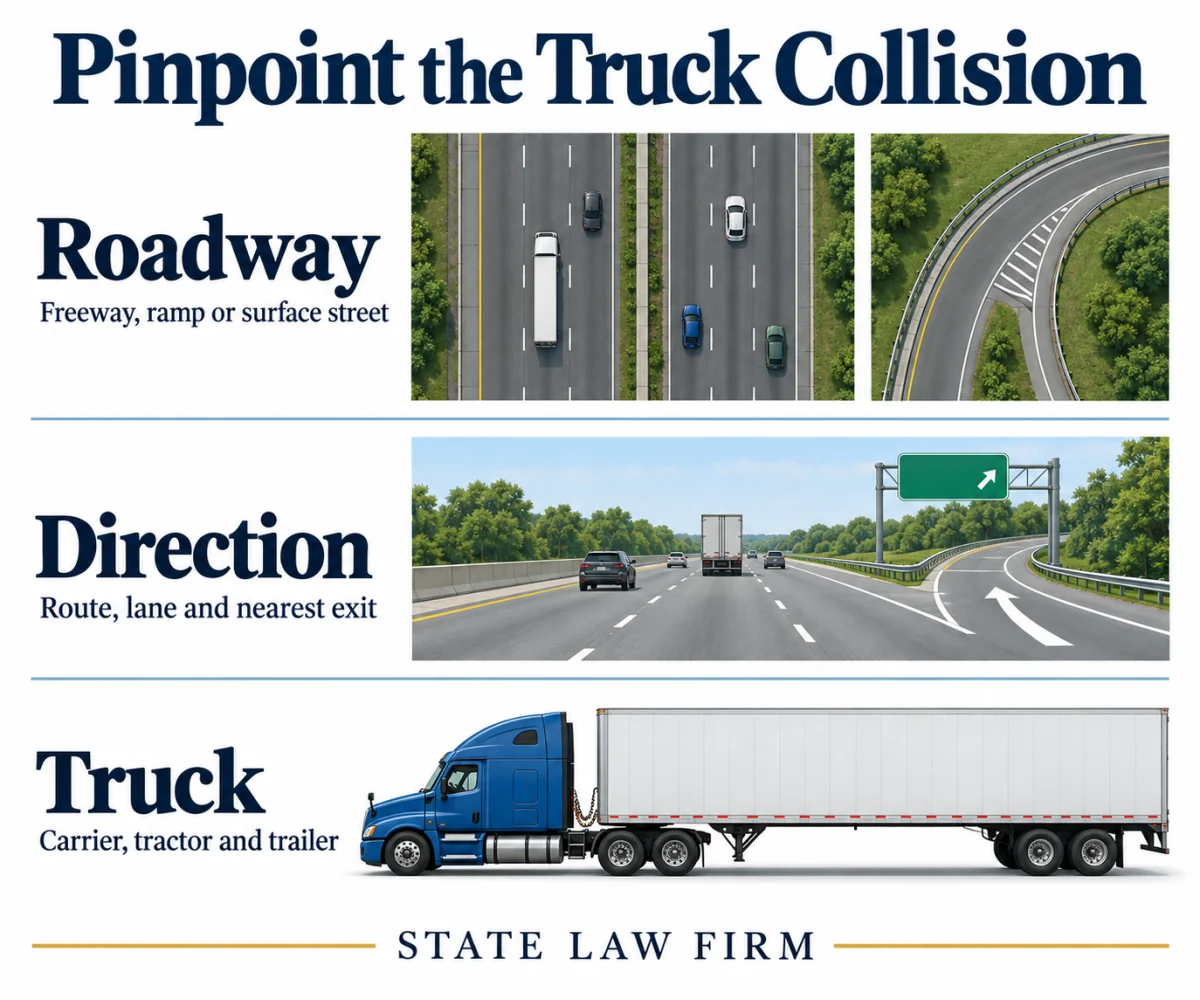
- Roadway: Identify the freeway, connector, ramp, surface street, or private loading area. Keep the incident date and time with the location.
- Direction: Note travel direction, lane position, the nearest exit or cross street, and each vehicle’s movement. Mark uncertain details as uncertain rather than estimating speed or distance as fact.
- Truck: Preserve the carrier name, any visible USDOT number, plate information, and tractor and trailer identifiers. The trailer may show a different name or number from the powered unit. Photographs of markings can be more useful than memory alone.
Tell the team whether there were several impacts or vehicles. Record the sequence you experienced and the positions you observed, without assuming that the last vehicle in a chain caused every injury. For narrower background, see our resources on truck wide-turn collisions and jackknife incidents.
Build Three Timelines From the Available Records
A truck investigation is not limited to what happened in the seconds before impact. Trip activity, the vehicle’s condition, and cargo handling can each have a separate history. Which records are relevant depends on the actual collision and the rules that apply to the vehicle and operation.
- Trip activity: Driver duty records, dispatch communications, route information, and pickup or delivery records may help establish the work and travel sequence. FMCSA’s ELD overview explains that an electronic logging device works with engine information to record duty-related data. A duty log is not automatically a second-by-second recording of a crash.
- Vehicle condition: Inspection reports, repair invoices, maintenance schedules, and complaints may help test a specific mechanical issue. 49 CFR section 396.3 addresses inspection, repair, maintenance, and associated records for covered vehicles. A repair record must be connected to the relevant equipment and dates, not merely to the same company.
- Cargo movement: Shipping documents, loading instructions, load photographs, and securement records may matter if movement or loss of cargo is alleged. FMCSA’s cargo-securement guidance describes general and cargo-specific requirements for covered interstate operations. A load photograph alone does not establish which rule applies or who was responsible.
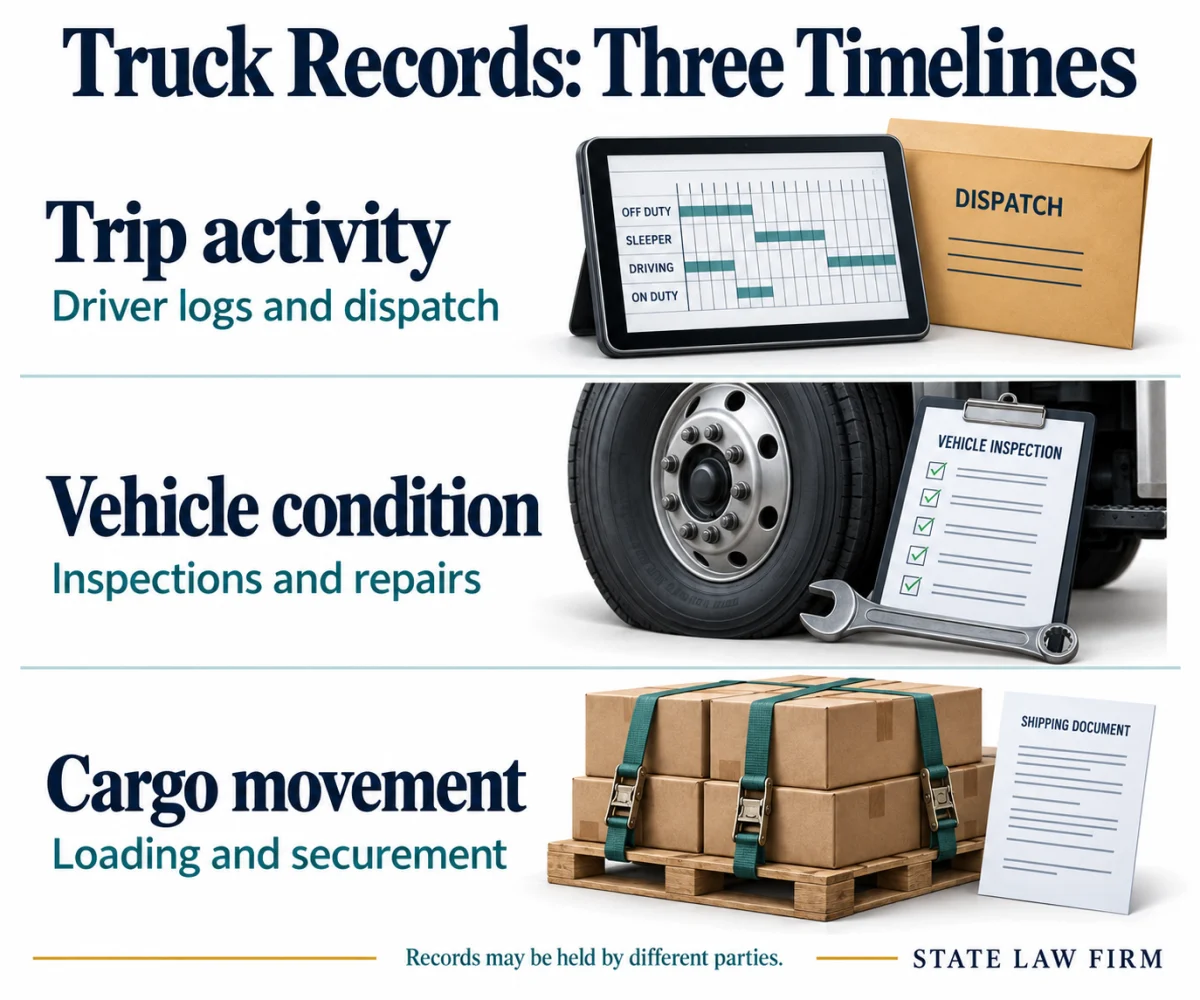
These records may be held by the carrier, driver, equipment owner, maintenance provider, or another business. Available data and retention periods vary. Promptly discuss appropriate preservation requests with counsel; do not assume that every truck has usable video or that every electronic system retains the same information. Keep your own original files and read our evidence-preservation resource.
Responsibility Requires More Than a Company Logo
The name on a truck helps identify a lead for investigation; it is not a complete liability finding. The review may involve driver conduct, the carrier’s role, vehicle ownership, maintenance, loading, other road users, or an alleged roadway condition. Each issue requires evidence of the relevant relationship, legal duty, causation, and harm.
A carrier’s responsibility for a driver’s actions and a separate company’s own loading or maintenance conduct are different questions. Our employer-accountability guide discusses the first topic; it should not be treated as a universal explanation for every third-party error. Likewise, a safety-rule violation must be assessed in context rather than presented as automatic proof of the entire claim.
Save the insurance information exchanged at the scene and any later coverage letters. A tractor, trailer, carrier, or other vehicle may involve different coverage questions, but several company names do not guarantee several available sources of payment. Do not assume cargo insurance covers a person’s injury or that an insurer’s allocation of fault is the final answer.
Request the Report From the Investigating Agency
Keep the responding agency’s name and the incident or report number. The CHP Newhall Area page identifies its local coverage, including the I-5/SR-14 interchange, and links to CHP’s report-access service. Do not assume that every Santa Clarita collision was investigated by CHP.
- If CHP investigated: follow the CHP collision-report instructions. The CHP 190 process requires confirmation that the requester is an eligible party, along with identification and any applicable fee. CHP does not supply another police agency’s report.
- If the Sheriff’s Department investigated: use the LASD Records and Identification Bureau guidance and confirm the appropriate station or records process. Eligibility and access requirements apply; check instructions before traveling or mailing documents.
- If you are unsure: keep the exchange sheet, responding officer’s details, or towing paperwork and ask for help identifying the agency. You can request a consultation while a report is pending.
A DMV report is a separate issue for involved drivers. The DMV’s SR-1 instructions require reporting within 10 days when someone is injured or killed, or property damage exceeds $1,000. An agent, broker, or legal representative can handle the filing as described by DMV. A police, CHP, or insurance report does not replace it; confirm who is handling any required submission.
Document the Injury’s Effect on Work and Daily Life
Keep provider names, visit dates, bills, treatment recommendations, and related receipts. Follow your clinician’s guidance and record limitations factually. Employer records, missed shifts, help needed at home, and transportation costs may help explain the impact. Supported losses and available legal remedies need individual assessment; a result advertised in someone else’s case is not a valuation of yours.
If you were working when injured, mention that immediately, whether you were driving the truck or another vehicle. The California Division of Workers’ Compensation employee guidance explains workplace-injury reporting and benefits. Work-related claims and a possible claim against another responsible party involve different questions. Our California workers’ compensation resource provides a separate starting point.
Check Legal Deadlines Before Waiting for Records
The general California personal-injury limitation period is two years under Code of Civil Procedure section 335.1. A claim involving a public entity may require an earlier presentation step: Government Code section 911.2 generally requires injury-claim presentation within six months after accrual. Separate lawsuit requirements may follow.
Those periods are not universal instructions for every case. Exceptions, accrual questions, the parties involved, and later notices can change the analysis. Flag a public vehicle, alleged roadway issue, an injured minor, or any rejection letter at the start. Neither waiting for trucking records nor sending this website’s consultation form extends a deadline or files a claim.
Meet the Attorneys

Eddie Tehrani
Eddie Tehrani founded State Law Firm after working in Los Angeles law offices handling personal injury and civil litigation. Review his background and discuss the firm’s approach to your truck injury questions.

Arnold Gross
Arnold Gross’s firm biography describes personal injury trial work and mediation and arbitration experience. Review the team’s backgrounds and ask how your matter would be handled.
Serving Santa Clarita From Our Sherman Oaks Office
State Law Firm’s office is at 15490 Ventura Blvd #205, Sherman Oaks, CA 91403. This page serves Santa Clarita truck-injury inquiries; it does not represent a separate Santa Clarita branch. Contact us by phone or online and confirm appointment arrangements before traveling. See Locations or Contact for the next step.
The initial consultation is free. Ask about any proposed fee agreement, case costs, and the scope of representation before hiring the firm. For a collision that does not involve a commercial truck, our Santa Clarita car accident page addresses the separate service. Neither page promises a particular recovery or timetable.
Frequently Asked Questions
What if the tractor and trailer show different company names?
Keep both names, plate details, and unit numbers if available. Ownership, operation, leasing, and insurance may involve different parties. The attorney can review the relationships; neither logo alone identifies everyone responsible for the collision.
Can I request help if I was a passenger in a multi-vehicle collision?
Yes. Explain which vehicle you occupied, the impacts you experienced, and what you personally observed. Keep driver and insurer information for the involved vehicles. The sequence of impacts, injuries, and coverage must be investigated rather than inferred from vehicle order alone.
Does every commercial truck have usable black-box data?
No. Equipment, recording capabilities, and available history differ. Duty logs, engine or vehicle data, and video serve different purposes. Tell the attorney about possible sources promptly; no particular recording or retention period should be assumed.
Do I have to wait for CHP or LASD to finish the report?
No. Start with the date, location, responding agency, and incident number if you have it. A report request can be discussed while other evidence and deadlines are reviewed. Pending agency records do not by themselves extend a filing deadline.
Can an injured truck driver contact State Law Firm?
Yes. Tell the team about your employment or contracting arrangement, the other vehicles, and any employer or insurer communications. Workers’ compensation and possible third-party claims need separate assessment. Eligibility and coverage cannot be determined from job title alone.
Do you have a Santa Clarita office, and is the consultation free?
The office identified for this page is in Sherman Oaks, not Santa Clarita. You can start by phone or online, and the initial consultation is free. Discuss meeting arrangements, secure document sharing, and any representation terms with the team.
Request a Santa Clarita Truck Accident Consultation
Tell us how to reach you about the truck collision. Have the date, route or street address, company or vehicle details, and any time-sensitive correspondence ready for the follow-up conversation.
This page provides general information, not legal advice. Contacting the firm does not by itself create an attorney-client relationship. An individual review is needed to assess your rights and deadlines.
Related legal resources: Truck accident practice, San Ramon truck accident lawyers, Stockton truck accident lawyers, Free consultation.