English
  Spanish
State Law Firm | Serving Anaheim, California
Anaheim Slip and Fall Attorneys
A fall at a hotel, store, stairway, or walkway can raise questions about the condition and who controlled the area. State Law Firm helps injured people in Anaheim review property evidence and discuss their options from our Sherman Oaks office.
Free initial consultation
Property-condition review
Evidence and reporting guidance
Sherman Oaks office
Keep the date, exact property location, what you observed, and any incident number or manager contact. Preserve original photos, footwear, receipts, and correspondence. A maintenance request is not the same as an injury claim; flag public-property questions and deadlines promptly.
An Anaheim Fall Deserves a Careful Look at the Property
If you were injured in a fall at an Anaheim hotel, store, apartment building, or other property, you may have questions about the condition that caused it and who was responsible for that area. State Law Firm helps injured people review those questions, organize available evidence, and discuss their options. A fall alone does not establish negligence, and a business’s incident report is not a decision about your legal rights.
You can request a consultation before you have every record. Start with the date, exact location, what you remember about the surface or obstacle, and any communications from the property or insurer. Our slip and fall practice resource and premises liability page explain the broader service.
Identify the Exact Entrance, Stair, or Walking Surface
In Anaheim’s hotel and event areas, the same trip can cross several properties. A hotel entrance, an event space, a parking structure, and the adjoining sidewalk should not be treated as one location. The city lists the Anaheim Convention Center at 800 W. Katella Avenue; if your visit involved that area, identify the actual building, door, level, or path rather than just naming Katella Avenue or the convention center.
That local context is not an allegation that any named venue is unsafe. Ownership, operation, maintenance, and control of the particular spot need investigation. Keep booking confirmations, parking receipts, event tickets, or store receipts that may help establish where you were and when. If you were visiting from outside the area, preserve those records before they disappear from an app or travel account.
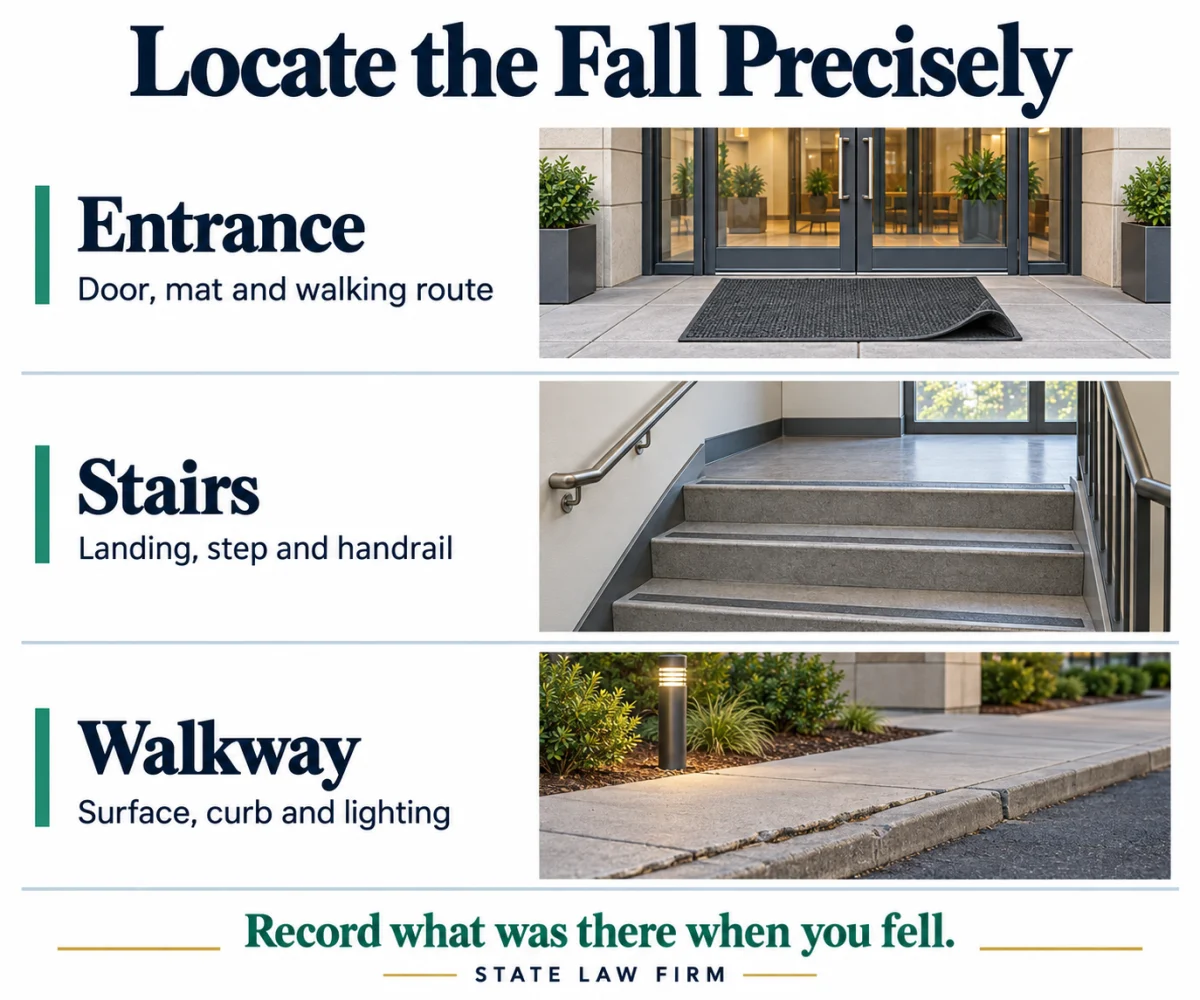
- Entrance: Identify the door, mat, floor transition, and route you took. Note any liquid, debris, warning, or obstruction you actually observed and whether you saw it before or only after the fall.
- Stairs: Record the building, floor, landing, and step involved if known, plus available information about lighting and the handrail. Do not test an unstable rail or recreate the fall to obtain evidence.
- Walkway: Locate the surface, curb, pavement edge, and nearby features. Wide photographs can show the route; closer photographs can document the specific condition when it is safe to take them.
Responsibility Depends on Control, Notice, and Causation
For a private-property premises claim, California’s CACI instruction 1000 addresses control of the property, negligent use or maintenance, harm, and the connection between negligence and that harm. Instruction 1003 addresses an unreasonably risky condition, actual or constructive knowledge, and a failure to repair, protect, or adequately warn. Public-property claims involve different statutory requirements.
A property owner, tenant, operator, manager, or maintenance contractor may have different responsibilities. The name on a storefront or booking confirmation is a starting point, not the complete answer. An attorney can assess the relevant relationships and records without assuming every listed business is liable.
Notice is also a timing question. CACI instruction 1011 considers whether the condition existed long enough to be discovered and addressed with reasonable care. There is no universal number of minutes that decides every spill case. A warning sign’s presence or absence likewise needs context: its placement, visibility, and relation to the actual condition matter.
Build a Record of the Condition Before and After the Fall
Your photographs may show the condition at one moment. Other records may help explain how it arose, what was known about it, and what happened next. Tell the attorney about possible sources promptly, but do not assume that every business records its floors or retains the same amount of footage.
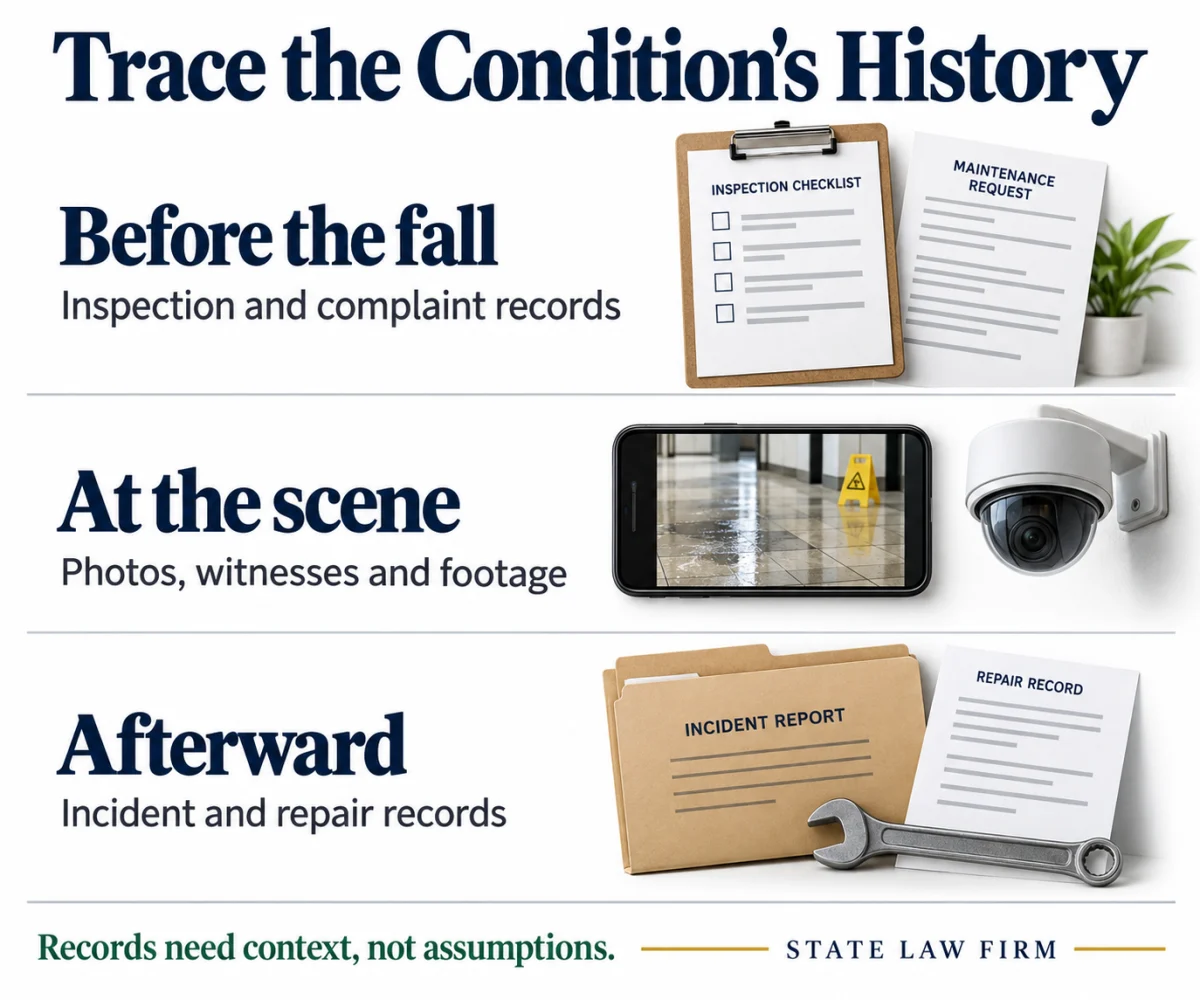
- Before the fall: Relevant inspection or cleaning records, earlier complaints, and maintenance requests may help establish a timeline. A record for a different floor, shift, or location may not answer the question; dates and scope must be checked.
- At the scene: Keep original photographs and video, witness contact information, and notes about statements you heard. Identify possible cameras for counsel. Preserve surrounding footage if available, not only a clipped moment, and distinguish observations from estimates.
- Afterward: Retain the incident number, manager or security contact, written messages, and any available repair information. A later cleanup or repair is not automatically an admission of liability; its significance and use require legal review.
Keep footwear and other relevant items without altering their condition, and preserve original digital files with backups. Do not remove a mat or other material from someone else’s property. Counsel can discuss appropriate preservation requests and lawful access to records. Our evidence-preservation guide provides additional context.
Three Reports Can Serve Three Different Purposes
- Property incident report: Notify the appropriate manager, operator, or security contact when practical. Give an accurate account, identify what you do not know, request a copy or reference number, and keep correspondence. An internal report does not itself file a lawsuit or preserve every possible deadline.
- City maintenance request: Anaheim Anytime accepts community reports about issues such as street maintenance and streetlight problems. The city monitors requests during business hours; it is not an emergency service. A request to address a condition should not be treated as a formal claim for injury damages.
- Claim against a public entity: If city property or conduct may be involved, investigate which entity is responsible and the correct claim procedure promptly. The City of Anaheim’s claim form identifies the City Clerk process and warns claimants to distinguish Anaheim from another public entity. Confirm current filing instructions with the Clerk before submitting.
An Anaheim address does not establish city ownership or liability. A sidewalk or shared entrance may require review of boundaries and maintenance responsibilities. Keep any city service-request number, but ask separately about a formal claim and legal deadlines. Do not wait for a maintenance response before getting that review.
Document the Injury’s Effect and Review Insurance Requests
Keep medical provider names, visit dates, treatment recommendations, bills, missed-work records, and receipts for related expenses. Record limitations factually and follow your clinician’s advice. If you return home after visiting Anaheim, keep a timeline of care in both places so the sequence is clear. A diagnosis or bill alone does not determine a case’s value; liability, supported losses, and available coverage all require review.
Save the insurer’s claim number, letters, document requests, and proposed releases. Ask what a payment or release would resolve before signing. If the insurer blames your footwear or says you should have seen the condition, preserve the relevant facts rather than assuming the issue is settled. California’s comparative-fault instruction permits a reduction for proven responsibility; an allegation alone is not proof.
Check Deadlines Early
California’s general personal-injury limitation period is two years under Code of Civil Procedure section 335.1. For a public-entity injury claim, Government Code section 911.2 generally requires claim presentation within six months after accrual. Separate lawsuit requirements may follow.
Exceptions, accrual questions, the parties involved, and later notices can affect the analysis. Mention an injured minor, public property, work-related injury, or rejection letter at the outset. Neither an incident report, a maintenance request, insurer discussions, nor this website’s consultation form automatically extends a filing deadline. Ask for an individual deadline review rather than relying only on a general period.
Meet the Attorneys

Eddie Tehrani
Eddie Tehrani founded State Law Firm after working in Los Angeles law offices handling personal injury and civil litigation. Review his background and discuss the firm’s approach to your property-injury questions.

Arnold Gross
Arnold Gross’s firm biography describes personal injury trial work and mediation and arbitration experience. Review the team’s backgrounds and ask how your matter would be handled.
Serving Anaheim From Our Sherman Oaks Office
State Law Firm’s office is at 15490 Ventura Blvd #205, Sherman Oaks, CA 91403. This page serves Anaheim fall-injury inquiries; it does not identify a separate Anaheim branch. You can start by phone or online. Confirm meeting arrangements and secure document-sharing options before traveling or sending sensitive records. See Locations or Contact.
The initial consultation is free. Discuss any proposed fee agreement, case costs, and scope of representation before hiring the firm. For a collision involving a person walking and a vehicle, use our separate Anaheim pedestrian accident page. Our Anaheim amusement-park injury resource addresses additional venue-related questions without assuming that all incidents involve a floor condition.
Frequently Asked Questions
Does a fall at a business automatically mean it was negligent?
No. The condition, responsibility for the area, notice, response, and connection to the injury need review. A business’s name on a receipt does not by itself establish every element of a claim.
What if a warning sign was nearby?
Record where it was, what it warned about, and whether it was visible along your route. Its presence is relevant but does not answer every question about the condition or response. Preserve photographs and describe what you actually saw.
Can I ask for help after returning home from an Anaheim visit?
Yes. Keep booking details, receipts, the property’s contact information, incident records, and care records from both locations. Start by phone or online and discuss meeting and document arrangements. Being away from Anaheim does not itself pause a legal deadline.
Does Anaheim Anytime file my injury claim?
Do not treat an Anaheim Anytime service request as a formal claim for damages. The service routes community concerns; a public-entity injury claim has separate requirements. Confirm the responsible entity, filing procedure, and deadline with counsel.
What if the floor was cleaned before I could photograph it?
Write down what you observed and when, preserve witness details and any existing photos, and tell the attorney about possible cameras or cleaning records. Do not recreate the condition. Other evidence may be relevant, but no particular recording or result is guaranteed.
Is the consultation free, and do you have an Anaheim office?
The initial consultation is free. The office identified for this page is in Sherman Oaks, not Anaheim. Contact the team by phone or online and confirm any appointment and representation terms directly.
Request an Anaheim Slip and Fall Consultation
Tell us how to reach you about the fall. Have the incident date, exact property location, any report number, and time-sensitive correspondence ready for the follow-up conversation.
This page provides general information, not legal advice. Contacting the firm does not by itself create an attorney-client relationship. An individual review is needed to assess your rights and deadlines.
Related legal resources: Los Angeles slip and fall attorneys, Modesto slip and fall attorneys, Bakersfield slip and fall lawyers, Redding slip and fall lawyers, Free consultation.