English
  Spanish

It depends on which insurer is asking and why. If you are making a claim against the other driver’s policy, you generally do not have a contractual duty to give that insurer a recorded interview. A claim under your own policy is different: notice, cooperation, and other policy conditions may require your participation in the investigation.
Before agreeing, identify the insurer, ask what information it needs, and clarify any deadline or policy requirement. Do not ignore your own insurer or assume you can postpone indefinitely. If you are injured, uncertain about a question, or facing a coverage dispute, ask for a reasonable opportunity to review the request and obtain advice.
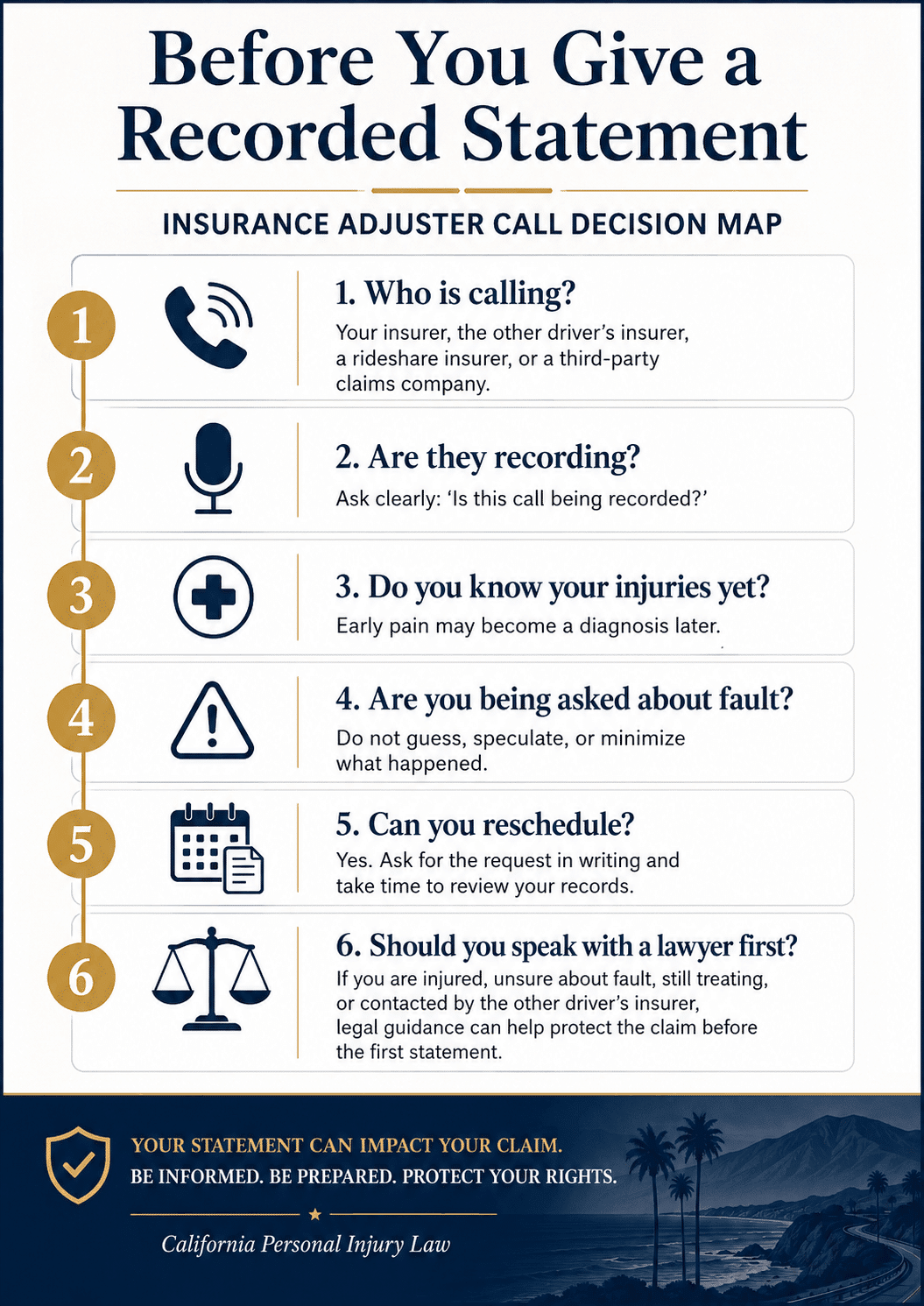
What is a recorded statement?
A recorded statement is an interview preserved as an audio or video record of your answers. An insurance adjuster may ask about the collision, vehicle damage, symptoms, treatment, missed work, witnesses, or earlier injuries.
The statement can become part of the claim evidence. Its details may be compared with photographs, medical records, reports, or later explanations. That does not make every request improper, but it makes accuracy important. An estimate should be identified as an estimate, and a fact you learned later should not be presented as something you personally observed.
Your insurer and the other driver’s insurer are different
| Who is requesting the statement? | What to clarify before responding |
|---|---|
| Your insurer, handling a claim under your policy | The coverage involved, applicable policy condition, information requested, and response deadline. |
| The other driver’s insurer, evaluating your claim against its insured | Why a recording is requested and whether the needed facts can be provided through documents or a written response. |
| A carrier or administrator whose role is unclear | Whom it represents and whether you are seeking benefits as an insured or asserting a claim against someone else. |
When your own insurer calls
The California Department of Insurance’s accident guide explains that an insurer may obtain a written or recorded statement and sometimes request an examination under oath. Review your policy and cooperate with legitimate investigation requirements. A blanket refusal can create a coverage dispute.
Ask the adjuster to identify the relevant condition if you do not understand the request. If pain, medication, language needs, or unavailable records affect your ability to answer accurately, explain the issue and ask about arrangements. Request confirmation of any agreed extension rather than assuming one exists.
When the other driver’s insurer calls
In an ordinary third-party liability claim, you are not seeking benefits under your own contract with that insurer. You can generally decline a voluntary recorded interview or discuss another way to provide information. However, declining a recording does not eliminate the need to prove your claim or require the insurer to accept your account without evidence.
Keep the distinction narrow. It is not permission to disregard a subpoena, court requirement, or a separate obligation under a policy that covers you. If both drivers use the same insurance company, identify which claim and coverage the adjuster is handling.
UM/UIM claims still require attention to your policy
A claim for uninsured or underinsured motorist benefits can involve a disagreement with your own insurer about fault or damages. That disagreement does not erase policy duties. Confirm the requirements for your particular claim instead of applying advice intended for the other driver’s insurer.
What should you do before an adjuster interview?
- Verify the caller. Obtain the person’s name, company, claim number, and contact details. If uncertain, call the insurer through a known number before sharing personal information.
- Get the request clearly stated. Ask whether the conversation will be recorded, which subjects it will cover, and whether there is a response deadline. For a policy-based request, ask what provision applies.
- Review the available record. Have the collision date, photographs, correspondence, and relevant reports available. You do not need to pretend every document or diagnosis is already available.
- Separate knowledge from uncertainty. Note what you personally saw, what you estimated, and what you learned from someone else. Do not rehearse a version that conflicts with your memory.
- Plan for accurate communication. Request an interpreter, a break, or a different appointment if needed. Tell the adjuster about a difficulty rather than silently missing the appointment.
- Ask how to obtain a copy. Request the recording or transcript and ask how to submit a correction or later update. Do not assume that a requested format or procedure has been accepted until it is confirmed.
A written statement can allow time for careful review, but it is still evidence. It is not automatically a substitute for every recorded-statement or examination requirement.
How to answer accurately without guessing
Answer the question you understand, truthfully and in your own words. Ask for clarification if it combines several topics or assumes something you did not say. Do not agree to an inaccurate summary merely to move the call along.
Collision details
If you do not know an exact speed, distance, or number of seconds, say so. If you give an estimate, identify it as one and explain its basis when asked. Describe observations rather than adopting a legal conclusion about fault before the evidence has been reviewed. Do not hide relevant facts about your own actions.
Symptoms and treatment
Describe how you actually felt at the time being discussed. Distinguish symptoms from a medical diagnosis, and avoid predicting recovery when your clinician has not addressed it. If evaluation is ongoing, say that only if it is true.
An earlier report of feeling well and a later report of symptoms should be explained with an honest timeline. Our guide to delayed pain and treatment gaps after a car accident explains documentation considerations. Do not change the onset date to make the claim appear stronger.
Earlier injuries and medical history
Do not deny a prior condition that existed or guess about an old diagnosis. If you do not remember, say so and explain that records may be needed. If a request appears unusually broad, ask how it relates to the claim and seek advice about its scope rather than giving a knowingly incomplete answer.
A practical response when you are not ready
You can explain the concern without accusing the adjuster of wrongdoing. Adapt this example to facts that are true for you:
“Before we begin, please confirm which insurer and claim you are handling, whether this interview is required under a policy, and the response deadline. I need to review the request so I can answer accurately. Please send the details in writing, and let us confirm a suitable time.”
This is a request for clarification and scheduling, not an automatic extension or a refusal to cooperate. If there is an existing deadline, respond promptly and resolve it explicitly. Do not use a script to claim you have a lawyer, ongoing treatment, or missing information when that is not true.
What if you already gave a statement?
Giving a statement does not automatically ruin a claim. Start by identifying whether there is an actual factual error, an answer that needs context, or genuinely new information.
- Request a copy of the recording or transcript.
- Identify the specific answer in question, rather than making a vague retraction.
- Explain accurately why a correction or update is needed and provide supporting records where appropriate.
- Keep the original correspondence and your dated follow-up.
- Get advice before making another lengthy statement if fault, coverage, or a significant inconsistency is disputed.
A correction does not erase the original statement or guarantee that the insurer will accept the explanation. Do not alter documents, backdate notes, or ask anyone to change an accurate record.
If the dispute has become a denial of responsibility, see what to do when an insurer denies liability. That is a separate issue from deciding whether and how to participate in an interview.
A recorded interview is not the same as an examination under oath
An examination under oath is a more formal, sworn process that may be requested under policy provisions. A deposition is part of litigation and involves separate procedural rules. Do not treat a formal notice as an ordinary voluntary adjuster call or assume the same response is sufficient.
If you receive either type of notice, review it promptly with counsel, including the requested documents, date, and governing requirements. This article does not determine whether a particular notice is enforceable.
Keep a record of the claim process
Save requests, responses, appointment arrangements, and the names of people involved. After a scheduling conversation, a brief factual email can confirm what was agreed.
California’s Fair Claims Settlement Practices Regulations address insurer communications and investigations. Insurance Code section 790.03(h) also identifies unfair claims practices. These protections do not make an adjuster your legal adviser or excuse your own applicable duties.
If a request is unclear or appears unreasonable, ask for an explanation in writing. Depending on the issue, you can seek legal advice or contact the California Department of Insurance about a claim-handling concern.
Frequently asked questions
Can I refuse every recorded statement?
No single rule covers every request. A voluntary interview sought by the other driver’s insurer differs from a request under a policy that covers you. Review the insurer’s role, policy terms, and any formal notice before deciding how to respond.
Can I wait until my medical treatment is finished?
Do not assume you can delay that long. Explain what is currently known and what remains under evaluation, and clarify any response deadline. Completing treatment is not a universal prerequisite to a claim interview.
Can I send a written statement instead?
You can ask, but the insurer may not agree and a written response may not satisfy a particular policy requirement. Confirm the arrangement. Written statements should be truthful and checked just as carefully as spoken answers.
What if I do not remember part of the accident?
Say what you do and do not remember. Do not fill a gap with someone else’s account or an assumed sequence. If records refresh your memory later, explain the basis for the update.
Do I need a lawyer for a routine insurance call?
Not every claim requires legal representation. Review may be especially useful for significant injuries, disputed fault, a coverage warning, an examination under oath, or a request you do not understand. A lawyer can help assess the specific duties and evidence.
Before the next call
Identify who is asking, clarify the request, and respond accurately. Neither an immediate interview nor a blanket refusal is the right approach for every claim.
If an adjuster request raises questions about a serious collision or disputed injury claim, State Law Firm’s Los Angeles car accident lawyers can review the circumstances. You can request a consultation and bring the request, relevant policy documents, and claim correspondence.
General educational information, not individualized legal advice. Policy language and the facts of a claim can change the analysis.