English
  Spanish
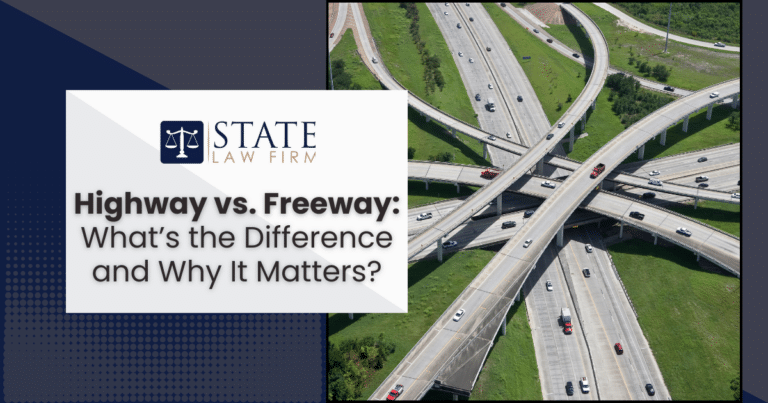
A freeway is a type of highway built for uninterrupted traffic flow. Freeways usually have entrance and exit ramps, medians or barriers, no stoplights, no direct driveway access, and no regular intersections where cross traffic cuts across the road.
A highway is a broader term for a major public road. Some highways look like freeways, but others may have traffic lights, intersections, cross streets, driveways, businesses, homes, pedestrians, bicyclists, and direct roadside access.
In short, all freeways are highways, but not all highways are freeways.
That difference matters in California because the type of roadway can affect speed, traffic flow, crash severity, evidence, fault disputes, and the way an accident claim is investigated.
If you were injured on a freeway, highway, interstate, expressway, or local road, State Law Firm can help you understand what evidence may matter and whether another driver, company, public entity, or third party may be responsible. You can learn more about our California car accident lawyers or contact our team for a free consultation.
Freeway vs. Highway at a Glance
| Feature | Highway | Freeway |
|---|---|---|
| Basic meaning | A broad term for a major public road | A specific type of highway |
| Access | May include intersections, driveways, cross streets, and traffic signals | Controlled access through ramps and interchanges |
| Traffic flow | May be interrupted by lights, turns, driveways, or cross traffic | Designed for continuous, uninterrupted flow |
| Intersections | May have at-grade intersections | Generally avoids at-grade intersections |
| Pedestrians and bicycles | May be allowed depending on the road and local rules | Generally restricted or prohibited unless signs allow otherwise |
| Speed | Varies widely by location, design, and posted signs | Often higher, but controlled by posted speed limits and California law |
| Common examples | Highway 1, rural state routes, some portions of US-101 | I-5, I-405, I-10, and many urban portions of US-101 |
| Accident issues | Intersections, turns, driveways, pedestrians, bicyclists, roadside access | Merging, lane changes, rear-end crashes, high speeds, multi-vehicle collisions |
What Is a Highway?
A highway is a general term for a public road that connects places and carries vehicle traffic. Highways may connect cities, counties, rural areas, coastlines, mountains, and commercial corridors.
In California, a highway may be:
- A rural two-lane road.
- A divided multi-lane road.
- A state route.
- A U.S. route.
- A road with traffic signals and intersections.
- A road with driveways and business access.
- A road that later turns into a freeway.
- A road that includes both freeway and non-freeway segments.
For example, Highway 1 is a California highway, but many portions of it are not freeways. It may include curves, scenic pullouts, local access points, intersections, pedestrians, bicyclists, and slower speed limits.
Similarly, US-101 can function as a freeway in some urban areas, including parts of Los Angeles, while other portions may behave more like a traditional highway with different access and traffic patterns.
That is why “highway” is the broader category. It tells you the road is important for travel, but it does not always tell you whether the road has full access control, ramps, no intersections, or freeway-style design.
What Is a Freeway?
A freeway is a highway designed for continuous traffic flow. The key feature is controlled access.
Controlled access means drivers usually enter and exit through ramps, not through driveways, parking lots, local streets, or ordinary intersections. Freeways are designed to keep through traffic moving without stoplights or cross traffic.
Freeways usually have:
- Entrance ramps.
- Exit ramps.
- Interchanges.
- Medians or barriers.
- Multiple lanes in each direction.
- No stoplights.
- No ordinary cross streets.
- No direct driveway access.
- Grade separations, such as bridges or overpasses.
- Restrictions on pedestrians and bicycles.
California examples include I-405, I-5, I-10, and many urban portions of US-101.
The purpose of a freeway is to move large volumes of traffic more efficiently. But because vehicles often travel at higher speeds, freeway crashes can be severe, especially when they involve sudden lane changes, rear-end impacts, commercial trucks, disabled vehicles, or multi-car collisions.
All Freeways Are Highways, But Not All Highways Are Freeways
This is the simplest way to remember the difference:
A freeway is a type of highway. A highway is not always a freeway.
Think of “highway” as the broader category and “freeway” as a more specific design.
A road can be a highway because it connects major areas or carries important traffic. But it only functions as a freeway when it has controlled access and is built for uninterrupted flow.
That is why drivers may hear people use the terms loosely. In everyday speech, someone might say “take the highway” when they mean “take the freeway.” But for roadway design, crash analysis, traffic safety, and legal claims, the distinction can matter.
Freeway vs. Highway vs. Interstate vs. Expressway
The terms can get confusing because people use them differently depending on where they live. Here is the practical difference.
| Term | Meaning |
| Highway | Broad term for a major public road. May or may not have traffic lights, intersections, or direct access. |
| Freeway | A controlled-access highway with ramps, no regular intersections, and uninterrupted traffic flow. |
| Interstate | Part of the Interstate Highway System. Many interstates are freeways, but “interstate” refers to the system, not just the design. |
| Expressway | Often a road with partial access control. It may have ramps and divided lanes, but it may also have some intersections or access points. |
| Turnpike | A term used in some states for toll roads. California drivers are more likely to hear “toll road,” “express lane,” or “managed lane.” |
Is an Interstate the Same as a Freeway?
Not exactly.
An interstate is part of the Interstate Highway System. In California, most interstates function as freeways because they are designed for high-speed, controlled-access travel. Examples include I-5, I-10, I-80, I-405, and I-605.
But “interstate” and “freeway” do not mean the same thing. “Interstate” describes the highway system. “Freeway” describes the road design.
So, an interstate is often a freeway, but the terms answer different questions:
- Interstate: What system is the road part of?
- Freeway: How is the road designed and accessed?
Is an Expressway the Same as a Freeway?
Usually, no.
An expressway is often a road designed for faster travel than ordinary streets, but it may not have full access control. Some expressways have ramps and divided lanes, while others may include traffic signals, intersections, or limited cross traffic.
A freeway has full controlled access. An expressway may only have partial controlled access.
In simple terms:
- A freeway is more controlled.
- An expressway may be partly controlled.
- A highway is the broadest term.
California Examples: Freeways and Highways
California roads can be confusing because a single route may change character depending on where you are driving.
I-405
The 405 is a freeway. Drivers enter and exit through ramps, and the road is designed for high-volume traffic flow through Los Angeles and Orange County.
I-5
I-5 is an interstate and a freeway through most of California. It is a major north-south route and often involves high-speed traffic, large trucks, merging, and long-distance travel.
I-10
The 10 is an interstate freeway that runs through Southern California and beyond. In Los Angeles County, it is a major commuter and commercial route.
US-101
US-101 can be confusing because it is often called “the 101” in Southern California and “Highway 101” in other parts of the state. In many urban areas, it functions like a freeway. In other areas, especially outside dense urban corridors, it may operate more like a traditional highway.
Highway 1
Highway 1 is a highway, but many portions are not freeways. Drivers may encounter scenic routes, curves, intersections, local access, lower speed limits, pedestrians, bicyclists, and roadside parking or businesses.
State Route 99
SR-99 has freeway-like and highway-like segments depending on location. Some portions have controlled access, while others may have different road conditions, ramps, intersections, or local access patterns.
Which Is Faster: A Freeway or a Highway?
A freeway is usually faster because it is designed for uninterrupted traffic flow. There are no ordinary stoplights, crosswalks, or direct driveways. Drivers enter and exit through ramps, which reduces interruptions.
A highway may be slower because it can include:
- Traffic lights.
- Intersections.
- Left turns.
- Driveways.
- Businesses.
- Pedestrians.
- Bicyclists.
- Farm or local access.
- Lower posted speed limits.
- Curves, hills, or rural road conditions.
That said, a freeway is not always faster in real life. Heavy traffic, construction, crashes, lane closures, and rush hour congestion can make a freeway slower than a nearby highway or surface route.
Which Is Safer: A Freeway or a Highway?
There is no simple answer because the risks are different.
Freeways generally reduce certain conflict points because they do not have ordinary intersections, stoplights, pedestrians, or driveways. That can lower the risk of some types of crashes, such as broadside intersection collisions.
But freeway crashes can be severe because of:
- Higher speeds.
- Sudden lane changes.
- Short following distances.
- Heavy traffic.
- Multi-vehicle chain reactions.
- Merging and exiting conflicts.
- Disabled vehicles on shoulders.
- Commercial trucks and buses.
- Rear-end crashes in stop-and-go traffic.
Highways can have different dangers, including:
- Cross traffic.
- Left turns.
- Driveways.
- Pedestrians.
- Bicyclists.
- Animals.
- Narrow shoulders.
- Poor lighting.
- Rural curves.
- Head-on collision risks on undivided roads.
The safer road depends on the conditions, speed, design, traffic volume, visibility, driver behavior, and whether everyone is following the rules of the road.
Why the Road Type Matters After a California Car Accident
After a crash, the difference between a highway and a freeway can matter because it helps explain how the collision happened.
A freeway accident may involve:
- Unsafe merging.
- Sudden lane changes.
- Rear-end impacts.
- Multi-vehicle pileups.
- Commercial trucks.
- Rideshare vehicles.
- High-speed impacts.
- Construction zones.
- Disabled vehicles.
- Shoulder-related crashes.
- Debris in the roadway.
A highway accident may involve:
- Intersection crashes.
- Failure to yield.
- Left-turn collisions.
- Driveway exits.
- Pedestrian or bicycle impacts.
- Head-on collisions.
- Unsafe passing.
- Poorly marked lanes.
- Rural road hazards.
- Dangerous road design.
- Poor lighting or signage.
This matters because fault is not always obvious. Insurance companies may focus only on the police report or the location of impact, but roadway design, traffic controls, and access points can change the analysis.
For example, a freeway rear-end crash may raise questions about speed, following distance, traffic congestion, sudden braking, and whether a disabled vehicle created a hazard. A highway intersection crash may raise different questions about signals, stop signs, right of way, sight lines, and whether a driver entered traffic from a driveway or side street.
If the insurance company is already blaming you or denying responsibility, read our guide on what to do when insurance denies liability after a car accident.
How Highway and Freeway Crashes Are Investigated
The type of road can affect what evidence is available.
In a freeway crash, important evidence may include:
- CHP traffic collision reports.
- Dashcam footage.
- Traffic camera footage.
- Freeway service patrol records.
- Caltrans construction or lane closure information.
- Vehicle event data.
- Tire marks.
- Debris patterns.
- Damage locations.
- Witness statements.
- Commercial truck logs or company records.
- Roadway shoulder conditions.
In a highway crash, evidence may include:
- Police or CHP reports.
- Intersection camera footage.
- Nearby business surveillance video.
- Signal timing records.
- Stop sign or traffic signal visibility.
- Driveway or property access points.
- Lighting conditions.
- Sight-line obstructions.
- Road design and signage.
- Pedestrian or bicycle infrastructure.
- Skid marks and impact location.
A police report can be helpful, but it is not always the final word. You may still be able to bring a claim even if the report is incomplete, delayed, or disputed. For more context, see our guide on whether you can file a claim without a police report.
Does the Road Type Affect Reporting Requirements?
The road type itself does not automatically decide whether you must report a crash. Reporting obligations usually depend on the severity of the accident, whether anyone was injured or killed, and whether property damage meets the required threshold.
In California, a crash may also require a DMV SR-1 report if it involves injury, death, or property damage above the reporting threshold. This can apply whether the crash happened on a freeway, highway, local road, or parking lot.
You can learn more in our guide to the California DMV SR-1 traffic accident report.
Do Speed Limits Differ on Highways and Freeways in California?
Yes, but the answer depends on the road, the posted signs, the type of vehicle, and California law.
Freeways often have higher posted speed limits than local highways or surface roads, but that does not mean drivers can assume every freeway is 70 mph or every highway is slower. California speed limits vary by location and roadway design.
As a general rule:
- Drivers must follow posted speed limits.
- California law sets default maximum speed rules.
- Two-lane undivided highways often have lower default limits unless posted otherwise.
- Trucks and certain vehicles may have different limits.
- Construction zones, weather, traffic, and road conditions can require slower speeds.
- Driving too fast for conditions can still be unsafe even if a driver is under the posted speed limit.
In accident cases, speed matters because it can affect reaction time, stopping distance, crash severity, and fault.
Can Pedestrians and Bicycles Use Highways or Freeways?
On many highways, pedestrians or bicyclists may be allowed depending on the road and local rules. This is especially true where the highway also serves local traffic or passes through a town.
Freeways are different. Pedestrians are generally prohibited from walking on freeways, and bicycles are usually restricted unless signs specifically allow bicycle access on limited segments.
This distinction matters after a crash. A pedestrian or bicycle collision on a highway may involve crosswalks, shoulders, local access points, or road design. A pedestrian or bicycle incident on or near a freeway may involve questions about emergency conditions, disabled vehicles, unlawful entry, signage, or whether the person was on a shoulder or ramp.
Why California Drivers Use “The” Before Freeway Numbers
In Southern California, people often say “the 405,” “the 10,” “the 5,” or “the 101.” In Northern California, drivers are more likely to say “101,” “I-80,” or “Highway 1.”
This is mostly regional language. It does not always tell you whether the road is technically a freeway, highway, interstate, state route, or U.S. route.
For example:
- “The 405” usually refers to Interstate 405, a freeway.
- “The 10” usually refers to Interstate 10, a freeway.
- “The 101” may refer to a freeway segment in Los Angeles.
- “Highway 101” may refer to a different segment of the same route elsewhere in California.
The legal and safety question is not what locals call the road. The important issue is how the road is designed, controlled, posted, and used.
Common Mistakes Drivers Make on Highways and Freeways
Different roads require different driving decisions. Common freeway mistakes include:
- Waiting too long to merge.
- Cutting across multiple lanes to exit.
- Tailgating in stop-and-go traffic.
- Driving too fast for traffic conditions.
- Stopping on the shoulder when it is not necessary.
- Failing to check blind spots.
- Driving distracted in heavy traffic.
- Not leaving room for motorcycles.
- Unsafe lane changes around trucks.
Common highway mistakes include:
- Misjudging oncoming traffic.
- Turning left without enough clearance.
- Ignoring driveways and cross streets.
- Passing unsafely on two-lane roads.
- Speeding through curves.
- Failing to yield to pedestrians or bicyclists.
- Driving too fast at night or in poor weather.
- Assuming a “highway” always means freeway-style driving.
The safest approach is to adjust your driving to the road you are actually on, not just the road number or name.
What to Do After a Highway or Freeway Accident
After a crash, your immediate priority is safety.
If possible:
- Move to a safe location.
- Call 911 if anyone is injured or if the crash is blocking traffic.
- Do not stand in active traffic lanes.
- Turn on hazard lights.
- Get medical care if you are hurt.
- Take photos of the vehicles, road, signs, lanes, skid marks, debris, and weather conditions.
- Get witness names and contact information.
- Exchange information with the other driver.
- Avoid admitting fault at the scene.
- Contact your insurance company, but be careful with recorded statements.
- Preserve dashcam footage if available.
- Speak with an attorney if there are injuries, disputed fault, commercial vehicles, or serious damage.
Highway and freeway accidents can become complicated quickly. Evidence can disappear, vehicles may be moved, traffic camera footage may not be saved forever, and insurance companies may begin building their version of the crash immediately.
Freeway vs. Highway FAQ
What is the difference between a freeway and a highway?
A highway is a broad term for a major public road. A freeway is a specific type of highway with controlled access, ramps, no ordinary intersections, and uninterrupted traffic flow.
Is every freeway a highway?
Yes. A freeway is a type of highway. But not every highway is a freeway.
Is every highway a freeway?
No. Many highways have traffic lights, intersections, driveways, cross streets, pedestrians, bicyclists, or direct access to businesses and homes.
What is a freeway?
A freeway is a controlled-access highway. Drivers usually enter and exit through ramps, and the road is designed to avoid stoplights, intersections, and direct driveway access.
What is a highway?
A highway is a major public road that connects places. Some highways are freeways, but others are ordinary roads with signals, intersections, and direct access.
What is the difference between a freeway and an interstate?
A freeway describes the road design. An interstate describes a road that is part of the Interstate Highway System. Many interstates are freeways, but the terms are not identical.
What is the difference between a highway and an interstate?
A highway is a broad term for a public road. An interstate is part of a national highway system built for long-distance travel. Most interstates are designed like freeways.
What is the difference between a freeway and an expressway?
A freeway generally has full controlled access. An expressway may have partial access control, meaning it can include some intersections, signals, or access points depending on the road.
Which is safer, a highway or a freeway?
It depends. Freeways reduce some risks by eliminating cross traffic and intersections, but crashes can be severe because of higher speeds. Highways may have more conflict points, including intersections, driveways, pedestrians, and bicyclists.
Do freeways have traffic lights?
Generally, no. Freeways are designed for uninterrupted traffic flow and usually do not have ordinary stoplights or cross intersections.
Can pedestrians walk on freeways in California?
Generally, pedestrians are not allowed on freeways. Highways may allow pedestrians depending on the location and local rules.
Why does the difference matter after an accident?
The road type can affect fault, evidence, speed analysis, traffic controls, roadway design issues, and whether third parties such as a trucking company, construction contractor, or public entity may be involved.
Sources and Legal References
This guide was prepared using official roadway and traffic-safety materials, including:
- Caltrans Traffic Operations Glossary, defining a freeway as a divided arterial highway with full control of access and grade separations at intersections.
- Federal Highway Administration Freeway Management and Operations Handbook, discussing freeways as controlled-access facilities designed for large traffic volumes and high-speed movement.
- Federal Highway Administration access management materials, explaining how controlling driveways and intersections can affect safety and traffic flow.
- California Vehicle Code Section 22349, regarding maximum speed rules on California highways.
- California Office of Traffic Safety traffic safety data and quick statistics.
- Caltrans annual crash data resources for the California State Highway System.
Speak With a California Car Accident Lawyer
Whether your crash happened on a freeway, highway, interstate, expressway, local road, or rural route, the road design can matter. It may affect how the crash happened, what evidence exists, who may be responsible, and how the insurance company evaluates fault.
State Law Firm helps injured drivers, passengers, pedestrians, motorcyclists, and families understand their rights after serious California roadway accidents. If you were injured in a crash, our team can help you evaluate what happened, preserve evidence, and determine whether another driver or third party may be legally responsible.
Learn more about our California car accident lawyers, Sherman Oaks car accident lawyer, and Sherman Oaks truck accident lawyer if your crash involved a commercial vehicle.