English
  Spanish
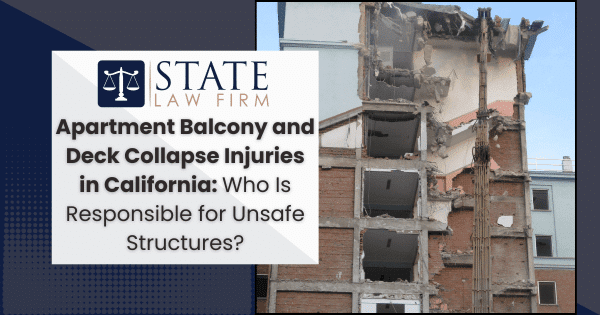
A collapsing apartment balcony or deck can cause serious physical injuries, displacement, medical expenses, and lasting uncertainty about how the structure was allowed to become unsafe.
Depending on the circumstances, responsibility may rest with the property owner, landlord, management company, homeowners association, contractor, developer, architect, engineer, inspector, or manufacturer. Liability generally depends on who controlled the structure, who created or knew about the danger, and whether reasonable inspections, repairs, warnings, or access restrictions could have prevented the collapse.
California premises liability rules and exterior elevated element inspection laws can play an important role, but each claim requires a fact-specific investigation.
Who Can Be Held Responsible for an Apartment Balcony or Deck Collapse?
Several parties may share Responsibility for an Apartment Balcony or Deck Collapse.
Several parties may share responsibility for an unsafe apartment balcony or deck:
- Property owners and landlords may be responsible for unreasonable inspection, maintenance, or repair failures.
- Property management companies may be liable when they control maintenance requests, inspections, vendors, or resident warnings.
- Contractors and developers may be responsible for defective construction, waterproofing, alterations, or repairs.
- Architects, engineers, and inspectors may face liability for professional errors within their assigned scope of work.
- Homeowners associations may be responsible for common-area structures or components assigned to the association.
- Manufacturers and suppliers may be responsible for defective structural components or materials.
Legal ownership is important, but it does not always identify every responsible party. Control over inspections, repairs, warnings, and access may be equally important. State Law Firm’s [California premises liability guide](https://statelawfirm.com/post/california-premises-liabili ains how ownership, occupancy, maintenance duties, and control can overlap. citeturn820278view0
The Apartment Owner or Landlord
California Civil Code section 1714 generally requires people to use ordinary care in managing their property. An owner or landlord may have acted negligently by failing to conduct reasonable inspections, repair deterioration, restrict access, or warn residents about a known or reasonably discoverable danger.
Evidence may include ignored complaints, recurring leaks, visible cracking, sagging surfaces, corrosion, prior inspection findings, or incomplete repairs. Liability still requiresonable conduct contributed to the structural failure and resulting injury. citeturn714686view0
The Property Management Company
A management company may have separate responsibility when its agreement gives it control over inspections, maintenance requests, vendor selection, repairs, or resident communications.
For example, maintenance employees may have documented water intrusion or movement in the structure, but management may have delayed the recommended inspection or repair. The management contract, work orders, emails, maintenance logs, and vendor communications may clarify which responsibilities belonged to the owner and which belonged to the manager.
Contractors, Subcontractors, and Developers
Construction-related responsibility may involve inadequate waterproofing, insufficient structural support, improper fasteners, defective connections, poor drainage, unpermitted alterations, or repairs that covered visible damage without correcting the underlying deterioration.
The investigation should distinguish defects from the original construction from problems introduced during later renovations or repairs. More than one contractor or subcontractor may have contributed to the unsafe condition.
Architects, Structural Engineers, and Inspectors
Architects, structural engineers, and inspectors may be responsible for unsafe designs, inadequate specifications, missed deterioration, or reports that failed to communicate serious safety concerns.
Professional liability depends on the person’s role, contract, scope of work, information available, and applicable professional standard of care. An inspection performed for a limited purpose does not necessarily make the professional responsible for every condition on the property.
A Homeowners Association or Condominium Association
An HOA may be responsible when governing documents assign it maintenance or repair responsibility for common-area balconies, decks, walkways, stairs, railings, waterproofing systems, or structural components.
The declaration, bylaws, maintenance matrix, reserve studies, inspection reports, and board records may show whether the association or an individual unit owner controlled the failed component. Calojects also have a separate statutory inspection framework discussed below. citeturn701920view1
Manufacturers and Suppliers of Defective Components
A manufacturer or supplier may be responsible if a defective railing, bracket, fastener, support, waterproofing product, connector, or prefabricated balcony system contributed to the failure.
A product claim may overlap with negligence claims against the installer, contractor, property manager, or owner. State Law Firm’s defective products practice page provides additional information about claims involving unsafe products.
Why Do Apartment Balconies and Decks Collapse?
Investigators commonly examine the following potential causes:
- Water intrusion, dry rot, and hidden decay. Failed flashing, membranes, coatings, or sealants may permit water to reach load-bearing wood. The walking surface can appear intact while concealed structural components continue to deteriorate.
- Defective construction or improper alterations. Insufficient supports, poor connections, inadequate drainage, deficient waterproofing, or work completed without required permits may weaken the structure.
- Corrosion, aging materials, and inadequate maintenance. Rusted connectors, deteriorated wood, cracked concrete, loose railings, and deferred repairs may reduce structural capacity.
- Excessive loads and failure to restrict access. Investigators may consider the number of occupants or weight stored on the structure. However, overloading allegations do not automatically eliminate claims involving preexisting deterioration, inadequate warnings, or a failure to restrict access.
California’s inspection statutes specifically focus on load-bearing compms, fungus, deterioration, decay, and improper alterations. citeturn701920view0turn714686view4
What California Law Requires Property Owners to Do
California Premises Liability and the Duty to Use Reasonable Care
Under California Civil Code section 1714, a person is generally responsible for an injury caused by a lack of ordinary care in managing property.
For a balcony collapse, reasonable care may include appropriate inspections, maintenance, repairs, warnings, and access restrictions. Liability depends on factors such as control, notice, foreseeability, causation, and the opportunity to discover or cooperty owner is not automatically liable merely because an injury occurred. citeturn714686view0
California Apartment Balcony Inspections Under Health and Safety Code Section 17973
California Health and Safety Code section 17973 applies to qualifying exterior elevated elements in buildings containing three or more multifamily dwelling units.
Covered elements include certain balconies, decks, porches, stairs, walkways, entry structures, supports, and railings that:
- Extend beyond the building’s exterior walls
- Have walking surfaces more than six feet above ground
- Are intended for human occupancy or use
- Rely substantially on wood or wood-based products for support
The initial statutory inspection deadline was January 1, 2026, followed generally by six-year inspection cycles. When an inspector identifies an immediate safety threat, the owner must take preventive measures immediately, which may include preventing access until emergency repairs are completed. The siance and continued safe maintenance on the building owner. citeturn701920view0turn714686view3
A missed inspection or statutory violation may be important evidence, but it does not automatically establish civil liability. California Evidence Code section 669 imposes additional requirements before a statutory violation creates a presumption of negligenc and proof that the injury was of the type the law was intended to prevent. citeturn935866view0
Condominium and HOA Inspections Under Civil Code Section 5551
California Civil Code section 5551 establishes a separate framework for qualifying condominium projects.
The association must arrange inspections of a statistically significant sample of qualifying exterior elevated elements for which it has maintenance or repair responsibility. Inspections generally recur every nine years. The first statutory inspection deadline was January 1, 2025.
If an inspector identifies an immediate threat, the association must take immediate preventive measures, including preventing occupant access until ed. Reports must also be maintained as association records. citeturn714686view5turn701920view1
Local Building Codes and Ordinances May Impose Additional Requirements
California law permits cities and counties to impose requirements that are stricter than the statewide minimums. Property-specific requiremention notices, local ordinances, and code-enforcement orders. citeturn701920view0turn701920view1
In Los Angeles, the Los Angeles Housing Department accepts exterior elevated element complaints concerning qualifying apartment buildings. Residents may use the city’s E3 apartment complaint process to report a susies and counties may use different agencies and procedures. citeturn138780view0turn343408view0
How an Injured Person Can Prove Balcony or Deck Collapse Liability
A balcony collapse claim generally requires evidence supporting four central issues:
- Duty: Establish who owned, controlled, maintained, inspected, designed, constructed, or repaired the balcony or deck. Relevant documents may include leases, management agreements, HOA documents, permits, vendor contracts, and property records.
- Breach: Show that a responsible party failed to use reasonable care. Evidence may include ignored complaints, missed inspections, delayed repairs, deficient construction, inadequate warnings, or a failure to restrict access.
- Causation: Connect the unsafe condition and defendant’s conduct to the structural failure and injuries. Structural engineers, architects, contractors, materials specialists, or accident reconstruction professionals may assist.
- Damages: Document the physical injuries, medical care, lost income, disability, emotional effects, and other legally recognized losses caused by the collapse.
Actual notice may arise from complaints, prior reports, inspection findings, or earlier failures. Constructive notice means the r circumstances in which a reasonable inspection should have discovered it. citeturn820278view0
Multiple parties may share responsibility. California comparative-fault principles may also reduce a claimant’s recovery when the claimant is assigned part of the responsibility, but partial fault does not necessarily eliminate the claim.
What Evidence Should Be Preserved After a Balcony Collapse?
Preserve Physical and Digital Evidence
When it can be done safely, preserve or identify:
- Photographs and video of the structure, debris, supports, railings, and surrounding area
- Clothing and personal property damaged in the collapse
- Cellphone, surveillance, doorbell, and witness recordings
- Names and contact information for residents, workers, and other witnesses
Request Property and Inspection Records
Important records may include:
- Inspection reports
- Maintenance requests and resident complaints
- Repair invoices and contractor records
- Permits and construction plans
- Code-enforcement notices
- HOA minutes and reserve studies
- Emails mentioning leaks, cracking, movement, decay, or unsafe conditions
Prevent Destruction or Premature Repair of Critical Evidence
Failed components should be photographed, measured, and evaluated before they are repaired, removed, discarded, or subjected to destructive testing.
An attorney may send a preservation notice requesting that the owner, management company, contractor, HOA, insurer, or other party preserve physical evidence, electronic communications, video, and relevant records.
Injuries and Compensation in a California Balcony Collapse Claim
Available compensation depends on the evidence, causation, applicable law, responsible parties, and the effects of the injury.
Medical Expenses, Lost Income, and Future Financial Losses
Potential economic damages may include emergency care, hospitalization, surgery, rehabilitation, mobility equipment, future medical needs, lost income, and reduced earning capacity.
Future losses generally require evidence showing that the expense or loss is reasonably likely and connected to the injury.
Pain, Disability, and Emotional Harm
Potential non-economic damages may include physical pain, disability, scarring, emotional distress, loss of mobility, inconvenience, and reduced enjoyment of life.
Severe falls may also result in injuries addressed by State Law Firm’s catastrophic injury practice. No standard formula determines the value of a balcony collapse claim.
Wrongful Death Claims After a Fatal Structural Collapse
When a collapse is fatal, qualifying family members or the personal representative may be able to bring a wrongful-death claim. California Code oion 377.60 identifies the people who may have standing to pursue the claim. citeturn395959view0
Potential damages may include funeral and burial expenses, lost financial support, and certain personal losses suffered by eligible family members. Eligibility and damages require careful case-specific review. State Law Firm provides more information about California wrongful-death claims.
What to Do After an Apartment Balcony or Deck Collapse
- Seek emergency medical care. Call emergency services when necessary and obtain an appropriate medical evaluation, even if the full extent of the injuries is not immediately clear.
- Report the collapse. Notify emergency responders, the landlord, property manager, HOA, and the appropriate building or code-enforcement agency.
- Document the scene and identify witnesses. Take photographs and video when it is safe. Record witness names, contact information, and what each person observed.
- Avoid signing releases or giving recorded statements too quickly. An insurer or property representative may request a statement before the cause of the collapse or extent of the injuries is known. Provide accurate required information, but consider obtaining legal advice before signing a release.
- Speak with a California premises liability attorney. Prompt investigation may help identify responsible parties, secure inspection and maintenance records, preserve failed components, and retain qualified structural experts.
How Long Do You Have to File a Balcony Collapse Injury Claim?
California’s General Personal Injury Filing Deadline
California Code of Civil Procedure section 335.1 generally provides twonvolving injury or death caused by another party’s wrongful act or neglect. citeturn714686view7
The exact deadline may be affected by accrual rules, delayed discovery, the claimant’s age or capacity, the identity of the defendant, and other circumstances. Construction, professional-liability, contractual, and product-related claims may involve additional deadlines.
Claims Involving a Government Entity
A collapse at public housing or another government-controlled property may involve the California Government Claims Act.
Under Government Code section 911.2, a claim concerning personal injury or death generally must be presented to the proper public entity no later than six Presenting an administrative claim and filing a lawsuit are separate steps. citeturn714686view8
Do not calculate a filing deadline solely from general online information.
Get Help Identifying Who Was Responsible for the Unsafe Structure
Balcony collapse cases may require immediate structural analysis and a detailed review of ownership, management, construction, inspection, maintenance, and repair records. More than one party may be responsible.
State Law Firm handles California premises liability matters from its main office in Sherman Oaks and serves clients throughout California. The firm emphasizes direct attorney involvement and clear, accessible communication. Injured residents, guests, workers, and ste Law Firm at (877) 659-9223 for a free consultation. citeturn928334view2turn714686view10
Frequently Asked Questions About California Balcony and Deck Collapses
Can a tenant sue a landlord after an apartment balcony collapses?
Potentially. A tenant may have a claim if the landlord controlled the balcony, failed to use reasonable care, and that failure substantially contributed to the collapse and injuries. The claim may depend on inspection records, prior complaints, visible deterioration, repair history, lease terms, and whether another party created the defect.
Does violating California’s balcony inspection law automatically prove negligence?
No. A missed inspection or statutory violation may be relevant evidence, but it does not automatically decide liability. The claimant must still connect the violation or other unreasonable conduct to the collapse and injury. California Evidence Code section 669 alsuirements before a statutory violation creates a presumption of negligence. citeturn935866view0
What happens if the property owner claims the balcony was overloaded?
Overloading may become part of the causation and comparative-fault analysis. Investigators should determine the structure’s design capacity, actual load, condition, deterioration, warnings, and whether access should have been restricted. An overloading allegation does not necessarily excuse defective construction or inadequate maintenance.
Can an apartment guest bring a balcony collapse claim?
A guest may potentially bring a claim if another party’s negligence caused the collapse and resulting injuries. The analysis generally focuses on control, unreasonable conduct, notice, causation, and damages rather than whether the injured person was named on the lease.
Can residents report an unsafe balcony before it collapses?
Yes. Residents should notify the landlord or management company in writing and retain copies of photographs and communications. A serious or unresolved concern may also be reported to the appropriate local building, housing, or code-enforcement agency. In Los Ange E3 complaints may be submitted through the Los Angeles Housing Department. citeturn138780view0
Responsibility for a balcony or deck collapse may extend from the property owner to managers, associations, construction professionals, inspectors, and manufacturers. Preserve evidence, obtain appropriate medical care, document prior complaints, and determine quickly whether statutory inspections, repairs, warnings, or access restrictions were missed.