Spanish
 English
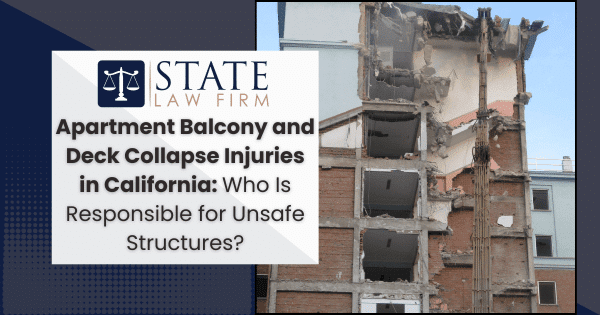
A California property owner, landlord, manager, contractor, or another responsible party may be liable for a balcony or deck collapse when a failure to use reasonable care causes an injury. Ownership alone does not answer every question. The investigation must connect each party’s duties and conduct to the structural failure and resulting harm.
After a collapse, obtain medical care and stay away from the damaged structure. If safe, preserve photographs and witness details. Inspection and repair records can be especially important because deterioration inside a balcony may not have been visible to a tenant or guest.
Who may be responsible for an unsafe balcony or deck?
| Possible party | Questions to investigate |
|---|---|
| Owner or landlord | Who controlled the structure, maintained it, and received reports of deterioration? |
| Property manager | What inspection, complaint-handling, or repair responsibilities did the manager undertake? |
| Contractor or designer | Did defective work or design contribute to the failure? |
| Condominium association | Did the association have maintenance or repair responsibility for the affected element? |
| Inspector or other professional | What was the inspection’s scope, what should it have identified, and did a supported failure cause harm? |
Several parties may share responsibility. Their contracts, conduct, and relationship to the property can matter. An inspection company is not automatically responsible for every later defect, and a management company’s name on a building does not establish the scope of its duties.
What must an injured person prove?
California premises liability generally concerns a failure to use reasonable care in owning, leasing, occupying, or controlling property. The claim also requires harm and a causal connection between that failure and the injury. sección 1714 del Código Civil supplies the general negligence principle.
The Judicial Council’s CACI 1000 and related premises-liability instructions explain the framework. Relevant evidence can show that a responsible party knew about a dangerous condition or should have discovered it through reasonable care. Notice is assessed in context, including who created the condition and the theory being pursued.
A collapse is a serious event, but the legal investigation still needs to establish why it happened and who was responsible. Inspection noncompliance can be relevant without automatically resolving causation or every element of the claim.
Common conditions that need investigation
- Water intrusion and deterioration of wood supports.
- Corroded fasteners or inadequate structural connections.
- Defective construction, alterations, or repairs.
- Damaged walking surfaces, railings, or support components.
- Loads or uses that the structure could not safely support.
These are investigation topics, not conclusions to draw from a photograph. A qualified structural professional may need to examine the failure location, materials, plans, and repair history. Visible cracking or staining can be relevant, but an injured person should not enter an unstable area to investigate.
California balcony inspection rules: apartments and condominiums differ
Qualifying apartment buildings
Health and Safety Code section 17973 addresses specified exterior elevated elements in buildings with three or more multifamily dwelling units. Its definitions concern matters such as height above ground and wood-based load-bearing components; it does not cover every porch or balcony in the same way.
El Los Angeles Housing Department’s apartment inspection guidance identifies January 1, 2026 as the initial inspection deadline, with inspections generally every six years thereafter. Property-specific exceptions, construction history, local requirements, and the statutory definitions should be checked.
Qualifying condominium projects
Civil Code section 5551 establishes a separate inspection framework for qualifying condominium projects and exterior elevated elements the association must maintain or repair. It generally uses a nine-year inspection cycle and an initial January 1, 2025 deadline, subject to the statute’s application and exceptions.
Do not substitute the apartment timetable for the condominium rule. Identify the property type, affected element, responsible entity, and relevant inspection dates first. A completed inspection also does not eliminate the need to respond reasonably to later reports of a dangerous condition.
Evidence that can explain the failure
Preserve what you already have and identify records others may hold:
- Photographs and video from before and after the collapse, including their original dates.
- Messages reporting leaks, movement, soft surfaces, damaged railings, or other concerns.
- Inspection reports, permits, structural plans, repair invoices, and maintenance logs.
- Witness names, incident reports, emergency response information, and available security video.
- Lease documents or association records that help identify control and maintenance duties.
- Medical records and documentation of work or daily activities affected by the injury.
Prompt preservation requests can help identify relevant records and physical evidence before ordinary deletion or removal occurs. They do not guarantee that records exist or that another party must immediately release everything requested.
Emergency stabilization and necessary repairs should not be delayed for an injury claim. Counsel and qualified professionals can discuss safe documentation, inspection access, and preservation of relevant components. Do not remove debris from someone else’s property or attempt destructive testing yourself.
What if the owner says you overloaded or misused the balcony?
That allegation requires evidence, including the actual use, loading, warnings, structural condition, and connection to the collapse. A party’s assertion does not settle the issue.
California comparative-fault principles may reduce damages when an injured person’s own negligence contributed to the harm. They do not mean a disputed allegation automatically eliminates the claim. Give an accurate account of who was present and what happened, including facts that may require explanation.
Injuries and losses to document
A collapse can produce significant injuries, but claim value depends on the person’s actual condition and supporting evidence. Relevant losses may include medical expenses, necessary future care, lost earnings, reduced earning capacity, and pain or other noneconomic harm where legally supported.
Keep receipts, work records, treatment recommendations, and a factual account of assistance needed at home. Future losses need appropriate support; a diagnosis by itself does not establish a lifetime care cost. Our catastrophic injury information addresses serious injuries with lasting consequences.
Steps to take after a collapse injury
- Get appropriate medical care and follow emergency instructions.
- Report the incident to the responsible property contact and retain a copy.
- Record witness details and preserve available evidence safely.
- Keep correspondence factual and retain any proposed release.
- Identify the applicable claim and lawsuit deadlines promptly.
California Courts explains that personal injury lawsuits generally have a two-year filing period, with exceptions. Government-related claims can require an earlier administrative claim. Negotiations, repairs, or an open investigation do not automatically extend a deadline.
Frequently asked questions
Can a guest bring a claim, or only a tenant?
A guest may have a claim if the legal elements are established. Tenant status is not the only basis for a premises-liability claim.
Does a missing inspection automatically prove the owner owes damages?
No. The applicable duty, violation, causation, and injury still require analysis. Inspection records can be important evidence.
What if the balcony looked safe before it failed?
Some structural conditions may be concealed. Records and professional investigation can help assess whether reasonable inspection or maintenance should have identified the danger.
Should I collect broken structural pieces?
Do not enter an unsafe area or remove property without authority. Discuss lawful, safe preservation with counsel and qualified professionals.
Can more than one company be responsible?
Yes, potentially. Maintenance, construction, management, and other duties may involve different parties, but each claim needs factual support.
Reviewing a balcony or deck injury claim
State Law Firm can review the incident, maintenance concerns, and available records. Learn about our Sherman Oaks premises liability representation. Bring photographs, communications with management, and any inspection or incident information already available.