English
  Spanish
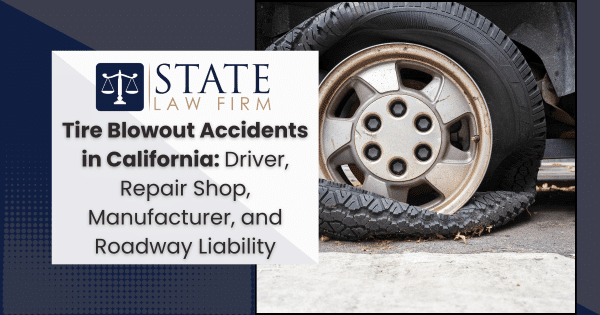
Tire blowouts are not always unavoidable. A failure may result from neglected maintenance, improper service, a defective tire, a dangerous road, or several causes at once. Identifying the vehicle that lost the tire does not, by itself, establish fault. The investigation must determine why the tire failed and who controlled the underlying risk.
Direct answer: A driver, vehicle owner, tire shop, mechanic, manufacturer, distributor, public entity, road contractor, or private property owner may be liable for a California tire blowout accident. Responsibility depends on whether that party’s negligence, meaning a failure to use reasonable care, defective product, or dangerous property condition substantially contributed to the failure and crash.
Who Can Be Liable for a Tire Blowout Accident in California?
- The driver or vehicle owner: Failure to inspect, maintain, inflate, or replace an unsafe tire may support negligence. Speed, overloading, and continued driving after warnings may also matter.
- The repair shop, mechanic, or tire dealer: Improper mounting, repair, inspection, or tire selection may create liability.
- The manufacturer, distributor, or product seller: A manufacturing defect, unsafe design, or inadequate warning may support a product-liability claim.
- A public entity, contractor, or private property owner: A pothole, debris, pavement edge, or construction hazard may create liability when the legal requirements for control, causation, creation, or notice are satisfied.
Evidence often includes the preserved tire, photographs, service records, maintenance history, expert analysis, and roadway records. Several parties may share responsibility.
How Tire Blowouts Happen and Why the Cause Matters
The physical cause often points toward the potentially responsible party.
| Possible cause | Potentially responsible party | Useful evidence |
| Low pressure, wear, age, or overloading | Driver, owner, employer, or fleet operator | Inspection, pressure, mileage, and load records |
| Improper mounting, repair, or tire selection | Shop, mechanic, or dealer | Work orders, invoices, and technician notes |
| Belt separation or production irregularity | Manufacturer, distributor, or seller | Tire examination, production records, and warranty information |
| Pothole, debris, or pavement defect | Public entity, contractor, or private owner | Scene photographs, complaints, and maintenance logs |
Common Maintenance and Use-Related Causes
Underinflation, overinflation, worn tread, excessive tire age, overloading, and delayed replacement can increase heat or stress. The National Highway Traffic Safety Administration recommends checking pressure, tread, tire size, age, and visible damage.
Possible Repair or Installation Errors
Examples include incorrect mounting, an unsafe puncture repair, installation damage, incompatible tire specifications, and improperly reassembled wheel components.
Possible Product Defects
Possible defects include tread or belt separation, weak bonding, contamination, missing material, or an allegedly unsafe design.
Roadway Hazards and Sudden Impact Damage
Deep potholes, metal debris, fallen cargo, sharp pavement edges, and poorly marked construction zones can cause rapid pressure loss or impact damage.
When the Driver or Vehicle Owner May Be Liable
A driver or owner may be responsible when warning signs or maintenance needs were ignored.
Signs the Driver May Be Responsible
- Cracks, bulges, exposed cords, punctures, or severe tread wear
- Repeated pressure loss, vibration, or dashboard warnings
- An ignored recommendation to replace the tire
- Incorrect tire pressure or excessive loading
- Continued high-speed driving after pressure loss
- An unreasonable steering or braking response
California Vehicle Code section 24002 restricts the operation of an unsafe vehicle that presents an immediate safety hazard. Vehicle Code section 27465 sets tread-depth standards that vary by tire and vehicle position. These statutes may be relevant, but they do not automatically resolve liability.
An employer, fleet operator, or non-driving owner may also face responsibility for missing inspections, ignoring complaints, overloading a vehicle, or continuing to use an unsafe commercial vehicle. Maintenance and inspection records can be important in a car accident investigation.
When a Tire Shop, Mechanic, or Dealer May Be Liable
A recent service visit does not automatically make the shop responsible. The issue is whether the business failed to use reasonable care within the work it undertook and whether that failure contributed to the blowout.
Negligent Tire Installation or Repair
Potential errors include improper mounting, damage to the bead or sidewall, an unsafe puncture-repair method, or incorrect reassembly of related components.
Failure to Identify or Disclose an Unsafe Condition
A shop may face liability for missing a reasonably detectable bulge, crack, exposed cord, or developing separation. Questions may also arise when a business represents a tire as safe without an adequate inspection. The shop’s duty may depend on the service it agreed to perform.
Installation of an Incorrect or Unsafe Tire
The wrong size, load rating, speed rating, or compatibility may create a safety risk. A damaged, aged, mismatched, or unsuitable used tire may raise similar concerns.
Important evidence includes invoices, work orders, technician notes, mounting records, retained parts, and the amount of time between the service and failure.
When the Tire Manufacturer or Distributor May Be Liable
Product liability is the legal responsibility that may arise when a defective product causes an injury. A blowout alone does not prove a defect. The evidence must connect the alleged defect to the tire failure and resulting harm.
California’s Civil Jury Instructions Resource Center publishes the applicable CACI instructions.
- Manufacturing defect: Under CACI 1201, the specific tire may be defective if it departed from its intended design or manufacturing specifications. Possible examples include contamination, improper bonding, missing material, or another production irregularity.
- Design defect: CACI 1203 and 1204 address the consumer-expectation and risk-benefit approaches. A design claim concerns the intended product design, rather than a one-time production error. The applicable framework depends on the evidence and allegations.
- Failure to warn: CACI 1205 addresses inadequate warnings or instructions. The issue may involve pressure, load limits, compatibility, service life, installation, or foreseeable misuse.
Manufacturers and sellers may argue that poor maintenance, misuse, modification, impact damage, improper third-party repair, or failure to follow warnings caused the loss. Preserving the tire is therefore essential.
State Law Firm’s defective products practice addresses injury claims involving allegedly unsafe products.
When Dangerous Road Conditions May Create Liability
A city, county, Caltrans, contractor, utility, or private property owner may be involved when a roadway hazard caused the blowout. In Sherman Oaks and elsewhere in Los Angeles County, investigators must identify who owned, controlled, constructed, or maintained the specific roadway.
Hazards That May Cause a Tire Blowout
Potential hazards include:
- Deep or concealed potholes
- Broken or uneven pavement
- Unsafe metal-plate edges
- Construction materials or debris
- Objects left in travel lanes
- Unmarked excavations or lane defects
Claims Against a City, County, State Agency, or Other Public Entity
Under Government Code section 835, a claimant generally must show:
- The public property was in a dangerous condition.
- The condition caused the injury and created a reasonably foreseeable risk of that type of injury.
- A public employee created the condition, or the entity had actual or constructive notice, meaning it knew or reasonably should have known about the danger, with enough time to take protective measures.
CACI 1100 reflects this framework. Relevant evidence may include prior complaints, inspection schedules, repair logs, work orders, photographs, and roadway measurements.
Claims Against Road Contractors or Private Property Owners
A contractor or private owner may be liable for creating a construction hazard, leaving debris in a travel lane, using inadequate warnings, or maintaining an unsafe private road or parking area.
Contracts, work schedules, photographs, employee testimony, surveillance footage, and records identifying who controlled the work area may help determine responsibility.
California Government Claim Deadlines
A personal-injury claim against a California public entity generally must be presented within six months after the claim accrues, meaning the date the claim legally arises, under Government Code section 911.2.
Exceptions and late-claim procedures may apply. Presenting a government claim is also not the same as filing a lawsuit. The California Courts government-claim guide explains the basic process.
Because roadway ownership and control are not always obvious, prompt investigation may help identify the correct agency or contractor before evidence disappears.
How California Comparative Fault Applies When Several Parties Contributed
California permits responsibility to be divided among multiple parties. A worn tire, an inadequate shop inspection, and a pothole could all contribute to the same crash.
For illustration only, a jury might assign 40 percent of the fault to the driver, 30 percent to the shop, and 30 percent to a roadway defendant. Actual percentages depend on the evidence.
CACI 405 and 406 address comparative negligence and apportionment of responsibility. An injured person’s failure to address a known tire problem, improper loading, product misuse, or unsafe driving response may reduce recovery rather than automatically eliminate the claim.
Evidence That Can Show Why the Tire Failed
Preserve and document the following:
- The tire, wheel, valve, detached tread, and related components
- Close photographs of the tread, sidewall, and DOT tire identification number
- Wide and close photographs of the roadway, signs, barriers, debris, and vehicle
- Tire purchase, pressure, rotation, alignment, mileage, and maintenance records
- Repair-shop invoices, work orders, recommendations, and communications
- Police, towing, witness, video, and available vehicle-data records
- Roadway complaints, inspection records, work orders, and construction contracts
- A chain-of-custody record showing who possessed each physical item and when
Do not discard, repair, alter, or surrender the tire without documenting it. A qualified tire-failure inspection may distinguish impact damage from underinflation, fatigue, improper repair, or a product defect.
Destructive testing generally should not occur before the evidence is documented and interested parties receive an appropriate opportunity to participate or object.
Compensation Potentially Available After a Tire Blowout Crash
Depending on liability and proof, recoverable losses may include:
- Medical expenses
- Lost income and reduced earning capacity
- Vehicle and personal-property damage
- Pain, emotional distress, and loss of normal activities
- Future treatment or assistance supported by evidence
- Wrongful-death damages when a fatal crash creates a valid claim
No category of compensation is automatic. Causation, comparative fault, insurance coverage, responsible parties, and supporting records all affect the claim.
Steps to Protect a California Tire Blowout Claim
- Obtain emergency medical care when needed.
- Report the collision and request the official report.
- Photograph the roadway, vehicle, wheel, tire, and debris.
- Tell the tow yard, insurer, and repair facility not to discard or alter the tire.
- Collect purchase, repair, maintenance, towing, medical, and employment records.
- Avoid destructive testing without legal and qualified expert guidance.
- Identify possible public-entity involvement promptly because special procedures may apply.
A complete investigation may require tire engineering, accident reconstruction, manufacturer information, repair records, and roadway-maintenance evidence.
State Law Firm provides personal injury representation in Sherman Oaks and throughout California. For a free consultation about a tire blowout accident, call (877) 659-9223. The firm emphasizes direct attorney involvement and clear, accessible communication.
Frequently Asked Questions
Is the driver automatically liable when a tire blows out?
No. The driver may be responsible if poor maintenance, overloading, ignored warnings, or unsafe driving contributed. A repair error, product defect, or dangerous roadway condition may instead be responsible, or several causes may overlap.
Can a tire shop be liable if the blowout happened after service?
Potentially. The evidence must connect the shop’s inspection, installation, repair, tire selection, or disclosure failure to the blowout. Timing may help establish context, but it does not prove negligence by itself.
Can I bring a defective-tire claim without a recall?
Potentially. A recall may provide useful evidence, but it is not necessarily required. The claimant must still prove a manufacturing defect, design defect, or inadequate warning and connect it to the tire failure and injury.
Who may be responsible when a pothole causes the blowout?
Responsibility may rest with a city, county, state agency, road contractor, utility, or private owner, depending on who controlled or created the hazard. Notice, causation, and compliance with public-entity claim procedures may also matter.
How long do I have to bring a tire blowout claim?
Deadlines depend on the defendant, type of claim, accrual date, and possible exceptions. A personal-injury claim against a public entity generally must be presented within six months after accrual. Claims against private defendants and product manufacturers follow different rules, so a case-specific review is important.
What if the tire was discarded after the accident?
Losing the tire may make causation more difficult to prove, but other evidence may remain useful. Photographs, repair records, purchase information, witness testimony, vehicle data, and roadway records may help reconstruct what happened. The tire and fragments should be preserved whenever they remain available.
A tire blowout investigation should begin with the cause, not an assumption about fault. Preserve the tire, document the vehicle and road, collect service and maintenance records, and identify every party that controlled a possible danger.
Early investigation is especially important when a public roadway, commercial vehicle, repair shop, or allegedly defective product may be involved. Additional information about the firm and its California practice is available on the State Law Firm About page and locations page.