English
  Spanish
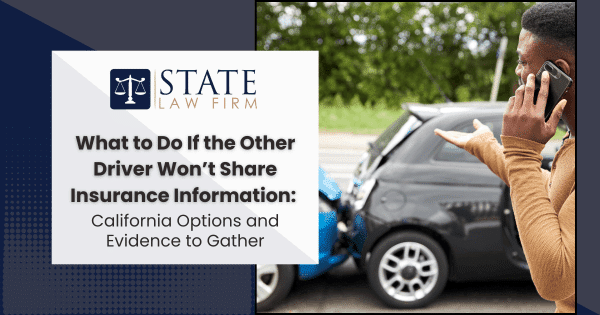
A car accident is stressful enough without the other driver refusing to provide insurance information. When that happens, the goal is not to win an argument at the scene. The goal is to stay safe, preserve proof, and create a clear record before evidence disappears.
NHTSA reported more than 6 million police-reported traffic crashes in the United States in 2024, which means small details at the scene can become important later. Whether the crash happened on a neighborhood road, highway, or freeway, State Law Firm’s guide on highway vs. freeway differences in California can help explain why location and roadway context may matter when reconstructing what happened.
Suggested Infographic: What to Do When the Other Driver Refuses Insurance
- Move to safety
- Ask once for required information
- Photograph the vehicle, plate, damage, and scene
- Record the refusal in your notes
- Call police or CHP when safety, injury, hit-and-run, or refusal issues arise
- Notify your insurer and preserve all evidence
California Drivers Are Supposed to Exchange Insurance Information
Short answer: In California, drivers involved in an accident generally must exchange identifying and financial responsibility information unless they are incapable of doing so.
Under California Vehicle Code Section 16025, a driver involved in an accident must exchange certain information with the other driver or property owner present at the scene. That includes identifying information and evidence of financial responsibility. If that financial responsibility is insurance, the driver must provide the insurance company’s name and address, along with the policy number.
That does not mean every driver will cooperate. Some drivers panic. Some claim they do not have their card. Some provide partial information. Some simply refuse. But refusal does not end your claim. It changes what you need to do next.
What Information Should Be Exchanged After a Crash
After a California crash, the information to collect generally includes:
- Driver’s name and current residence address
- Driver’s license number
- Vehicle identification number, if available
- Registered owner’s current residence address
- Insurance company name and address
- Insurance policy number
- License plate number
- Vehicle make, model, color, and visible damage
If the other driver will not provide this information, write down what they refused to give and collect what you can safely observe.
Why Refusing to Share Insurance Can Matter Later
Missing insurance information can delay almost every part of the claim. It may slow down claim setup, fault investigation, repair estimates, injury documentation, and insurer communications. If the other driver later denies being involved, denies fault, or claims the damage happened somewhere else, your evidence from the scene may become the backbone of the claim.
First Steps at the Scene If the Other Driver Refuses
If the other driver refuses to provide insurance information, keep your response calm and deliberate.
- Move yourself and your vehicle to a safe location if possible.
- Ask once for the required information.
- Do not argue, threaten, block the driver, or chase the vehicle.
- Photograph the vehicle, license plate, damage, roadway, and surroundings.
- Record the time, location, and exact words used during the refusal.
- Call police or CHP if there are injuries, danger, suspected impairment, aggressive behavior, major damage, refusal to identify, or the driver appears ready to leave.
- Notify your own insurance company promptly.
The California Department of Insurance recommends collecting driver, witness, vehicle, and scene information after an accident, taking photos when possible, and notifying your insurer.
Stay Safe and Avoid Escalating the Situation
Do not let the other driver’s refusal pull you into a confrontation. A bad scene can become worse quickly. Do not stand in traffic, reach into the other driver’s car, block their door, grab their paperwork, or follow them if they drive away. Your safety matters more than the insurance card.
If the driver becomes hostile, step back, call 911 if needed, and focus on observable facts: plate number, vehicle description, direction of travel, passengers, and witnesses.
Ask Once, Document the Refusal, and Preserve the Moment
A simple sentence is enough: “California requires us to exchange information. Can I have your insurance company and policy number?”
If they refuse, document it. Write down the exact words if you can. Note whether the driver said they had no insurance, would not provide it, did not own the car, was driving for work, was driving for a rideshare company, or was borrowing the vehicle.
Evidence to Gather Before the Driver Leaves
When you cannot get the insurance card, evidence becomes your substitute memory. Gather proof in categories.
Vehicle ID
- License plate
- Make, model, and color
- VIN, if visible and safe to photograph
- Damage location
- Stickers, decals, company logos, bumper stickers, or temporary tags
Scene Evidence
- Traffic signals
- Stop signs
- Lane markings
- Debris
- Skid marks
- Vehicle resting positions
- Weather and lighting
- Road defects or construction
- Dashcam footage
Witness and Business Evidence
- Names and phone numbers of witnesses
- Nearby storefronts, gas stations, apartment buildings, or offices
- Security cameras
- Traffic cameras
- Rideshare receipts
- Delivery app records
- Photos of passengers or commercial markings, only if taken safely and lawfully from a public vantage point
Photos and Videos That Help Identify the Driver and Vehicle
Start with the license plate. Then photograph the whole vehicle, damage, and its position relative to your car. If the vehicle has a company logo, rideshare decal, rental sticker, dealership frame, or commercial markings, photograph those too.
If the crash involved Uber, Lyft, or another rideshare situation, insurance questions can become more complicated because coverage may depend on whether the driver was logged into the app, waiting for a ride, or transporting a passenger. State Law Firm’s Uber and Lyft accident lawyers in Chico page explains how rideshare accident claims can require a closer look at available coverage.
Scene Evidence That Helps Prove Fault
Photograph the facts that tell the story of the crash. Capture lanes, traffic controls, intersection layout, damage angles, road conditions, vehicle positions, and anything blocking visibility. These details may help show who had the right of way, who changed lanes, who failed to stop, or why the impact happened where it did.
Witness and Business Evidence to Capture Quickly
Witnesses leave. Camera footage gets overwritten. Businesses may only retain video for a short time. If someone saw the crash, ask for their name and phone number. If nearby stores or apartment buildings may have cameras, write down the business name, address, camera location, and the time range to preserve.
Reporting Options When Insurance Information Is Missing
| Report Type | When It Helps or May Be Required |
| Police or CHP report | Helpful when there are injuries, suspected impairment, aggression, refusal to identify, hit-and-run concerns, major damage, or disputed fault. |
| DMV SR-1 | May be required within 10 days if anyone is injured or killed, or if property damage is over $1,000. |
| Insurance claim notice | Helps your insurer investigate, locate coverage, inspect damage, and evaluate UM, UIM, collision, Med Pay, or rental coverage. |
When to Contact Police or CHP
You should consider contacting police or CHP when the other driver refuses to identify themselves, leaves the scene, appears impaired, becomes aggressive, or when anyone is injured. You should also call when the crash creates a traffic hazard or the damage appears significant.
The California DMV’s collision guidance also says drivers should call 911 right away if anyone is hurt and show license, registration, insurance information, and current address to the other driver, law enforcement officer, and anyone else involved.
When the DMV SR-1 May Be Required
The California DMV SR-1 accident report must generally be submitted within 10 days if someone is injured, killed, or property damage exceeds $1,000. The SR-1 asks for other-party information if available. If the other driver refused to provide insurance information, do not ignore the deadline. Provide what you have and keep records showing what information was unavailable.
Why a Police Report Can Help the Insurance Claim
A police report can help document identity, statements, witness names, vehicle information, location, road conditions, diagrams, and sometimes suspected violations. It is not the only evidence that matters, but it can give insurers and lawyers a formal starting point.
Insurance Options If You Cannot Get the Other Driver’s Policy Information
You may still have options even if the other driver’s insurance information is missing.
Mini decision map:
- Driver identified: Your insurer or attorney may be able to investigate coverage.
- Driver unknown: Hit-and-run issues may arise, and your own policy becomes especially important.
- Driver uninsured: UM coverage may apply if you purchased it.
- Driver underinsured: UIM coverage may apply if the at-fault driver’s limits are too low.
- Property-only damage: Collision coverage or uninsured motorist property damage may be relevant, depending on your policy.
Notify Your Own Insurance Company Promptly
Report the crash to your insurer with accurate facts. Do not guess. Say what happened, what you observed, what the other driver refused to provide, and what evidence you collected. Your policy may require prompt notice, and your insurer may be able to help identify coverage through the plate, registration, police report, or claim investigation.
Check UM, UIM, Collision, Med Pay, and Rental Coverage
The California Department of Insurance auto coverage guide explains several coverages that may matter after a crash.
- UM coverage may help when the at-fault driver has no insurance.
- UIM coverage may help when the at-fault driver does not have enough insurance.
- UMPD may cover vehicle damage up to a California limit if the uninsured driver is identified.
- Collision coverage may help repair or replace your vehicle, subject to your deductible.
- Med Pay may help with medical expenses regardless of fault.
- Rental reimbursement may help with transportation while your car is being repaired, if included in your policy.
Coverage depends on the policy, exclusions, limits, facts, and timing.
What If the Driver Is Identified but Not Insured
If the driver is identified but uninsured, your options may include a UM claim, collision claim, direct claim against the driver, small claims for lower property damage disputes, or a civil lawsuit. If the driver was using someone else’s car, driving for work, driving a commercial vehicle, or driving for a rideshare platform, there may be additional coverage questions to investigate.
Mistakes That Can Make the Claim Harder
Avoid these common mistakes after the other driver refuses to cooperate:
- Do not say “I’m fine” if you do not know how you feel yet.
- Do not apologize in a way that sounds like admitting fault.
- Do not guess about speed, distance, fault, or injuries.
- Do not repair your vehicle before taking clear photos.
- Do not wait to get medical care if you have pain or symptoms.
- Do not lose witness information.
- Do not wait to request camera footage.
- Do not assume no insurance means no recovery.
For a broader example of why early documentation matters in injury claims, State Law Firm’s article on burn injuries from tanning beds shows how proof, timing, and medical records can shape the way an injury claim is understood.
Do Not Guess About Fault or Injuries
After a crash, adrenaline can hide pain. You may not know whether you are injured. You may also not know how fast either vehicle was moving or what the other driver saw. Stick to facts. “I felt impact on the rear passenger side” is better than “I think they were going 50.”
Do Not Wait to Preserve Evidence
Camera footage, witnesses, dashcam files, and app records can disappear quickly. The sooner you act, the better your chance of preserving the facts before they are overwritten, deleted, or forgotten.
Do Not Assume No Insurance Means No Recovery
A refusal at the scene is not the end of the case. There may be UM/UIM coverage, vehicle owner liability, employer coverage, commercial coverage, rideshare coverage, or evidence that helps identify a different policy.
When to Contact a California Car Accident Lawyer
You should consider contacting a California car accident lawyer when you are injured, the other driver refuses to cooperate, the driver leaves, fault is disputed, the insurance information appears fake, the vehicle is commercial, the driver was working, or a rideshare company may be involved.
A lawyer can help turn fragments into a claim: the license plate, police report, DMV information, witness statements, camera footage, medical records, app records, and insurance communications.
A Lawyer Can Help Identify Coverage and Preserve Evidence
A lawyer may help request police reports, investigate vehicle ownership, communicate with insurers, send preservation letters, follow up with witnesses, evaluate coverage, and pursue subpoenas when needed. This can matter because the person who caused the crash may not be the only relevant party. In some cases, the vehicle owner, employer, or commercial entity may also need to be evaluated.
State Law Firm Can Help Protect the Claim Before Evidence Disappears
If the other driver refused to provide insurance information, State Law Firm can help you understand your options, preserve evidence, and pursue available coverage. The sooner the evidence is organized, the harder it becomes for the other side to rewrite what happened later.
If the other driver will not share insurance information after a California accident, stay calm, stay safe, and document everything. Get the plate, photograph the scene, collect witnesses, report when required, notify your insurer, and preserve proof quickly. Refusal can make the claim harder, but it does not make the claim impossible.