English
  Spanish
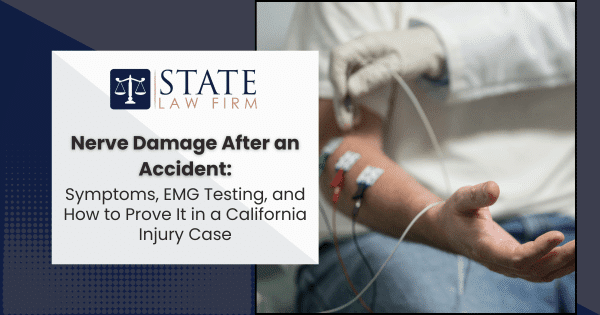
Nerve damage after a car accident can cause numbness, tingling, burning pain, or weakness. These symptoms need medical evaluation, but they do not establish a diagnosis or prove that a crash caused an injury. A California injury claim may require both clinical evidence of the condition and facts connecting the harm to someone else’s negligence.
Start with your health. Describe new or changing symptoms to a medical professional, follow their recommendations, and keep the records. EMG and nerve conduction studies can help answer certain medical questions, but neither test is a universal requirement for an injury claim.
Symptoms of nerve damage after an accident
Pay attention to changes in sensation, strength, and everyday function. Symptoms worth reporting include:
- Numbness or pins-and-needles sensations in an arm, hand, leg, or foot.
- Burning, shooting, or electric-like pain.
- New weakness, trouble gripping objects, or difficulty walking.
- Unusual sensitivity to touch or changes in coordination.
Tell the clinician where you feel the symptoms, when you first noticed them, and whether they are improving or worsening. Symptoms may have more than one possible cause. A medical history and examination help determine what needs investigation.
When to seek emergency care
Seek emergency medical care for new difficulty emptying your bladder, loss of bowel or bladder control, numbness around the groin or buttocks, or severe or rapidly worsening leg weakness. These can be warning signs of serious nerve compression. The American Association of Neurological Surgeons explains the emergency warning signs of cauda equina syndrome. Do not wait for an insurance appointment or a scheduled nerve test.
What nerve damage after an accident means
Trauma can stretch, compress, or injure nerves. The National Institute of Neurological Disorders and Stroke identifies physical injuries, including crashes and falls, among the possible causes of peripheral nerve damage. Other conditions can cause similar problems, which is why the diagnosis matters.
A peripheral nerve injury involves nerves outside the brain and spinal cord. A nerve-root problem near the spine, often called radiculopathy, is a different clinical description. If a disc is involved, our guide to herniated discs after a car accident explains the disc-specific claim issues.
Symptoms alone do not establish permanent nerve damage, a particular disc injury, or complex regional pain syndrome. Ask your clinician what diagnosis is supported and what remains uncertain.
How doctors diagnose nerve injuries
Evaluation starts with the symptom history and examination. Depending on the findings, a clinician may recommend imaging, specialist assessment, or tests of nerve and muscle function. Let the treating professional decide which tests are appropriate and when to perform them.
What EMG and nerve conduction studies can show
According to MedlinePlus’s guide to EMG and nerve conduction studies, EMG measures electrical activity in muscles. Nerve conduction studies assess how quickly and effectively electrical signals travel along tested nerves. They are often performed together to help evaluate muscle and nerve disorders.
The report should be interpreted with the examination and medical history. An abnormal result is not, by itself, proof of when an injury happened, who caused it, or whether the condition is permanent.
What a normal test does not settle
A normal result does not answer every question about pain or altered sensation. Standard EMG and nerve conduction testing does not fully evaluate every type of nerve problem. NINDS discusses separate testing for small-fiber neuropathies. Ask the clinician what the result means for your symptoms and whether further evaluation is indicated. Do not assume either a normal or abnormal test decides the legal claim.
Why medical timing and accurate records matter
Record the accident date, the first symptoms you remember, your first medical visit, and later changes. Distinguish what you noticed at the scene from what developed afterward. If you are unsure of a date, say so instead of reconstructing an exact timeline you cannot support.
A gap in treatment does not automatically invalidate a claim. However, it can raise questions about what happened during that period. Keep an honest record of access problems, appointment delays, or other reasons for interrupted care. Seek care based on medical need, not to generate paperwork for a settlement.
Useful records include test reports, visit summaries, referrals, prescriptions, work restrictions, bills, and a brief symptom log. Describe specific limitations, such as how long you can type or whether you need help carrying groceries. Note improvements as well as difficulties.
How to prove a nerve injury in a California claim
A diagnosis and legal responsibility are separate questions. In a typical negligence claim, the evidence must establish negligence, harm, and a causal connection. California Civil Jury Instruction 400, reproduced by Justia, describes the requirement that the defendant’s negligence be a substantial factor in causing the harm.
- Document the accident. Preserve incident reports, photographs, witness information, and available video. Medical tests do not establish which driver was responsible.
- Identify the condition. Collect the clinician’s findings, relevant test results, treatment recommendations, and stated uncertainties.
- Address causation. The timeline, mechanism of injury, prior health history, and medical opinions may help explain whether the accident caused or worsened the condition. The fact that symptoms followed a crash is important, but not conclusive by itself.
- Document the losses. Keep medical expense records, evidence of missed work, and descriptions of functional limitations. Future-care or long-term work-loss claims need support, not assumptions.
What if you had symptoms before the crash?
A prior condition does not automatically prevent recovery. California Civil Jury Instruction 3927, reproduced by Justia, distinguishes the original condition from harm caused by its aggravation. Earlier records can help show what changed after the accident. Be accurate about prior symptoms and treatment rather than assuming that an older diagnosis makes the claim impossible.
California deadlines and practical next steps
California Courts explains that personal injury lawsuits generally have a two-year filing deadline from the injury. Exceptions can change the applicable deadline. Do not assume that a later EMG or diagnosis starts a new two-year period.
Claims involving a public entity can require an earlier administrative claim, generally within six months for personal injury, followed by a separate lawsuit deadline. Review the California Courts government-claim guidance and obtain advice about the specific defendant and dates.
While care continues, preserve accident evidence and insurance correspondence. Before signing a release, understand which claims it resolves and whether your prognosis and future needs have been adequately assessed. A diagnosis does not establish a standard settlement amount.
Frequently asked questions
Can a car accident cause nerve damage?
Yes, trauma can injure nerves. Whether a particular crash caused your symptoms requires medical evaluation and review of the facts. Similar symptoms can have unrelated or preexisting causes.
Do I need an EMG to make a nerve injury claim?
Not in every case. Testing should be guided by a clinician. The appropriate evidence depends on the diagnosis, disputed issues, and available medical findings. Ordering a test solely to strengthen a claim is not a substitute for medical judgment.
Can I still have symptoms with a normal nerve test?
Yes. A normal result does not evaluate every possible cause of symptoms. Ask the interpreting clinician what was tested and what the result does or does not exclude.
How much is a nerve damage settlement worth?
There is no reliable amount that applies to every nerve injury. Evaluation depends on responsibility, medical causation, supported losses, prognosis, available coverage, and other case-specific issues. A test result alone cannot value a case.
Does numbness mean the damage is permanent?
No. Numbness alone does not establish either the diagnosis or the outlook. Ask the treating clinician about the likely cause, recommended follow-up, and what evidence would support a longer-term prognosis.
When legal review may be useful
Legal review may help when responsibility is disputed, symptoms interfere with work, an insurer challenges causation, or a settlement is proposed before the medical picture is clear. For a collision in Sherman Oaks or the surrounding area, learn about State Law Firm’s car accident representation in Sherman Oaks and request a consultation about your circumstances.
This article provides general information, not medical advice or legal advice about an individual case.