English
  Spanish
State Law Firm | Oakland, California
Oakland Bicycle Accident Lawyer
A bicycle injury claim starts with the rider's route and what happened around them. State Law Firm helps injured Oakland riders review road conditions, disputed responsibility, evidence, and insurance questions.
Free initial consultation
Bicycle injury claim review
Road layout and ride evidence
Serving Oakland from Sherman Oaks
Start with the crash date, exact cross streets, direction of travel, and any report number. Preserve original video and ride files, and tell the team where the bicycle and gear are stored. A consultation can begin before every record is available; evidence preservation and deadlines may need prompt attention.
Start With the Rider’s Route, Not Assumptions
After a bicycle crash in Oakland, a claim may turn on a few seconds: a vehicle crossing the rider’s path, a door opening beside the curb, or an obstruction that required a change in position. State Law Firm helps injured riders review what happened, the available evidence, and who may bear responsibility.
Start with the crash date, exact cross streets, direction of travel, and any report number. Explain whether you were in a marked bike lane, a separated bikeway, an intersection, or a shared traffic lane. Your medical needs come first; you do not need every photograph or report before asking for an initial consultation.
Oakland’s Road Layout Matters
Telegraph Avenue is not one uniform riding environment. The City’s corridor project information describes different segments and improvements, including separated lanes and intersections. Around Lake Merritt, the 27th Street and Bay Place project provides another example of changing street design. A plan or project page is background, not proof of the layout on the day of a particular crash.
Document the block and approach, not just the street name. Temporary barriers, loading activity, a bus boarding area, vegetation, or construction signs may help explain what each road user could see. Preserve dated photographs and describe the conditions you actually encountered instead of relying only on a current online map.
- Approach and direction: Identify your route, the vehicle’s approach, and where their paths came together.
- Signals and markings: Record the relevant signals, lane boundaries, turn arrows, and intersection markings.
- Doors and curb space: Note parked vehicles, which door opened, and any loading, parking, or pickup activity.
- Surface and visibility: Capture debris, pavement defects, obstructions, lighting, and what limited the view.
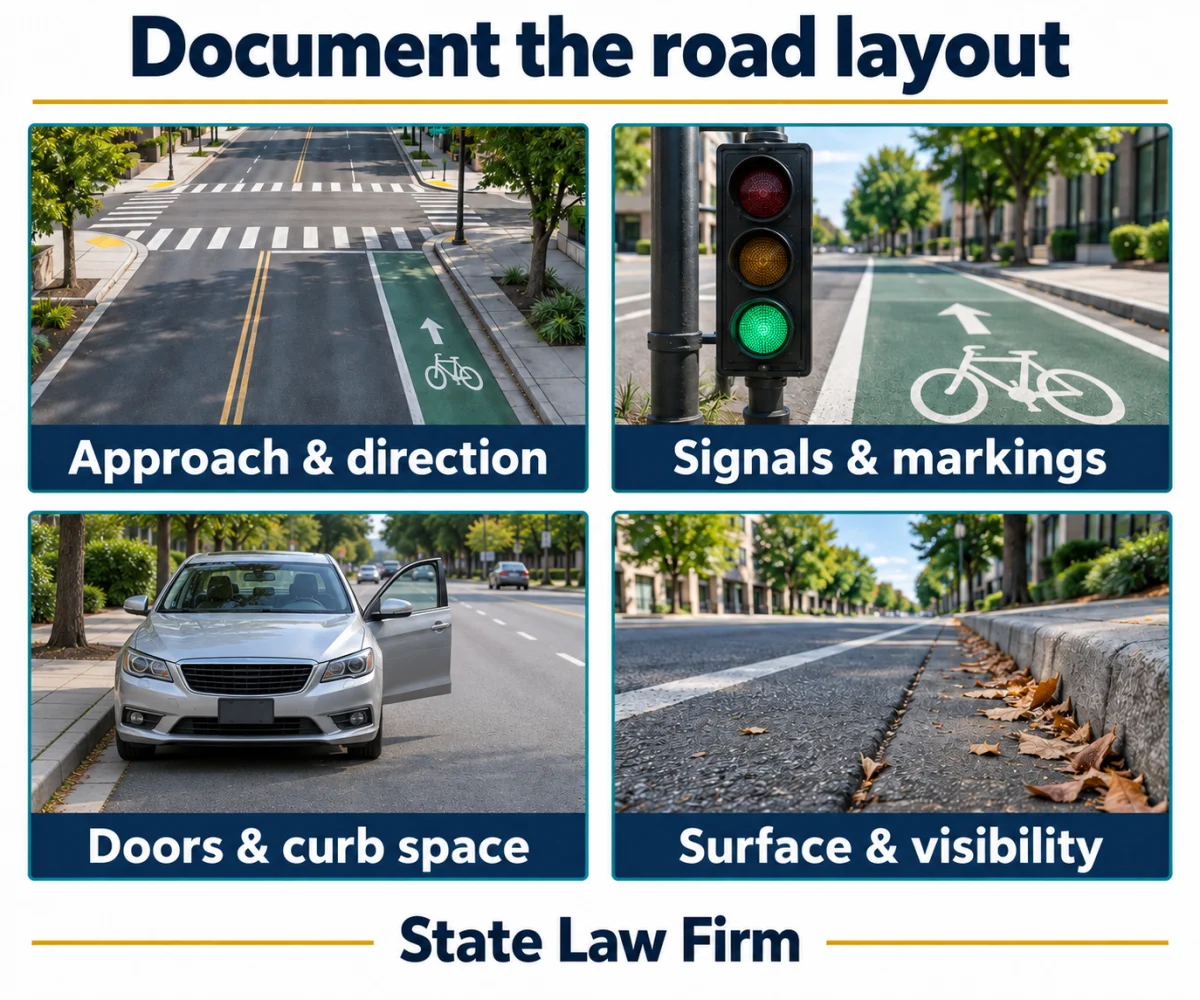
Photograph only when it is safe and lawful. Do not return to moving traffic, reposition vehicles, or recreate a collision to obtain evidence. A sketch can help explain your account if photographs are unavailable; distinguish your recollection from measurements or facts established by other records.
Passing, Lane Position, and Opening Doors
Vehicle Code section 21760 addresses safe passing and three-foot clearance. It also requires a driver overtaking a bicycle in the same lane to move into another available same-direction lane when practicable, safe, and legally permitted. If traffic or roadway conditions prevent compliance, the statute requires slowing and passing only when doing so would not endanger the rider. A bare distance estimate does not resolve every passing dispute.
Riders are not invariably required to hug the curb. Section 21202 addresses slower bicycle traffic and includes exceptions for circumstances such as avoiding hazards, passing, and preparing for turns. Section 21208 separately governs established bicycle lanes, with exceptions and safe-movement requirements. Explain why you were in a particular position; neither a driver’s accusation nor a lane marking alone settles fault.
Section 22517 restricts opening a vehicle door toward moving traffic unless it is reasonably safe and does not interfere with traffic. In a dooring review, the door’s position, timing, surrounding space, and rider’s approach matter. See our California bicycle dooring resource for related background.
Preserve the Ride Record and Equipment
- Video originals: Keep the complete camera file, including footage before and after the event. Do not rely only on a trimmed social-media clip.
- Route and time: Preserve the original ride file from your bike computer or app, along with relevant photographs and messages. Note any known clock or GPS errors rather than changing the original data.
- Bike and gear: Photograph the bicycle, helmet, clothing, lights, and damaged components. Keep purchase and repair records, and discuss inspection or preservation before discarding or altering potential evidence.
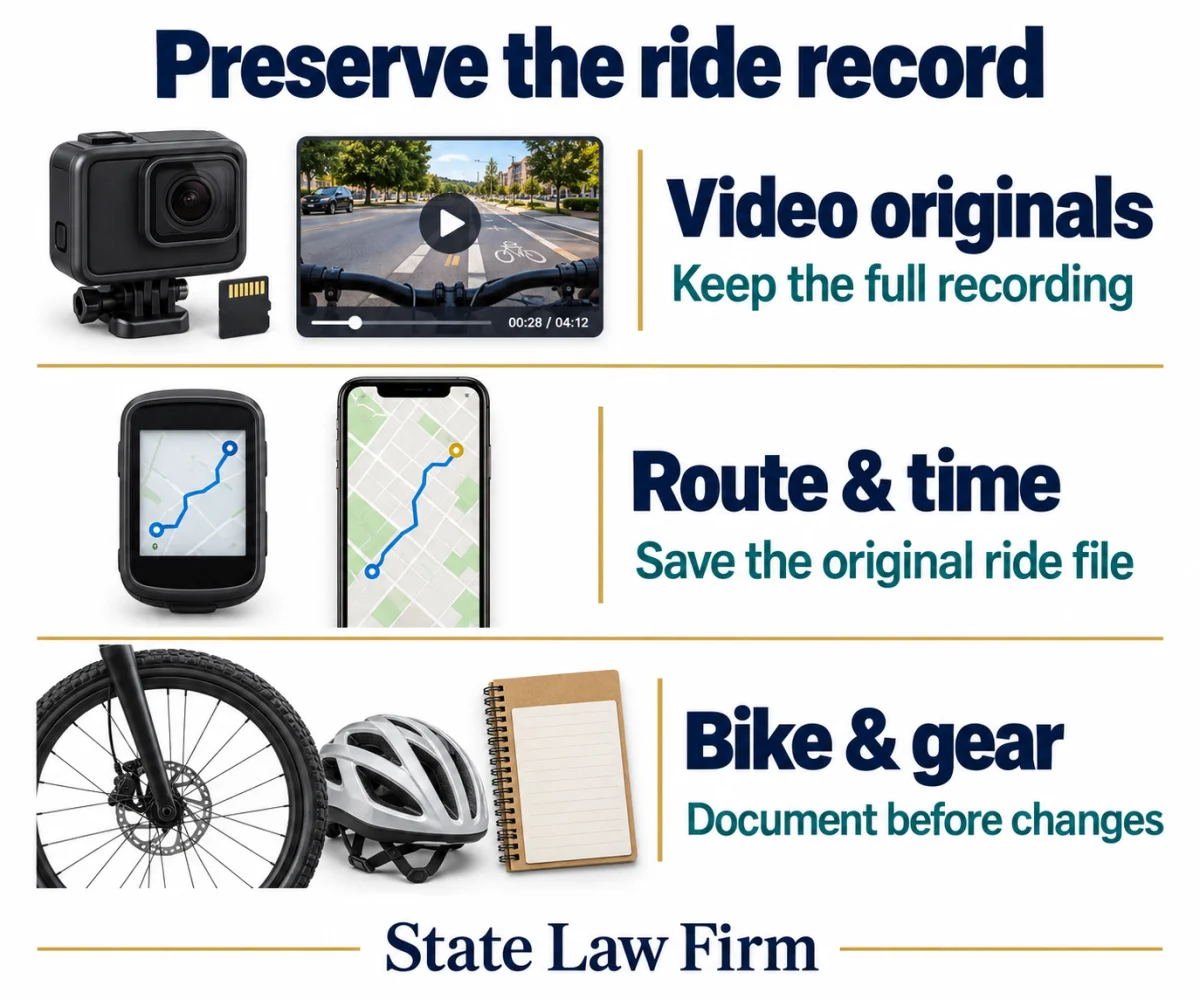
Preserving equipment does not mean continuing to ride a damaged bicycle or reuse impacted protective gear. Tell the team where the items are stored and whether a shop or insurer has inspected them. Ask how to share sensitive ride data securely, especially when it includes home or work locations.
If a shop, residence, bus, or vehicle may have recorded the event, identify the likely camera and location promptly. Availability and retention vary; no particular recording can be guaranteed. Our evidence-preservation resource explains why originals and timely requests matter.
Oakland Police Reports and Street-Hazard Requests
For an emergency, call 911. Otherwise, consult Oakland’s official police-reporting guidance about reporting in person or by phone and the limited incidents eligible for online reporting. Do not assume the online portal accepts every bicycle injury crash; describe the injuries, available evidence, and known parties to the appropriate police contact.
If Oakland Police prepared the report, its Vehicle Collision Reports page provides request options and identifies information needed to locate a report. Keep the report number, date, location, and involved names. Ask about availability and authorization requirements; a report request is different from making the initial report. If another agency investigated, identify that agency rather than assuming Oakland holds the file.
OAK 311 handles infrastructure service requests, including potholes and signal issues. Save the request number if you report a road condition. A maintenance request does not replace a police report, insurance notice, or required government injury claim, and does not by itself establish who was responsible for the condition.
Hit-and-Run, Insurance, and Other Claim Questions
If a driver left, preserve the vehicle description, any plate information, witness contacts, and nearby camera locations. Separate what you saw from later assumptions, and do not pursue the vehicle. Bring police and insurer correspondence to the review. Our hit-and-run bicycle resource provides additional background.
Potential coverage depends on the people, vehicles, policies, and facts involved. Give the team relevant auto or household policy information, even though you were riding a bicycle, and ask whether any coverage may apply. Do not assume uninsured-motorist benefits cover every unidentified-driver event. If an app-based ride, delivery, or work assignment was involved, preserve that status and any trip records too.
When retained, State Law Firm can investigate responsibility, request records, review insurance, communicate with insurers, and evaluate negotiation or litigation. Keep treatment information, bills, receipts, missed-work records, and a factual account of how the injury affects daily activities. The evaluation is based on the evidence, not a promised settlement amount or timetable.
Check Deadlines Before Waiting for Every Record
California’s general personal-injury limitation is two years under Code of Civil Procedure section 335.1. The relevant dates, claim type, and exceptions require a case-specific review. Do not wait for an insurer’s response, completed treatment, or a final collision report before asking which deadlines apply.
If public property or a public entity may be involved, Government Code section 911.2 generally requires an injury-related administrative claim within six months of accrual, with separate lawsuit requirements afterward. A public-road condition also raises statutory issues under section 835. Confirm property control, the correct entity, and applicable procedures rather than assuming the City is liable for every Oakland road incident.
Meet the Attorneys

Eddie Tehrani
Eddie Tehrani founded State Law Firm after working in Los Angeles law offices handling personal injury and civil litigation. Review his background and discuss how the firm would approach your bicycle injury questions.

Arnold Gross
Arnold Gross’s firm biography describes personal injury trial work, along with mediation and arbitration experience. Read his professional background on the firm’s attorney page.
Serving Oakland From Our Sherman Oaks Office
State Law Firm’s main office is at 15490 Ventura Blvd #205, Sherman Oaks, CA 91403. Oakland riders can begin by phone or online and ask about meeting arrangements before traveling. See Locations for office details or contact the team at (877) 659-9223.
For related situations, visit the bicycle accident practice, Oakland car accident, or Oakland rideshare accident pages. If your bicycle was electric, preserve its make, model, class label, and any modifications; our California e-bike guide offers background, but the vehicle’s classification needs its own review.
Frequently Asked Questions
Can I request a consultation before the police report is ready?
Yes. Start with the crash date, exact location, investigating agency, and report number if you have one. The team can discuss missing records, evidence preservation, and time-sensitive questions while the report is pending.
What if I left the bike lane to avoid an obstruction?
Explain the obstruction, your movement, any signal, and surrounding traffic. California’s bicycle-lane rule includes exceptions, but a movement must still be assessed for safety. Photographs and the complete recording may help show why your position changed.
Can a claim be reviewed if no vehicle touched my bicycle?
Yes. Describe what caused the evasive movement or fall and preserve witnesses, footage, and road-condition evidence. Whether another party is legally responsible and whether insurance applies are separate questions; no-contact events need careful factual review.
Should I repair or discard the bicycle right away?
Document its condition and ask promptly about inspection and preservation before changes are made. Keep estimates, replaced parts when feasible, and any insurer instructions. Do not ride damaged equipment while these questions are being addressed.
Does an OAK 311 request count as my injury claim?
Do not rely on it to do so. OAK 311 is a service-request route, not a substitute for required legal claim procedures. Keep the reference number and ask which entity, recipient, and deadline apply.
Is the initial bicycle accident consultation free?
Yes. The initial consultation is free. Ask the team to explain proposed attorney fees, case costs, and any engagement agreement before deciding whether to retain the firm.
Request an Oakland Bicycle Accident Consultation
Tell the team where and when the crash happened, your direction of travel, and what records you have. Start with the information available and ask which evidence or deadlines need attention next.
Request a free consultation or call (877) 659-9223.
This page provides general information, not legal advice. Contacting the firm does not by itself establish an attorney-client relationship. A case-specific review is needed to assess the facts, available claims, and deadlines.