English
  Spanish
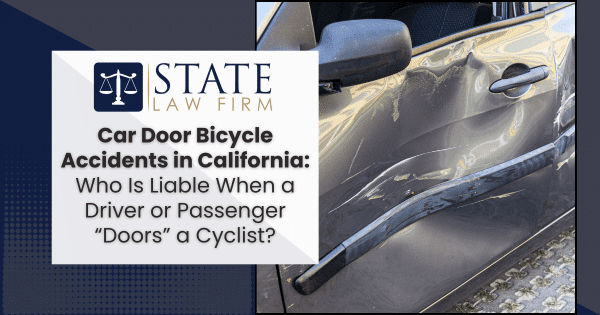
A Suddenly Opened Car Door Can Cause a Serious Bicycle Crash
A car door bicycle accident, commonly called a dooring accident, occurs when a driver or passenger opens a vehicle door into the path of an approaching cyclist. These collisions are especially dangerous on streets where parked vehicles sit beside bicycle lanes or active traffic.
Direct answer: In California, the person who opened the vehicle door may be liable if they failed to confirm that opening it was reasonably safe. California Vehicle Code section 22517 applies to both drivers and passengers. Depending on the circumstances, a driver, vehicle owner, employer, rideshare company, insurer, or public entity may also be involved.
Determining responsibility requires more than identifying who touched the door. The investigation may also examine where the vehicle stopped, what each occupant could see, whether someone gave a warning, and how the cyclist was riding.
What Is a Car Dooring Accident?
A bicycle dooring collision generally involves a vehicle door being opened or left open in a cyclist’s path. The cyclist does not always have to make physical contact with the door. An unsafe opening may also cause a rider to brake, fall, swerve into traffic, or strike another object.
Direct Collisions With an Open Vehicle Door
In a direct collision, the cyclist strikes a door opened into a bicycle lane or travel lane. The impact may throw the rider onto the pavement, over the door, or into nearby traffic.
Crashes Caused by Swerving to Avoid the Door
A no-contact claim may be possible when evidence shows that the unsafe door opening caused the cyclist’s evasive action and resulting injuries. Causation may be established through witness statements, video, bicycle marks, roadway evidence, and medical documentation.
Driver-Side and Passenger-Side Dooring Scenarios
Common scenarios include:
- A driver opening the street-side door after parking.
- A passenger exiting into a bicycle or traffic lane.
- A taxi or rideshare passenger being dropped beside an active bicycle lane.
- An occupant leaving a door open longer than needed to load or unload.
What Does California Law Say About Opening a Car Door Into Traffic?
California Vehicle Code Section 22517
California Vehicle Code section 22517 states that no person may open a vehicle door on the side available to moving traffic unless it is reasonably safe and can be done without interfering with traffic. It also prohibits leaving the door open longer than necessary to load or unload passengers. Because the statute uses the term “no person,” it applies to passengers as well as drivers.
California’s car-door rule in plain English: Before opening a door toward moving traffic, the occupant must check that doing so will not interfere with an approaching cyclist, motorcyclist, driver, or other road user.
The California DMV Driver Handbook similarly instructs occupants to look carefully for passing vehicles, bicycles, and motorcycles before exiting.
How a Statutory Violation Can Support a Negligence Claim
Under California Evidence Code section 669, violating a safety statute may create a rebuttable presumption of negligence when the violation caused the injury, the accident was the type the law was intended to prevent, and the injured person was within the protected class. The cyclist must still prove causation, injuries, and claimed losses. A traffic citation alone does not guarantee civil liability or compensation.
Who May Be Liable for a California Bicycle Dooring Accident?
Depending on the evidence, one or more of the following parties may be responsible.
1. The Driver Who Opened the Door
A driver may be liable for failing to check mirrors or blind spots, opening into a bicycle lane, becoming distracted, or leaving the door open longer than necessary.
2. A Passenger Who Opened the Door
Passengers have their own duty under section 22517. Lack of control over the vehicle does not automatically excuse a passenger who opens a door without checking for approaching traffic. Identifying the passenger and obtaining their contact information can therefore be critical.
3. A Driver Who Failed to Warn or Control the Drop-Off
A driver may have separate responsibility for selecting an unsafe unloading location, encouraging a passenger to exit beside an active bicycle lane, or failing to warn a passenger after seeing an approaching cyclist. Whether that conduct was negligent depends on what the driver knew and could reasonably have done.
4. The Vehicle Owner
Vehicle Code section 17150 can make a vehicle owner responsible for certain negligent acts committed by a person using or operating the vehicle with permission. Whether the statute applies to a particular door-opening incident can depend on who acted, whether that person was operating or using the vehicle, and how the accident occurred.
5. An Employer, Taxi Company, Delivery Company, or Rideshare Business
An employer or principal may be responsible for an employee’s negligence committed within the scope of work or agency business. California Civil Code section 2338 addresses a principal’s responsibility for an agent’s negligence in the transaction of agency business.
For a commercial or rideshare drop-off, responsibility for the individual’s conduct and the availability of commercial or transportation-network-company insurance are separate questions. The trip status, driver’s conduct, passenger’s conduct, and applicable policies must be reviewed. State Law Firm’s Los Angeles rideshare accident resource discusses the additional parties and insurance questions that may arise in these cases.
6. A Public Entity or Public Employee
Special procedures may apply when the vehicle belongs to a city, county, transit agency, school district, or other public entity, or when a public employee was acting within the scope of employment. These claims can require an administrative claim before a lawsuit is filed.
Can the Cyclist Be Found Partly Responsible?
California’s Comparative-Fault Rule
California follows pure comparative fault. Responsibility can be divided among the cyclist, driver, passenger, and other parties, and the cyclist’s recovery may be reduced by their assigned percentage of fault. Partial fault does not necessarily eliminate the claim.
For illustration, if proven losses were $100,000 and the cyclist were assigned 20 percent of the fault, the recovery before other legal or insurance adjustments would be reduced to $80,000. This is only an example, not a prediction of any case result.
Conduct Insurers May Examine
Insurers may investigate whether the cyclist was:
- Traveling against traffic.
- Riding without legally required nighttime lighting.
- Moving too fast for visibility or traffic conditions.
- Distracted or impaired.
- Disregarding a signal or another applicable traffic rule.
California requires roadway cyclists to travel in the same direction as vehicles and imposes lighting and reflector requirements for nighttime riding.
Riding Outside the Door Zone Is Not Automatically Improper
Vehicle Code section 21202 permits cyclists to move away from the right edge when reasonably necessary to avoid unsafe conditions, including vehicles and fixed or moving hazards. Cyclists generally have the roadway rights and responsibilities applicable to drivers under Vehicle Code section 21200.
The DMV also recommends riding far enough from parked vehicles to avoid opening doors. That safety guidance may be relevant, but it does not automatically establish cyclist fault.
What Evidence Helps Prove Who Opened the Door and Why the Crash Happened?
When a driver and passenger dispute who opened the door, photographs and independent records can become especially important.
Dooring accident evidence checklist:
- The vehicle, license plate, open door, and bicycle’s final position.
- Bicycle-lane markings, parking layout, sight lines, and traffic conditions.
- Contact and insurance information for the driver, passenger, and vehicle owner.
- Names and contact information for witnesses.
- Visible injuries and damage to the bicycle, helmet, clothing, phone, or equipment.
- Nearby dashcam, residential, business, bus, taxi, or rideshare video.
- Police reports, 911 recordings, body-camera footage, and app trip records.
- Medical records, wage-loss documents, repair estimates, and a recovery log.
Surveillance footage and commercial trip records may be deleted under routine retention practices. Prompt preservation requests can reduce the risk that important evidence disappears.
For additional guidance when the responsible person cannot be identified, see State Law Firm’s resource on hit-and-run bicycle accidents in California.
What Compensation May Be Available After a Dooring Accident?
Compensation depends on the injuries, supporting evidence, responsible parties, insurance, comparative fault, and other case-specific circumstances.
| Loss category | Examples |
| Medical and rehabilitation expenses | Emergency care, hospitalization, medication, physical therapy, and reasonably necessary future treatment |
| Lost income and earning capacity | Missed work, reduced hours, documented self-employment losses, and supported future work limitations |
| Property damage | Bicycle repair or replacement, helmet, clothing, phone, and cycling equipment |
| Non-economic harm | Physical pain, emotional distress, scarring, disability, sleep disruption, and loss of normal activities |
Potential payment sources may include vehicle liability insurance, employer or commercial insurance, taxi or rideshare coverage, and applicable health or medical-payment benefits. Uninsured or underinsured motorist coverage may also require review. Insurance Code section 11580.2 contains detailed requirements and exclusions, so coverage should not be assumed without examining the policy and accident facts.
What Should a Cyclist Do After Being Doored?
1. Move to Safety and Request Medical Assistance
Call 911 for serious injuries or unsafe roadway conditions. Avoid unnecessary movement when a head, neck, or spinal injury may be involved, and obtain an appropriate medical evaluation.
2. Identify Both the Driver and Every Passenger
Do not collect only the driver’s information when a passenger opened the door. Record each occupant’s name, contact details, insurance information, and relationship to the vehicle.
3. Document the Vehicle, Door, Roadway, and Bicycle
When it is safe, photograph the scene before the door, bicycle, vehicle, or debris is moved.
4. Avoid Recorded Statements or Premature Settlements
Do not speculate about fault or minimize symptoms. An early settlement proposal may arrive before the medical and financial effects of the injury are understood.
5. Preserve the Bicycle and Damaged Equipment
Do not repair, alter, or discard the bicycle, helmet, clothing, or other relevant items until they have been photographed and, where appropriate, inspected.
How Long Does a Cyclist Have to File a Claim in California?
The General Personal Injury Deadline
California Code of Civil Procedure section 335.1 generally provides two years for an action involving personal injury caused by another person’s wrongful act or neglect. Different deadlines or accrual rules may apply depending on the parties and circumstances.
Claims Involving Government Vehicles or Public Employees
For qualifying personal-injury claims against a public entity, Government Code section 911.2 generally requires presentation of an administrative claim within six months after accrual. Presenting a government claim is not the same as filing a lawsuit. Government Code sections 945.4 and 950.2 can also affect claims against public entities and employees.
Do not calculate a filing deadline from this article alone. Waiting can also result in lost video, unavailable witnesses, repaired property, and disputes over when symptoms began.
Frequently Asked Questions About California Car Door Bicycle Accidents
Is the Driver Liable If a Passenger Opened the Door?
Possibly, but not automatically. The passenger may be directly responsible for opening the door. The driver may share fault for selecting an unsafe drop-off location, instructing the passenger to exit, or failing to warn the passenger after observing an approaching cyclist.
Can I Bring a Claim If I Swerved but Never Hit the Door?
Potentially. Physical contact is not always required if evidence demonstrates that the unsafe door opening caused the cyclist to brake, fall, enter traffic, strike another object, or suffer another injury-producing event.
Does It Matter Whether I Was in a Bicycle Lane?
A bicycle lane can provide important evidence about where the cyclist was expected to travel and whether the door obstructed that path. Liability does not depend solely on whether the rider was inside a marked lane, however. The entire roadway configuration and each person’s conduct matter.
Can a Passenger Be Personally Liable?
Yes, potentially. Vehicle Code section 22517 applies to any person who opens a door on the side available to moving traffic. A passenger may therefore be responsible when an unsafe door opening causes a cyclist’s injuries.
What If the Driver or Passenger Left the Scene?
Preserve the license plate, vehicle description, witness information, photographs, video, police records, and insurance information immediately. Recovery options will depend on whether the responsible person and vehicle can be identified and whether liability, commercial, uninsured-motorist, or other coverage applies.
Injured After Being Doored? Protect the Evidence and Learn Who May Be Responsible
A dooring claim may require identifying the person who opened the door, the vehicle owner, the driver’s conduct, employment or rideshare relationships, applicable insurance, and any comparative fault allegations.
Preserve the bicycle, helmet, photographs, witness details, medical records, and available video. State Law Firm’s Sherman Oaks bicycle accident lawyers assist injured cyclists with liability, evidence, insurance, and filing-deadline questions. The firm’s main office is in Sherman Oaks and it offers free consultations.
Contact State Law Firm at (877) 659-9223 for a free consultation about a California bicycle dooring accident. A case evaluation can address the responsible parties, available insurance, documented injuries, and applicable deadlines.