English
 Spanish

State Law Firm | Serving Redondo Beach, California
Redondo Beach Uber and Lyft Accident Lawyer
A Redondo Beach rideshare claim may depend on what the app showed before the collision, who was in the vehicle and where pickup or drop-off occurred. State Law Firm reviews those details with the collision evidence and available insurance.
Free initial consultation
California injury representation
Evidence and next-step review
Sherman Oaks office
Save the ride receipt, trip history, messages and exact pickup or drop-off location. App status helps identify potentially relevant coverage, but it does not decide who caused the crash or guarantee a payment.
Reviewing an Uber or Lyft Collision in Redondo Beach
A rideshare collision may affect a passenger, the app-based driver, someone in another vehicle, or a person walking or cycling nearby. Each role can raise different coverage and evidence questions. State Law Firm reviews the incident and available records without assuming that an app company’s involvement establishes fault or guarantees compensation.
For a pickup near the waterfront, a trip along Pacific Coast Highway or a collision around Aviation Boulevard, identify the actual address, curb and direction of travel. Save the pickup pin and the place where you actually entered or left the vehicle; they may differ. A driver’s app status can also change between accepting a request, arriving and completing a trip.
Save the App Timeline and the Collision Record
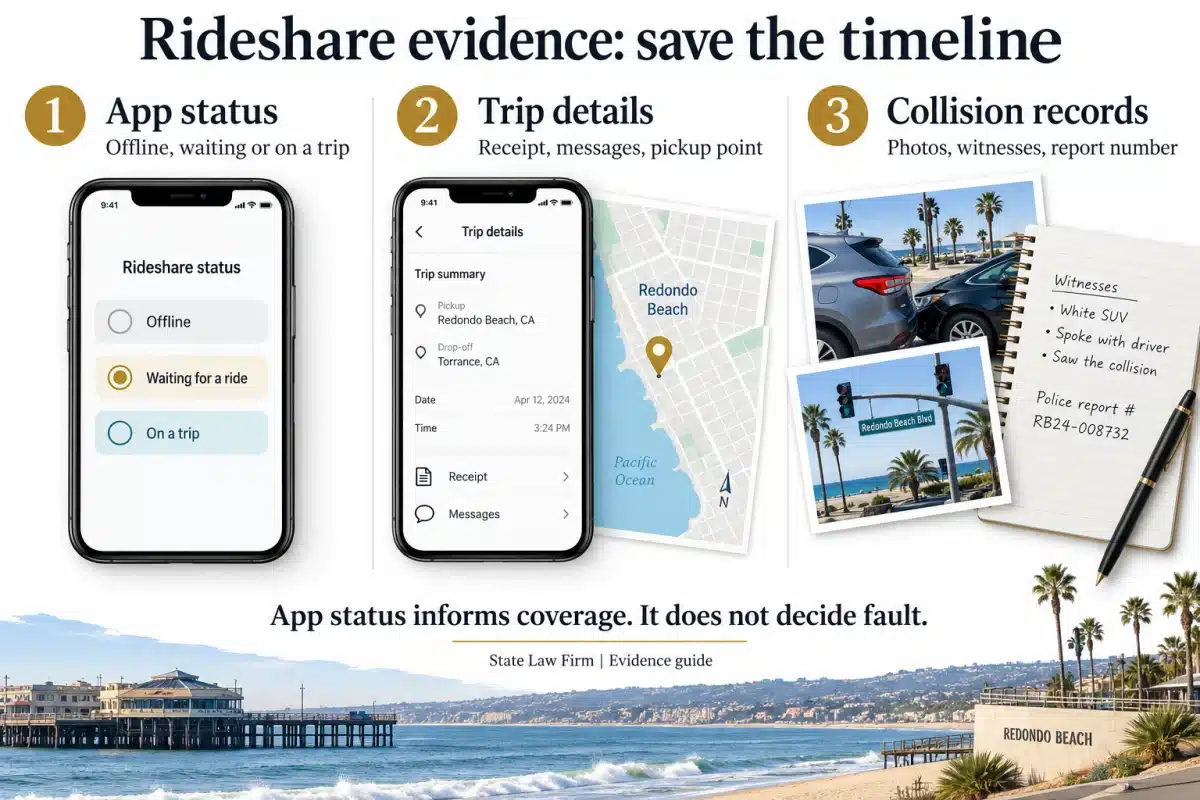
- App status: whether the driver was offline, available for requests, traveling to a pickup or transporting a passenger, if known.
- Trip details: the receipt, trip ID, pickup and drop-off locations, driver and vehicle details, timestamps and relevant messages.
- Collision records: original photographs, witness information, report number, vehicle damage and dated communications with insurers or the platform.
Take screenshots of information available in your own account and retain original emails and downloaded receipts. Do not alter messages or access another person’s account. If the app record differs from your recollection, keep both and explain the difference. You may not be able to see the driver’s complete activity; a legal review can identify what additional records should be sought.
At a curbside pickup, note whether the vehicle was stopped, moving, turning or pulling away, and where doors and passengers were positioned. Those details can matter independently of trip status. The firm’s rideshare incident guide provides additional steps for organizing the initial information.
Why Ride Status Matters to Insurance
The California Public Utilities Commission’s TNC insurance requirements distinguish the period when a driver is logged on and waiting from the accepted-trip and passenger-transport periods. The requirements differ by period. Offline driving generally raises personal-policy questions rather than an assumption that the rideshare company’s coverage applies.
Preserve the policy and claim information for every insurer involved. Coverage still depends on the incident date, applicable policy, trip status and facts. A liability limit is not a promised settlement, and liability coverage, uninsured or underinsured motorist coverage, collision benefits and driver injury protection are not interchangeable. Ask for the relevant policy terms and explanations instead of relying on a general online dollar amount.
App status does not decide who caused the collision. Responsibility may involve a driver, another motorist, a vehicle owner, an employer or another party where supported by the facts and law. Keep the fault investigation separate from the question of which policy may respond.
Redondo Beach Collision Reports and Video
The Redondo Beach Police records-request form lists traffic-collision reports and other record categories. It explains that release is reviewed and may not be immediate. Follow the Records Unit’s current instructions for identification, eligibility and fees, and keep the incident number and request receipt.
Reporting an accident to Uber or Lyft is separate from requesting the police report, opening an insurance claim or meeting any applicable DMV reporting requirement. If another agency investigated, start with that agency. Video requests also need the location and time window; neither a police report nor an app report automatically preserves nearby private footage.
Treatment, Work and Insurance Communications
Keep treatment records, medical bills, work restrictions, missed-income documentation and out-of-pocket receipts. Describe symptoms and prior relevant conditions accurately to your healthcare providers. If you were driving for work or using more than one app, tell the attorney rather than assuming one claims process addresses everything.
Save each insurer’s letters and messages under the correct claim number. Your own policies may contain notice and cooperation requirements; do not ignore them. Ask about the scope of a recorded statement, authorization or release when you do not understand it. A settlement review should address what claims would be resolved and any reimbursement obligations.
Recoverable losses depend on the evidence and law, not a rideshare multiplier or an online average. The medical-bill resource explains why treatment payments, insurance claims and later reimbursement questions may follow separate timelines.
Working With State Law Firm
Founder Eddie Tehrani is listed by the State Bar as Itamar B. Tehrani, also known as Eddie Tehrani, California Bar No. 303165. Review the attorney team’s backgrounds and his State Bar record before choosing representation. The firm’s main office is at 15490 Ventura Boulevard, Suite 205, Sherman Oaks, CA 91403. Serving your city does not imply a separate office there; confirm meeting arrangements through Locations or Contact.
The initial consultation is free. Bring the incident date and location, the people or businesses involved, records you already have and any approaching deadline. The team can identify missing information and whether further review is appropriate. You do not need a finished report or complete medical file before making an inquiry.
State Law Firm handles personal-injury matters on a contingency-fee basis. Attorney fees depend on a recovery and the written agreement; case expenses are a separate issue. Before signing, ask how fees are calculated, how expenses are paid and what obligations apply if there is no recovery. Neither a free consultation nor contacting the firm guarantees representation or a result.
Filing deadlines depend on the claim and the parties. Government claims can have much shorter initial requirements, and exceptions may affect other deadlines. Ask for a case-specific review rather than relying on an insurer’s timeline. The California Courts personal-injury guide provides general information, not a calculation for your case.
Frequently Asked Questions
Can I request a consultation if I was not the rideshare passenger?
Yes. Drivers, people in other vehicles, pedestrians and cyclists can ask for a review. Explain your role and what is known about the app-based vehicle; the available claims and coverage will depend on the facts.
What if the trip ended just before the collision?
Save the completion time, messages and any pickup or drop-off photographs. Timing can affect the coverage analysis, but an app timestamp alone may not answer every factual or policy question.
Does making a report in the app preserve every record?
No. Keep your own available receipts and messages, and ask promptly about other evidence. Platform reporting is separate from police, insurer and legal preservation processes.
Is a large insurance limit the value of my claim?
No. A limit describes potential coverage subject to policy terms. Claim value and payment depend on liability, documented losses, applicable law and the coverage that actually applies.
Request a Free Initial Consultation
Use the consultation form or call (877) 659-9223 to discuss the incident and next steps. Keep the initial message brief and ask how to send sensitive documents securely.
This page provides general information, not legal advice. An inquiry does not itself create an attorney-client relationship. Every matter depends on its own facts, evidence and applicable law; no outcome is guaranteed.