Spanish
 English

A rideshare crash in Redondo Beach can feel like a normal car accident at first glance, but the claim often becomes more complicated the moment an app based driver is involved. Liability can shift depending on what the driver was doing in the minutes before impact, which insurance policy applies, and whether additional parties caused or contributed to the collision.
If you were hurt while riding in an Uber or Lyft, driving your own vehicle, crossing the street, biking, or even stepping toward a curbside pickup, you want two things right away: medical care that documents your injuries and a plan that protects your right to recover money for what this crash costs you. For help with a rideshare injury claim that reaches Redondo Beach and the South Bay, start here: Abogados de Los Ángeles especializados en accidentes de transporte compartido.
This guide explains how Uber and Lyft accident claims are evaluated, what steps protect you in the first hours and days, and how an attorney can build the kind of evidence insurers cannot easily dismiss. When you are ready to talk, you can request help through consulta gratuita with State Law Firm.
Understanding Uber and Lyft accident claims in Redondo Beach
A rideshare accident is typically defined by one key fact: a vehicle providing ridesharing service is involved, and the event may include the rideshare driver, other motorists, pedestrians, or bicyclists. That single detail can add layers to the claim because determining who is responsible can involve multiple parties and multiple insurance policies.
One of the biggest practical issues is timing. Rideshare liability often depends on whether the driver was considered on duty or off duty in the app context at the time of the crash. That timing can influence whether the claim is handled primarily under a personal auto policy, a rideshare policy, or both.
Even when the rideshare driver did not cause the collision, the rideshare insurance layer can still matter. For example, State Law Firm notes that when a passenger is injured and the at fault driver is uninsured or underinsured, the passenger may still turn to Uber or Lyft for coverage through uninsured and underinsured motorist insurance.
Because these cases are built on details most people do not think to collect at the scene, the safest approach is to treat any rideshare crash as evidence first: photos, witnesses, the app timeline, and prompt reporting. If you want a focused overview of rideshare claims, see accidentes de viajes compartidos y accidentes automovilísticos.
If you are specifically looking for pages tailored to Uber or Lyft collisions, you can also review Accidente de Uber y Accidente de Lyft, then compare how your situation fits the scenarios described.
Who is responsible when a rideshare crash happens
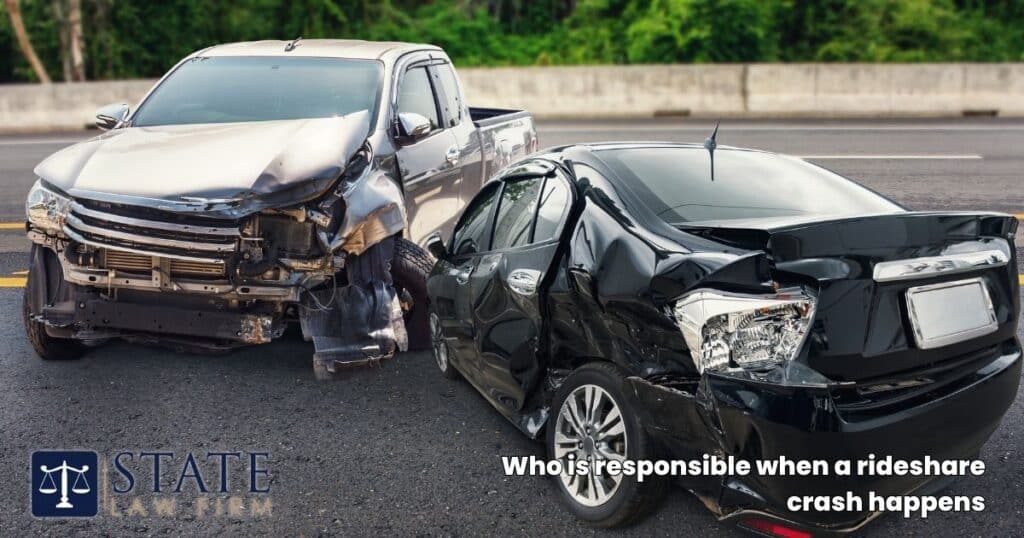
Most rideshare injury cases still come down to basic negligence principles. To recover compensation, the claim usually needs to show duty of care, breach of duty, causation, and damages. State Law Firm describes these core elements and gives examples such as running a red light, texting while driving, or failing to yield as behaviors that can establish breach.
In rideshare collisions around Redondo Beach, responsibility commonly falls into one or more of these buckets: the rideshare driver, another driver, a vehicle owner who created risk by lending a car to an unsafe driver, an employer whose employee caused a crash while working, or a third party whose conduct or failure created the dangerous condition that led to impact. The most important takeaway is that liability can be shared even when the crash feels straightforward.
Vehicle ownership can matter because insurance often follows the car. State Law Firm explains that the registered owner is commonly the first line of responsibility and that most auto insurance policies follow the vehicle rather than the driver. If someone else was driving a borrowed car, this becomes a major angle to evaluate early. For a deeper look, read responsabilidad civil ante terceros.
Work related driving can change the claim. If an employee causes an accident while acting within the scope of employment, the employer may be held liable under vicarious liability, which assigns responsibility to one party for the actions of another in that employment context. If your crash involved a driver on the clock or if you were injured while working, review responsabilidad indirecta y accidentes automovilísticos en el trabajo.
If you were hurt while working and the facts allow both a workers compensation claim and a third party personal injury claim, it matters because the benefits and recoverable damages can differ. State Law Firm explains that workers compensation is generally a no fault system, while personal injury claims require proof that a third party was negligent, and workers compensation does not typically include pain and suffering damages. To explore that crossover, see California workers compensation lawyers.
When multiple vehicles are involved, the claim can turn into a sequence question: who caused who to hit who. If your crash chain involved more than two cars, review opciones legales en caso de accidentes con varios vehículos alongside the core framework in negligencia automotriz.
Insurance coverage and liability disputes

Rideshare claims often become insurance disputes fast because insurance carriers may argue about fault percentages, the level of coverage available, and whether a specific policy applies based on the driver’s app status. State Law Firm notes that rideshare liability can depend on whether the driver was on duty or off duty, and that liability might fall on the rideshare company, the driver, or other negligent parties.
A common frustration is the mismatch between what you know happened and what an insurance company is willing to accept without being forced to by evidence. State Law Firm describes the claims adjuster’s role as investigating and valuing the claim in a way that favors the insurance company’s interests, and emphasizes that the adjuster’s goal is often to resolve the claim quickly and for as little money as possible. This dynamic is why early statements and missing documentation can cost real dollars. To understand these tactics, read El papel de las compañías de seguros en los casos de lesiones personales.
Liability splits are another pressure point. Insurers may push a shared fault narrative, including 50/50 arguments, because every percentage point assigned to you reduces what they pay. State Law Firm explains that under California’s pure comparative negligence rule, you can still recover damages even if you are partially at fault, but your compensation is reduced by the percentage of fault assigned to you. If you are facing a shared fault fight, review Cómo luchar contra una reclamación de seguro 50/50.
Evidence is the lever that moves those percentages. In its guidance on disputing 50/50 findings, State Law Firm highlights police reports, witness statements, accident scene photos, and vehicle damage documentation as core tools for shifting liability in your favor. That advice matters in rideshare claims because there may be multiple insurers watching for an excuse to deny or reduce responsibility.
Coverage limits can be significant during certain ride phases. For example, State Law Firm states that when an Uber driver accepts a ride request through the app and is actively transporting a passenger, Uber provides insurance coverage and its policy limit is up to $1 million during that period, along with coverage that can apply in uninsured or underinsured motorist situations and contingent collision coverage in certain circumstances. While the exact coverage analysis still depends on the case facts, this is why your claim should document app status, trip acceptance time, and when the passenger was picked up or dropped off. For more on this topic, see Uber crash lawyer Encino.
If your rideshare accident happened in the South Bay and you also need guidance on the broader auto claim side, you can compare the local context with Torrance car accident lawyer.
What to do right after an Uber or Lyft collision
What you do in the first hour affects both your health and the strength of your claim. State Law Firm’s rideshare accident guidance emphasizes four immediate priorities: call the police, document the crash with photos and witness information, get medical treatment even if you feel fine, and speak with an attorney. That sequence protects you because it creates an official record, preserves scene detail, and connects injuries to the collision before insurers can claim something else caused them. Start with what to do after an Uber or Lyft accident.
Police reporting has deadlines that people miss when they are overwhelmed. State Law Firm explains that under California Vehicle Code section 20008, drivers involved in an accident resulting in injury or death must report the incident to law enforcement within 24 hours. The same guide recommends reporting when property damage exceeds $1,000 and notes that a DMV Form SR 1 is also needed in that situation. For step by step guidance, see filing a police report after an accident.
The DMV reporting requirement is separate from the police report. State Law Firm explains that the SR 1 is the Report of Traffic Accident Occurring in California and that you must file within 10 days if anyone is injured, anyone dies, or property damage to any one person exceeds $1,000. The same page stresses that filing is required even if an officer took a report and even if you already opened an insurance claim. That requirement is easy to overlook after a rideshare crash because people assume the app company or insurer handles it. If you want a clean checklist, use SR 1 form guide.
If you need the official report for your insurance claim or your injury case, State Law Firm offers detailed guidance on how to request it and what timelines to expect. It also notes that promptness matters because the statute of limitations for personal injury claims in California is typically two years from the date of the accident, so starting early helps preserve evidence and witness recollection. Use Cómo obtener un informe de accidente en California y California statute of limitations for personal injury.
If the California Highway Patrol investigated the crash, your attorney or insurance carrier may rely heavily on that CHP report. State Law Firm explains that you can obtain it by submitting the CHP 190 Application for Release of Information, and that the request generally requires you to qualify as a party of interest. Their guide walks through what to submit, including a completed form, identification, and payment. Refer to CHP 190 form when you need to retrieve that record.
Video turns disagreements into proof. If the crash happened near an intersection with cameras or close to a business with security footage, State Law Firm recommends acting quickly and gathering the exact date and time, precise location, vehicle details, and the police report number to support your request. Their guide also identifies who you may need to contact, including local law enforcement, municipal traffic management centers, Caltrans for highway footage, and private businesses. When footage exists, it can anchor fault determinations and undercut shifting stories. See obtener imágenes de cámaras de tráfico.
Digital evidence can matter just as much as video. State Law Firm discusses how text messages can become evidence, which is relevant in rideshare cases where messages can confirm pickup timing, route, and what was communicated before or after impact. If you suspect phone use, a rushed pickup, or distracted driving played a role, preserve what you have and speak with counsel before handing material to an insurer. Review text messages as court evidence.
If you drive frequently in the South Bay, especially around rideshare pickup zones, a dashcam can create the clearest version of the story. For practical guidance on that tool, see Las mejores cámaras para salpicadero para la seguridad en accidentes de coche.
What compensation can include

The value of an Uber or Lyft injury claim is usually built from two categories: economic damages and non economic damages. Economic damages can include medical expenses and lost wages. Non economic damages can include pain, suffering, and the impact the injury has on your daily life. State Law Firm’s rideshare accident page lists common compensation categories, including medical expenses and lost wages, and emphasizes that the details of your injuries and evidence shape the outcome.
Medical costs often become the most stressful part of the aftermath because bills arrive long before a settlement does. State Law Firm explains that post crash billing is a coordination puzzle, where health insurance or MedPay may pay first, liens can accrue, and the at fault insurer often pays only at the end. A well handled claim tracks every bill, keeps benefit paperwork organized, and plans for lien resolution so your net recovery does not get eaten by surprises. For a deeper breakdown, see who pays medical bills after a car accident.
Pain and suffering is real, and it is also one of the most often disputed categories because it is not a line item invoice. State Law Firm describes two common approaches used in California cases: the multiplier method, where economic damages are multiplied by a number often between 1.5 and 5 depending on severity, and the per diem method, where a daily rate is assigned for the period of suffering. Those frameworks are not a guarantee of results, but they provide a useful way to understand how claims get valued in negotiation. Review Estimar el dolor y el sufrimiento en California.
Many rideshare crashes also cause emotional harm, especially when the collision is violent or when symptoms linger and driving becomes stressful. State Law Firm explains that emotional distress damages can be pursued under different legal theories, including IIED and NIED, and offers a practical distinction: IIED involves outrageous conduct done on purpose or with reckless disregard that causes severe distress, while NIED involves negligence that causes serious distress and typically fits either a direct victim pathway or a bystander pathway. If your recovery includes anxiety, panic, sleep disruption, or trauma responses, discuss it early so the evidence matches the lived reality. See IIED vs NIED in California y emotional distress claims after a car accident.
Traumatic brain injuries are another category that can be overlooked because symptoms do not always appear immediately. State Law Firm notes that TBI symptoms can vary and that some develop days or weeks later. Their checklist includes physical symptoms like persistent headaches and dizziness, cognitive symptoms like memory problems and difficulty concentrating, and emotional or behavioral changes like mood swings and anxiety. If you notice these issues after a rideshare crash, get medical attention and document the timeline. Review derechos legales por lesiones cerebrales traumáticas.
Property damage is not just about repair bills. If your vehicle was damaged and later loses resale value because the accident appears in history reports, a diminished value claim may apply. State Law Firm explains multiple types of diminished value, including inherent diminished value, which refers to a loss in resale value due to accident history even if repairs are perfect. If you are pursuing this category, it often involves repair documentation, photos, and a structured demand. Review diminished value claims after an accident.
If your loved one died as a result of an Uber or Lyft collision, the claim may shift into a wrongful death case with its own damages and deadlines. For that path, see Abogados de muerte por negligencia en Los Ángeles.
How legal representation can change the outcome
The earliest advantage of counsel in a rideshare case is controlling the record. That means preserving evidence, managing insurer communications, and preventing unintentional statements that later get used to reduce or deny the claim. State Law Firm’s rideshare accident guide recommends consulting a lawyer and specifically cautions against providing an accident statement to an insurance company over the phone without consulting an attorney, because insurance representatives may ask leading questions to weaken a claim.
The next leverage point is the demand package. State Law Firm explains that a personal injury demand letter typically includes a description of how the injury occurred, a breakdown of damages such as medical bills, lost wages, and pain and suffering, supporting evidence, and a specific dollar amount demanded. When done correctly, the demand letter shapes the narrative and can drive early negotiations from a position of strength. For context, see Guía para cartas de demanda por lesiones personales.
If a fair agreement is not reached, the case may move toward litigation, but that does not always mean trial. State Law Firm explains that filing a lawsuit means presenting the case in court for a judge or jury, while settling out of court means the parties negotiate a mutually acceptable amount of compensation without trial, which can happen at any point during the process. Their guide also lists benefits of settlement such as faster resolution and more control, while acknowledging litigation can be lengthy and uncertain. Review lawsuit vs settling out of court.
Deadlines are not flexible, and missing them can end a valid case. State Law Firm’s statute of limitations guide states that general personal injury claims, including car accidents, are subject to a two year deadline from the date of injury, and also highlights that claims against a government entity may require an administrative claim within six months, with an additional six months to file in court after denial. If your rideshare crash involved public property, a government vehicle, or roadway issues tied to a public entity, that shorter window can become critical. See statute of limitations for personal injury claims in California.
For many injured people, cost is the reason they hesitate to call. State Law Firm describes contingency fee representation as a common structure in personal injury, meaning you pay nothing upfront and the lawyer gets paid if compensation is recovered. State Law Firm also states in its Uber and Lyft accident guidance that there are no fees until you win, which is designed to let injured people pursue a strong case without adding financial strain during recovery. You can start here: consulta gratuita.
If you want to learn more about the team and how the firm approaches injury cases, explore sobre nosotros, abogados, testimonios, y estudios de caso. If you have immediate questions about the process, you can also scan Preguntas frecuentes.
Important note: This page is for general information. Every Uber or Lyft accident case is fact specific, and outcomes depend on liability evidence, injury documentation, and the insurance coverage available. If you were injured in Redondo Beach, getting advice early can help you avoid mistakes that are hard to fix later. Begin with Abogados de Los Ángeles especializados en accidentes de transporte compartido or request a case review through consulta gratuita.