Spanish
  English
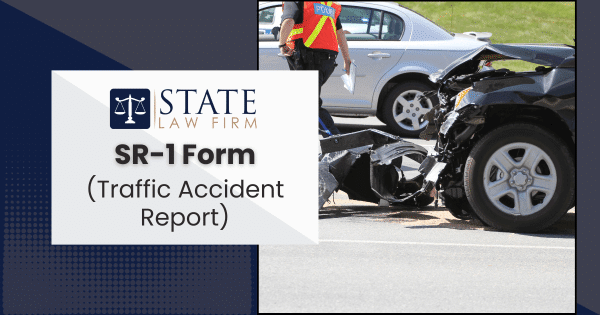
In California, file an SR-1 with the DMV within 10 days after a reportable crash involving any injury, a death, or more than $1,000 in damage to the property of any one person. This is a separate filing, even if police responded, an insurer opened a claim, or another driver caused the crash.
Use the official California DMV SR-1 filing page to start online or obtain the current English or Spanish PDF. This article explains how the filing fits into your post-crash responsibilities. State Law Firm is not the DMV, and filing an SR-1 does not itself start a personal injury claim.
What the SR-1 Is and When It’s Required
The SR-1 is the DMV’s Report of Traffic Accident Occurring in California. It documents a qualifying collision and provides insurance information. The reporting threshold is set by California Vehicle Code §16000, not by who caused the crash.
You must file within 10 days if any of the following occurred:
- Any person was injured, even a minor injury.
- Any person died.
- Property damage to any one person was more than $1,000.
A police report or insurance claim does not replace the SR-1. Many private-property crashes are reportable, including qualifying parking-lot collisions. There are exceptions: the current DMV instructions exclude an accident on the driver’s own property involving only that driver’s personal property, with no injury or death. They also identify certain nonregistered-vehicle and military-base exceptions. Read the current form instructions if one of these situations applies.
Who Must File and the 10-Day Deadline
California law puts the duty on each driver who was involved. A representative may file for you, but you remain responsible for making sure the DMV receives a complete report.
Use this quick reference:
| Topic | Rule | Notas |
|---|---|---|
| Who files | Each driver involved | An insurance agent, broker, legal representative, or other designated representative may submit it for you. |
| When | Within 10 calendar days of the crash | Do not wait for an insurer’s fault decision or for every repair to be completed. |
| Where it applies | Any reportable crash in California | Includes many crashes on private property and certain off-highway crashes that meet statutory criteria. |
| Passengers | Usually do not file | The DMV form also provides instructions for a passenger reporting an accident; identify that role accurately. |
If information about the other party is unavailable, follow the current form’s instructions for indicating that. Do not invent a license number, insurer, or injury status. Make the deadline a priority and contact DMV promptly if missing information prevents you from completing the submission.
How to Complete the SR-1 Form (Step-by-Step)
Before you start, gather:
- Your DL/ID number, date of birth, and current address.
- Your vehicle year, make, license plate or VIN.
- Your auto insurance company name, policy number, policy period, and NAIC number.
- The other party’s vehicle and insurance information if available.
- Basic crash facts: date, time, location, number of vehicles, and whether injuries or damage over $1,000 occurred.
- Names and addresses of injured persons and owners of other damaged property. Keep witness details separately for your claim.
Now complete the form:
- Reporting Party and Accident Facts
Enter the date, time, and California city or county. Check the box for “on private property” if applicable. Indicate the vehicle’s status at impact. Accuracy on these basics avoids DMV follow-up. - Driver & Vehicle Details
Provide your legal name, DL number and state, complete mailing address, and phone. List the vehicle year and make, and either the license plate or full VIN. If you were driving for an employer, identify that. If you were not the owner, fill in the registered owner’s information as well. - Insurance & Financial Responsibility
List the insurance company name exactly as it appears on the ID card, not the agent or broker. Include the policy number, policy period, and the carrier’s NAIC code. If you were uninsured, be prepared for a DMV suspension unless a legal alternative form of financial responsibility applied. - Other Party Information
If known, provide the opposing driver’s name, DL number, address, vehicle details, and insurance information. For missing other-party information, follow the form’s instructions. Distinguish information you do not know from a fact you know is absent; do not report someone as uninsured simply because you have not obtained their policy details. - Injuries and Property Damage
Identify anyone who was injured or killed and list the owner of any damaged property other than vehicles. Check the “damages over $1,000” box where appropriate. If you damaged fixed objects like a fence or pole, include the owner’s name and address if you can obtain it. - Review & Sign
Read the perjury statement. Review legibility and completeness. Attach extra sheets if you need to list more parties or details. Sign and date.
Practical tips:
- Use the insurer’s exact legal name and NAIC number to avoid a wrongful “no insurance” flag.
- If you provide an additional sheet or a copy of a law-enforcement report, check the Additional Information Attached box. Keep your claim photos separately; a police report is not a substitute for completing the SR-1.
- Keep a complete copy for your records.
How and Where to Submit, and What to Keep
Use the current official SR-1 PDF and its instructions, rather than an older copy saved on another website. The version reviewed for this guide is marked Rev. 6/2025.
You can file the SR-1 in one of two ways:
- Online: Start from the DMV accident-reporting page and save the confirmation provided after submission.
- By mail using the current SR-1 PDF. Mail it to the DMV Insurance Unit at the Sacramento post office box listed on the form.
What to keep:
- A PDF or screenshot of your online confirmation, or a copy of the signed form and proof of mailing.
- Your notes and any attachments you submitted.
- A reminder before the filing deadline to verify submission, especially if a representative is filing for you.
Need Spanish materials? The DMV also publishes a Spanish SR-1 version.
What Happens After You File: Records, Insurance, SR-22
The DMV records reportable accident information without deciding civil fault. Keep any notices you receive and check that the insurance information you supplied matches the policy that was in effect on the accident date.
Failure to file and a lack of required financial responsibility can lead to license consequences. The applicable procedure depends on the reason for DMV action and the notice issued. The DMV’s financial-responsibility and collision guidance explains these obligations.
Un SR-22 is proof of financial responsibility filed by an insurer when required; it is not the SR-1 accident report. Do not assume that submitting one document satisfies a requirement for the other. Ask DMV and your insurer about your specific notice, and do not drive while your license is suspended.
SR-1 vs. Police Report vs. CHP 190
These documents serve different functions:
| Comparison | SR-1 (DMV) | Police Report | CHP 190 Application |
|---|---|---|---|
| Objetivo | Financial responsibility report to DMV | Law-enforcement crash investigation | Request form to obtain a copy of a CHP crash report |
| Who completes | Each driver or their representative | Officer or agency | A “party of interest” submits to CHP to get the report |
| When required | Within 10 days if injury, death, or damage over $1,000 | Agency policy and state law for injury or death | When you want a copy of the CHP report |
| Effect of filing | Provides DMV the required accident and insurance information | Creates official narrative and evidence | Provides you the official report for claims or lawsuits |
You still must file the SR-1 when required even if a police report exists, and you file insurance claims separately. If CHP investigated, see our CHP 190 crash-report request guide. For a DMV insurance-information or accident-record request, the SR-19C guide covers a different process. Neither request replaces an SR-1.
Common Mistakes That Cause Problems
- Missing the 10-day deadline. Fix: file immediately and keep proof of submission.
- Using the agent’s name instead of the insurer’s legal name. Fix: Copy the insurer name exactly from the ID card and include the NAIC number.
- Guessing missing facts. Fix: follow DMV instructions for unavailable other-party information and contact the agency if you cannot complete a required field.
- Forgetting the injury or damage checkboxes. Fix: double-check the “injured,” “deceased,” and “damages over $1,000” sections.
- Illegible or incomplete addresses. Fix: print clearly and verify ZIP codes for all parties.
Missed the 10-Day Window or Uninsured? Do This Now
- Address the missing report promptly. Contact DMV if the filing deadline has passed or you received a notice; late filing is not a guarantee that suspension or other consequences will be avoided.
- Explain and document. Keep proof of mailing or online confirmation and any reason for delay.
- Expect possible suspension notices if the crash was reportable and you filed late or had no insurance.
- Verify the exact insurance issue. Ask DMV what evidence it needs and contact your insurer about coverage on the accident date and any proof-of-insurance requirement.
- Monitor mail and email for DMV notices and respond within any stated timelines.
Common California SR-1 Questions
Do I need to file if I was not at fault?
Yes, if your crash meets the reporting criteria. Each involved driver’s filing obligation is separate from the investigation of fault. Do not rely on the other driver’s promise to report for you.
Is exactly $1,000 of property damage enough?
The statute uses damage to any one person’s property in excess of $1,000. Any bodily injury or death is a separate trigger. If the damage amount is uncertain, seek a reliable estimate and prompt DMV guidance without ignoring the deadline.
Can I wait until the repair shop finishes its estimate?
The reporting deadline is tied to the crash, not completion of repairs. Gather available facts promptly and ask DMV about missing information rather than treating the estimate as an automatic extension.
Does filing the SR-1 protect my injury-claim deadline?
No. This filing does not start a lawsuit or satisfy every insurance or legal notice requirement. Those deadlines depend on the claim and parties involved. A government-related claim, for example, can involve different procedures from a claim against a private driver.
Organize Your Accident Records and Get Injury-Claim Guidance
Keep your completed report, submission confirmation, medical records, repair documents, and insurance correspondence together. Record which agency investigated the crash and the claim numbers assigned by each insurer. This makes it easier to identify missing evidence and correct inconsistencies.
If the crash injured you and you need help assessing liability, insurance issues, or your losses, visit State Law Firm’s car-accident representation page. A personal injury consultation is separate from DMV customer service or a determination that your license has been reinstated.
If you are also deciding whether the vehicle is safe to use, read what California law says about driving after a crash. Filing the report does not certify a damaged vehicle as roadworthy.
This article provides general California legal information, not advice about a specific accident, insurance policy, or license suspension. Follow current DMV instructions and obtain advice for your circumstances.