English
  Spanish
State Law Firm | Riverside, California
Riverside Rideshare Accident Lawyer
An Uber or Lyft collision can involve trip records and more than one insurer. State Law Firm helps injured passengers, drivers, and other road users in Riverside understand the evidence and their options.

Free initial consultation
Uber and Lyft injury claims
Trip and insurance review
Serving Riverside from Sherman Oaks
Start with the collision date, location, your role in the trip, and any trip receipt or incident number. Save app messages and driver information you already have. You do not need to identify every insurer before requesting a consultation; ask promptly about evidence preservation and filing deadlines.
Help After an Uber or Lyft Collision in Riverside
A rideshare collision can leave you dealing with treatment, missed work, an unfamiliar driver, and messages from more than one insurer. A passenger may have only a trip receipt. Another motorist may not know whether the driver was using an app. A rideshare driver may need to separate injury questions from vehicle-damage coverage.
State Law Firm helps injured people in Riverside review what happened, identify the relevant trip information, and understand their options. You do not need to resolve the insurance questions before contacting the firm. Call (877) 659-9223 or request a free consultation. Our rideshare accident practice page provides broader information about the firm’s Uber and Lyft injury work.
Document the Actual Riverside Pickup or Drop-Off
The pickup pin, the place the vehicle stopped, and the collision location may be different. Record each separately. For a trip connected with Riverside-Downtown station on Vine Street, note the station entrance or street side rather than simply writing “the train station.” For an event near the Riverside Convention Center on Fifth Street, identify the corner, driveway, or curb where you actually met the vehicle.
These are location examples, not designated rideshare zones or claims about crash frequency. Signs, temporary restrictions, loading activity, lighting, and the vehicle’s movement need to be checked for the time of the incident. If a driver changed the meeting point through an app message, preserve that conversation along with the original pickup information.
Identify the Driver’s App Status
A rideshare decal does not show whether the driver had accepted a ride. The California Public Utilities Commission describes different operating periods for waiting, traveling to a pickup, and carrying a passenger. Begin by identifying these factual situations:
- App offline: Was the driver using the vehicle outside app-based passenger service? Identify any applicable personal or other auto policy.
- Waiting for a ride: Was the driver logged in and available but had not accepted a passenger request?
- Pickup accepted: Had the driver accepted a request and started traveling to meet the passenger?
- Passenger on board: Had the passenger entered, and when did the passenger actually exit?
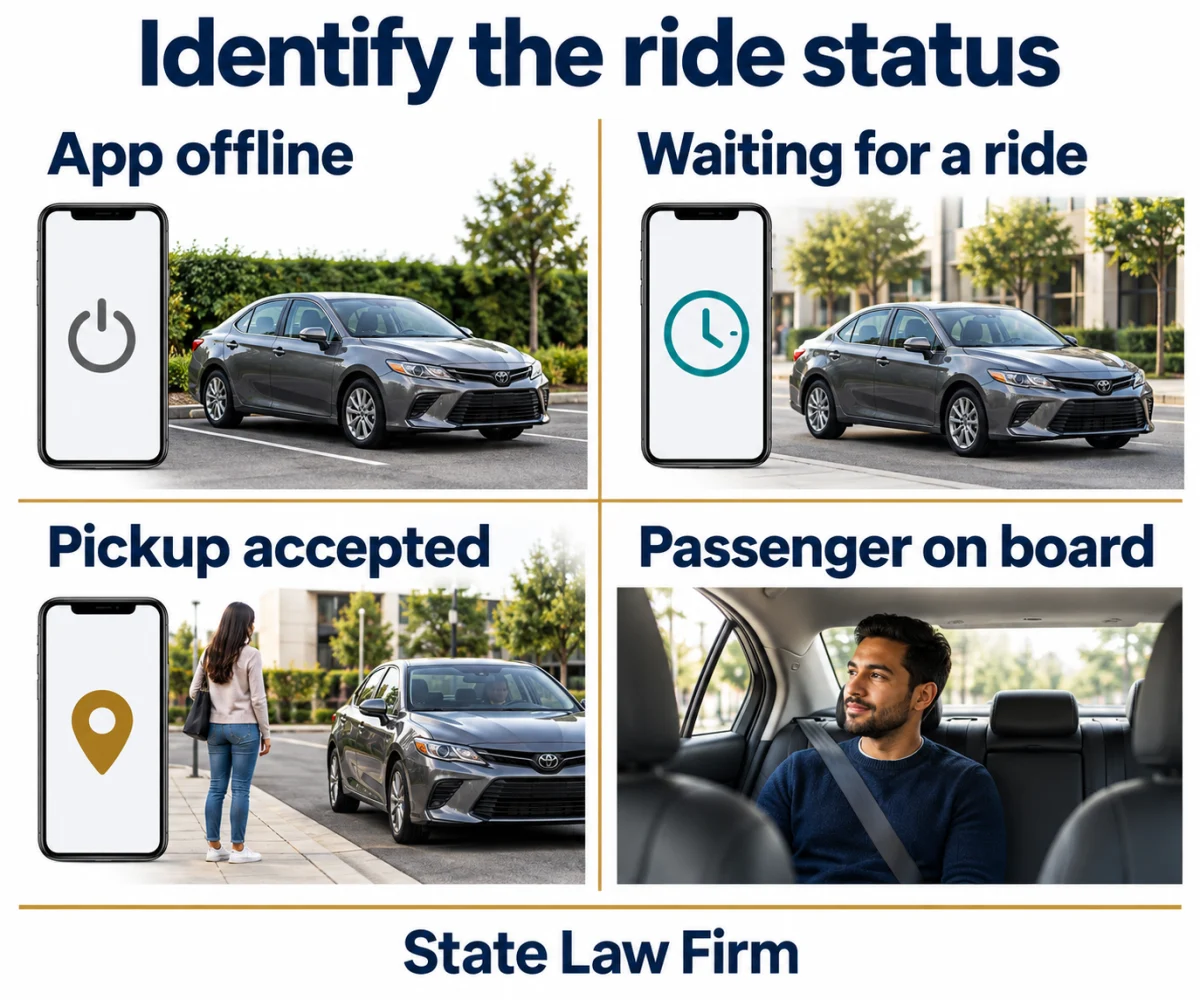
Under Public Utilities Code section 5433, insurance requirements depend on the stage of the ride. Transaction completion and the end of the ride can both matter. Do not assume that tapping “end trip” alone determines coverage. The policies and law applicable to the collision date must be reviewed, including any separate uninsured or underinsured motorist coverage.
A coverage limit is not a promise of payment or the value of an injury claim. Responsibility, who qualifies for coverage, the type of loss, and policy terms still matter. If several apps were active, give the attorney the information you have for each rather than guessing which one applies.
Keep the Trip Evidence and Original Files
Get to safety and seek medical help first. Do not use your phone while driving or enter traffic to collect evidence. Once it is safe, preserve information already available to you and ask about time-sensitive records that may require a formal request.
- Trip receipt: Keep the receipt, trip identifier, date and time, pickup and destination information, and the driver’s name and vehicle details as shown in your account. Note who booked the ride if it was not you.
- App messages: Save pickup changes, cancellations, incident confirmations, and communications with the driver or platform. Preserve full context rather than only a cropped screenshot.
- Scene and video: Keep original photographs and recordings, witness contacts, vehicle plates, and the investigating agency’s incident number. Tell the attorney about possible dashcam or nearby business footage without assuming it exists.
- Care and expenses: Organize treatment records, bills, missed-work documentation, transportation receipts, and a factual record of activity limitations.
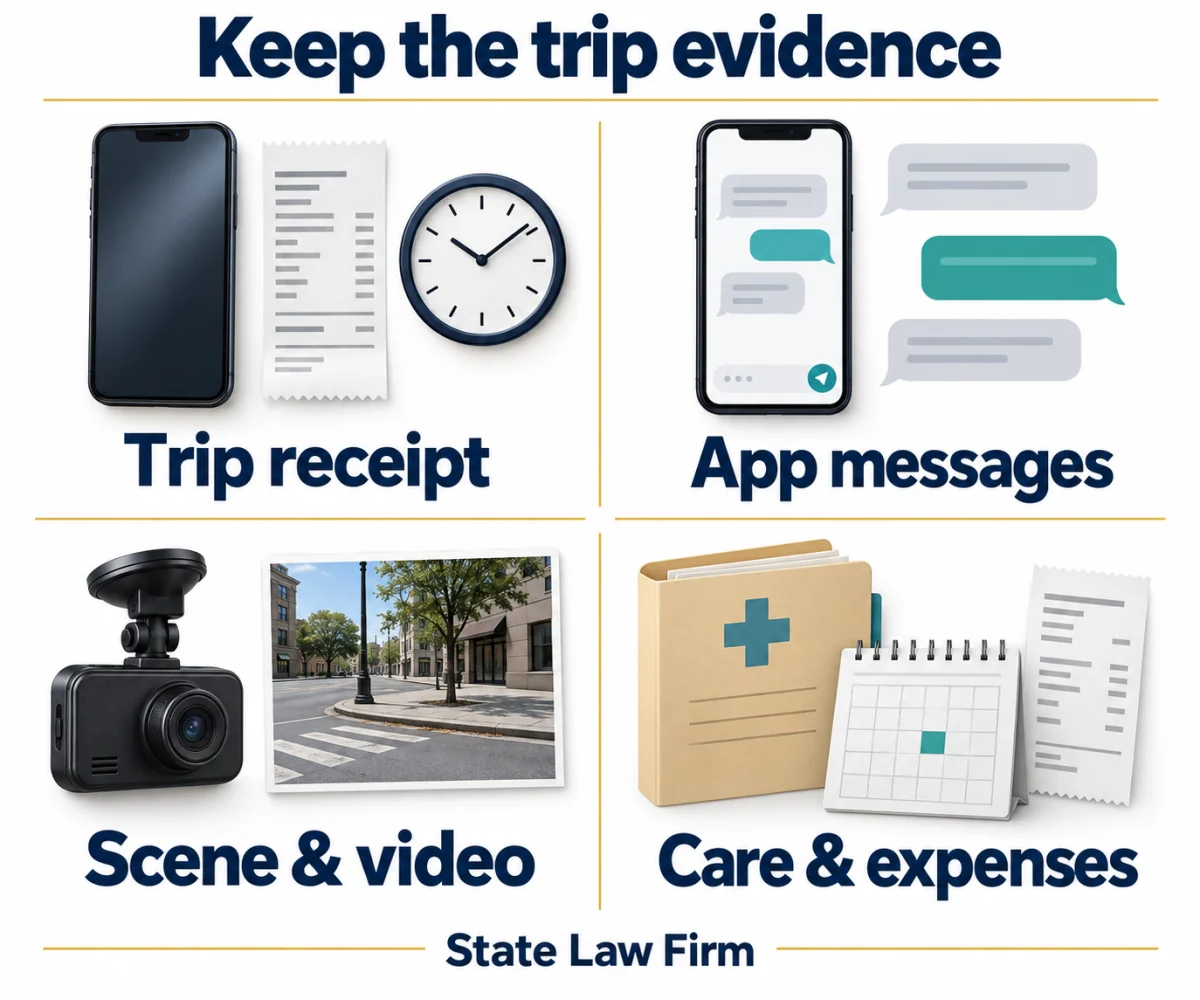
Do not delete your account or alter original files while questions about the trip remain unresolved. A screenshot may help identify a record, but platform logs and other evidence may be needed to confirm it. Our Uber and Lyft accident guide and camera-footage resource discuss related evidence questions. Ask the team how to share private records securely; you do not need to place a full medical history in an initial website inquiry.
Passenger, Driver, and Other Road-User Claims
If you were a passenger, identify where you were seated, which trip you were taking, and whether another vehicle was involved. If someone else ordered the ride, ask them to preserve the receipt and messages. You can request a consultation even if you do not yet know which driver caused the collision.
If you were driving for an app, preserve your trip-status information and communications with each insurer. Liability coverage for injuries to others is not the same as coverage for your own injuries, lost income, or repairs. Ask about applicable policies and benefits rather than assuming every loss falls under one policy.
If you were in another vehicle, walking, or cycling, record the plate, vehicle description, driver information, and any visible app identification if you can do so safely. Not having access to the other driver’s account does not prevent an initial review. The investigation can address how to request relevant trip records.
A claim assessment connects the collision evidence with documented injuries and losses. California’s comparative-fault framework can reduce damages by an injured person’s share of responsibility; see California civil jury instruction CACI 405. An insurer’s allegation is not a final finding. When retained, the firm can review the evidence, communicate with insurers, and assess negotiation or litigation without promising a particular outcome.
Police Reports and Platform Reports Are Different
If Riverside Police investigated, consult the department’s Records Bureau about obtaining a copy. The bureau identifies report-release services for authorized people. Keep the incident number and ask about eligibility, identification, availability, and the current request process. If another agency handled the collision, contact that agency instead.
A message to Uber or Lyft is not a police report, an insurance claim, or a court filing. Keep each confirmation and reference number separately. Do not assume that the platform has notified every relevant insurer or that a pending report pauses a deadline. See our California police-report guide for additional context.
Review Offers and Filing Deadlines Early
Keep proposed releases, settlement offers, and requests for recorded statements. Ask which claims and parties a release would cover before signing. Medical needs, missed earnings, and other losses require supporting records; another person’s result or an advertised insurance limit does not establish your claim’s value. Our recorded-statement guide explains questions to discuss with counsel.
California generally allows two years for a personal-injury lawsuit under Code of Civil Procedure section 335.1. Exceptions and other claims may have different deadlines. If a public entity may be involved, an administrative injury claim generally must be presented within six months under Government Code section 911.2, with separate lawsuit requirements afterward. Request a case-specific deadline assessment; an app report or insurance negotiation does not replace it.
Meet the Attorneys

Eddie Tehrani
Eddie Tehrani founded State Law Firm after working in Los Angeles law offices handling personal injury and civil litigation. Review his background and discuss the firm’s approach to your rideshare injury matter.
Arnold Gross
Arnold Gross’s firm biography describes personal injury and wrongful death trial work, along with mediation and arbitration experience. Read his professional background on the firm’s attorney page.
Serving Riverside From Our Sherman Oaks Office
State Law Firm’s main office is at 15490 Ventura Blvd #205, Sherman Oaks, CA 91403. Riverside clients can start by phone or online and ask about meeting arrangements before traveling. Visit Locations for office information or contact the team at (877) 659-9223.
For collisions without app-based passenger service, see our Riverside car accident page. Food and package deliveries can raise different coverage questions; the passenger rideshare discussion here should not be treated as a coverage guide for every delivery platform.
Frequently Asked Questions
Can I request a consultation if someone else booked the ride?
Yes. Ask the person who booked it to preserve the receipt, trip identifier, driver information, and relevant messages. Explain that you were the passenger and identify what records you can access. Missing app access can be discussed during the consultation.
What if I was hit before the passenger was picked up?
Whether the driver had accepted a ride request can be important even without a passenger in the vehicle. Preserve the available driver and collision information. The applicable trip status and insurance need to be investigated rather than inferred from an empty back seat.
Does reporting the crash in the app open every necessary claim?
No. A platform report should not be treated as confirmation that all insurers, police agencies, or other parties have been notified. Keep its reference number and ask what additional reports, notices, or filings are needed.
What if the ride was canceled or ended near the collision time?
Save the cancellation or completion message and describe what physically happened, including whether the passenger was still in the vehicle. Exact timing and the sequence of events need review. A single screen or app label does not by itself resolve all coverage questions.
Does rideshare liability insurance cover the driver’s own repairs?
Not automatically. Liability coverage and coverage for damage to the driver’s vehicle are different. The available policy terms, endorsements, deductibles, and collision circumstances need to be examined before assuming repairs will be paid.
Is the initial Riverside rideshare consultation free?
Yes. The initial consultation is free. Ask the team to explain any proposed attorney fees, case costs, and representation terms before signing an agreement.
Request a Riverside Rideshare Accident Consultation
This page provides general information, not legal advice. Contacting the firm does not by itself establish an attorney-client relationship. A case-specific review is needed to assess your rights, coverage, and deadlines.