English
  Spanish
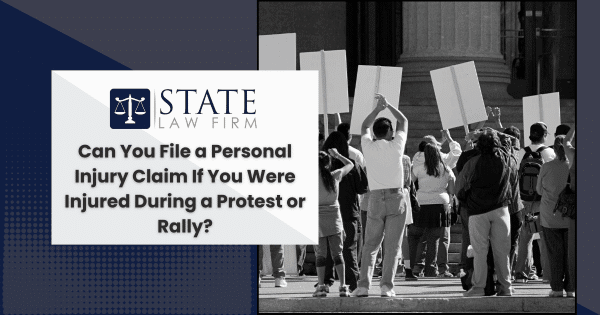
Yes. A person injured at a protest or rally in California may be able to file a personal injury claim when another person, driver, business, property owner, security provider, or government actor caused the injury through negligence, intentional violence, or other legally wrongful conduct.
Attending a demonstration does not mean that you automatically accept the risk of being struck by a vehicle, assaulted, injured by a dangerous property condition, or subjected to unlawful force. However, the fact that an injury happened at a protest does not automatically establish liability either.
A successful claim generally requires evidence showing who caused the injury, what that person or organization did wrong, and how the conduct resulted in physical, emotional, or financial harm.
Protest-related injuries can be legally complicated because one incident may involve private individuals, businesses, event organizers, security personnel, law enforcement agencies, and multiple insurance policies. Claims involving a city, county, police department, sheriff’s department, or other public agency can also have much shorter procedural deadlines than an ordinary personal injury case.
Does the Right to Protest Affect a Personal Injury Claim?
The First Amendment to the United States Constitution protects freedom of speech and the right of people to peaceably assemble and petition the government. Peaceful demonstrations, marches, picketing, and other expressive activities may therefore receive constitutional protection.
That protection does not make every action at a demonstration lawful. Violence, threats, property destruction, trespassing, and other conduct may create separate criminal or civil issues.
At the same time, an arrest, citation, dispersal order, or allegation that a person violated a rule does not automatically excuse another person’s negligence or make every use of force lawful. The analysis depends on what occurred, who caused the injury, what warnings were provided, and whether the conduct was reasonable under the circumstances.
When Can an Injury at a Protest Support a Personal Injury Claim?
A protest injury may support a claim when someone owed the injured person a legal duty and caused harm by failing to use reasonable care.
California Civil Code § 1714 provides the general foundation for negligence liability in California. Depending on the facts, a protest injury may involve negligence, automobile liability, premises liability, negligent security, intentional torts, public-entity law, civil-rights law, or a combination of these areas.
Potential claims may arise when:
- A driver negligently strikes a protester, journalist, observer, pedestrian, or bystander
- A person intentionally punches, pushes, sprays, or throws an object at someone
- A property owner fails to address a dangerous condition
- Private security personnel use unreasonable physical force
- Unsafe barricades, stages, wires, exits, or temporary structures cause an injury
- A protest or event organizer creates a specific, foreseeable hazard
- A government employee causes an injury under circumstances in which the law permits liability
- A law enforcement officer allegedly uses excessive or unlawful force
- A person is denied necessary medical assistance after being injured or detained
The existence of an injury alone is not enough. The evidence must connect the defendant’s conduct to the harm.
Who May Be Responsible for an Injury at a Protest?
A Driver or Vehicle Owner
Protests frequently take place near roads, intersections, parking areas, government buildings, and other places where vehicles remain present.
A driver may be responsible after:
- Failing to stop for pedestrians
- Accelerating into a group of people
- Driving while distracted
- Making an unsafe turn
- Backing without checking the surrounding area
- Ignoring temporary traffic controls
- Traveling too quickly for crowded conditions
- Attempting to drive around or through a demonstration without reasonable care
When a negligent driver causes the injury, automobile liability insurance may provide a source of compensation. A vehicle owner, employer, or other organization may also be relevant depending on who controlled the vehicle and why it was being operated.
A person injured by a vehicle can learn more about the claims process by reviewing State Law Firm’s information about working with a California car accident lawyer. State Law Firm maintains a California car accident practice and represents people injured in vehicle collisions.
An intentional vehicle attack may create additional criminal, civil, and insurance issues. An insurer may dispute coverage for intentional conduct even when the driver remains personally responsible.
An Individual Assailant
A person who intentionally punches, pushes, kicks, strikes, sprays, or throws an object at someone may face personal civil liability.
A criminal prosecution and a civil injury claim serve different purposes. The criminal case concerns whether the government can prove an offense and impose criminal penalties. A civil claim focuses on compensating the injured person for losses caused by the wrongful conduct.
A criminal conviction is not always required before an injured person may pursue a civil claim. However, collecting compensation may be more difficult when the assailant has no applicable insurance or sufficient personal assets.
A Property Owner or Business
A protest may occur at or near a shopping center, office complex, hotel, apartment building, college campus, parking structure, stadium, or privately owned plaza.
A property owner is not automatically responsible merely because an injury occurred on the property. Liability may arise when a dangerous condition within the owner’s possession or control contributed to the injury and the legal requirements for duty, notice, causation, and damages are satisfied.
Examples may include:
- Broken stairs or railings
- Unmarked drop-offs
- Blocked exits
- Exposed electrical wires
- Inadequate lighting
- Unsecured temporary structures
- Dangerous crowd-control barriers
- Slippery or damaged walking surfaces
- A known security danger the owner failed to address despite a legal duty
State Law Firm’s California premises liability claims guide explains how property control, notice, dangerous conditions, and causation are evaluated.
A Private Security Company
Businesses, property owners, government contractors, and organizers may hire private security personnel.
A security company or guard may be responsible when an injury results from conduct such as:
- Unreasonable physical force
- Improper restraint
- Negligent crowd management
- Failure to follow established safety procedures
- Negligent hiring, training, retention, or supervision
- Creating an unsafe bottleneck or blocked exit
- Failing to respond reasonably to a known danger after undertaking a security responsibility
Whether the guard, security company, property owner, organizer, or several parties share responsibility depends on their contracts, level of control, training, and conduct.
A Protest or Event Organizer
Organizing a demonstration does not make the organizer responsible for every action committed by a protester, counterprotester, driver, police officer, or unrelated third party.
An organizer may become relevant when its own conduct contributed to the injury. Examples might include:
- Negligently installing a stage, barrier, sign, or electrical system
- Directing people into a known physical hazard
- Employing security personnel who caused the injury
- Blocking a required exit
- Assuming responsibility for a safety measure and performing it negligently
- Failing to address a specific danger within the organizer’s control
The legal question is generally not whether the organizer could have prevented every unexpected event. It is whether the organizer owed and breached a legally recognized duty that contributed to the injury.
A Government Entity or Law Enforcement Agency
Claims involving a city, county, police department, sheriff’s department, state agency, or public employee are particularly complicated.
Under California Government Code § 815, a public entity generally is not liable unless a statute authorizes the claim. Government Code § 815.2 addresses certain injuries caused by public employees acting within the scope of their employment, although immunities and other defenses may still apply.
Depending on the facts, a protest injury involving government personnel may raise issues such as:
- Excessive or unreasonable force
- Improper use of a less-lethal projectile
- An impact involving a police or government vehicle
- Unlawful restraint
- Failure to provide necessary medical assistance
- A dangerous public property condition
- Negligent conduct for which a statute permits liability
- Interference with constitutional or statutory rights
Federal 42 U.S.C. § 1983 permits certain civil actions when a person acting under color of state law deprives someone of rights protected by the Constitution or federal law.
California’s Tom Bane Civil Rights Act may also provide a remedy when someone interferes with constitutional or statutory rights through threat, intimidation, or coercion. The statute provides that speech alone generally is insufficient unless it constitutes a qualifying threat of violence.
These claims have distinct legal requirements. A negligence claim against a government entity is not the same as a federal or state civil-rights claim.
What If You Were Arrested or Cited?
An arrest or citation does not automatically prevent an injured person from pursuing a civil claim.
For example, an arrest does not necessarily determine:
- Whether the amount of force used was reasonable
- Whether a driver was negligent
- Whether a property condition was dangerous
- Whether necessary medical care was delayed
- Whether an individual committed an assault
- Whether the arrest itself caused the particular injury
- Whether the arrest or citation was legally justified
Pending criminal charges can affect a related civil case. Statements made to police, insurers, investigators, government agencies, news organizations, or on social media may be used in more than one proceeding.
Someone facing criminal accusations should consider obtaining criminal-defense advice before providing detailed recorded statements about the event.
Does Civil Disobedience Prevent You From Recovering Compensation?
Not necessarily.
A defendant may argue that the injured person contributed to the incident by entering a roadway, remaining after a dispersal order, crossing a barrier, participating in physical conduct, or failing to avoid an apparent danger.
California follows comparative-fault principles. When an injured person’s own negligence contributed to the harm, the person’s compensation may be reduced according to the percentage of responsibility assigned to them. Partial fault does not necessarily eliminate the claim. California’s current civil jury instructions address comparative fault and the allocation of responsibility among multiple parties.
The analysis should focus on conduct rather than political viewpoints. A person should not be assigned fault merely for expressing an unpopular opinion or peacefully participating in protected activity.
Why Protest Injury Claims Can Be Difficult to Prove
Several Potential Defendants May Be Involved
A single incident may involve:
- An individual assailant
- A driver
- A vehicle owner
- An employer
- A property owner
- A security contractor
- An organizer
- A city or county
- A police department
- One or more individual officers
Each potential defendant may have different duties, defenses, insurance coverage, immunities, and filing deadlines.
The Scene May Be Chaotic
Protest scenes may involve crowds, vehicles, noise, smoke, projectiles, multiple law enforcement units, and rapidly changing conditions.
Witnesses may observe only one portion of the incident. Videos may begin after the conduct leading to the injury. Two accurate recordings may appear inconsistent because they were taken from different angles.
The Responsible Party May Be Difficult to Identify
An injured person may not immediately know:
- Which officer deployed a device
- Which agency employed the officer
- Who drove a particular vehicle
- Which company provided security
- Who owned or installed temporary equipment
- Whether a participant was acting independently or on behalf of an organization
Identifying the responsible parties may require public records, witness interviews, vehicle records, body-camera footage, surveillance video, contracts, dispatch recordings, or other investigation.
Government Immunities and Special Rules May Apply
Claims against public agencies do not follow the same rules as claims against private people and businesses.
A claimant must identify a statute that permits the state-law claim, satisfy applicable claim-presentation requirements, and address any immunity asserted by the public entity or employee.
Causation May Be Disputed
A defendant may argue that the injury:
- Existed before the protest
- Happened somewhere else
- Was caused by another person
- Did not result from the claimed impact or force
- Was worsened by the injured person’s own conduct
Prompt medical documentation and preservation of original evidence can help address these disputes.
What Evidence Can Help Prove a Protest Injury Claim?
Useful evidence may include:
- Original photographs and video recordings
- Metadata showing when and where files were created
- News footage or livestream recordings
- Body-camera or vehicle-camera footage
- Surveillance video from nearby homes or businesses
- Witness names and contact information
- Statements from journalists or legal observers
- Officer names and badge numbers
- Agency, unit, and vehicle markings
- Vehicle descriptions and license plates
- Damaged clothing or personal property
- Physical objects involved in the injury
- Medical records and injury photographs
- Police, arrest, or incident reports
- Social media posts from witnesses
- Event maps, flyers, permits, and organizer communications
- Emergency-call or dispatch recordings
- Employment and wage-loss documentation
Save original files rather than relying only on compressed social-media copies. Keep the entire recording, including the moments before and after the visible injury. Avoid editing the original file, and create multiple backups.
What Should You Do After Being Injured at a Protest?
Reach a Safe Location
Move away from an immediate danger when possible. Do not place yourself or someone else at greater risk solely to collect photographs or video.
Obtain Medical Care
Call 911 for an emergency and seek appropriate medical evaluation.
Protest-related injuries may include head injuries, eye injuries, hearing damage, chemical exposure, fractures, internal injuries, burns, cuts, or injuries caused by physical restraint. Some symptoms may not be immediately obvious.
Photograph Your Injuries
Take clear photographs as soon as reasonably possible and continue documenting visible changes during the following days.
Preserve damaged clothing, glasses, cameras, phones, bags, signs, or other property.
Preserve Original Video Files
Do not rely exclusively on a social-media post. Save the original file with its metadata and make backup copies.
Ask witnesses to preserve their complete recordings rather than only short clips.
Identify Witnesses
Collect:
- Full names
- Telephone numbers
- Email addresses
- Social-media handles
- A brief description of what each witness observed
Journalists, legal observers, nearby residents, employees, and other attendees may have independent footage.
Record Identifying Details
When law enforcement or security personnel were involved, note any available:
- Names
- Badge numbers
- Agency or company markings
- Unit or vehicle numbers
- Equipment used
- Time and location
- Direction of travel or deployment
Do not confront personnel or interfere with an active operation to collect this information.
Be Careful About Public Statements
Public posts may be saved, shared, or taken out of context.
Avoid guessing about another person’s identity, motives, employment, or conduct. Do not exaggerate what happened or publish statements that conflict with the available evidence.
Obtain Legal Guidance Promptly
Prompt review is particularly important when a public entity may be involved because the deadline for presenting a government claim can arrive much earlier than the ordinary personal injury statute of limitations.
What Compensation May Be Available?
Depending on the responsible parties, legal theory, insurance coverage, and evidence, an injured person may seek compensation for:
- Emergency medical treatment
- Hospital expenses
- Follow-up appointments
- Physical therapy and rehabilitation
- Psychological treatment
- Prescription medication
- Future medical care
- Lost wages
- Reduced earning capacity
- Damaged clothing or personal property
- Physical pain
- Emotional distress
- Scarring or disfigurement
- Loss of enjoyment of life
Serious injuries involving the head, spine, eyes, internal organs, or permanent impairment may require extensive medical and vocational evidence. State Law Firm provides additional information about cases involving a catastrophic injury.
The available damages depend on the claim. Punitive damages, statutory damages, attorney fees, or injunctive relief may be available under certain intentional-tort or civil-rights statutes, but they are not available in every case.
What Deadlines Apply to a California Protest Injury Claim?
Claims Against Private Parties
California generally allows two years to file a lawsuit for personal injury caused by another person’s wrongful act or negligence under Code of Civil Procedure § 335.1. Exceptions and shorter deadlines may apply depending on the claim and defendant.
State Law Firm’s guide to the California personal injury statute of limitations explains why an injured person should not wait until the ordinary deadline is approaching.
State-Law Claims Against Public Entities
A claim relating to personal injury or damage to personal property against a California public entity generally must be formally presented within six months after the claim accrues under Government Code § 911.2.
Government Code § 945.4 generally requires a claim subject to the Government Claims Act to be presented before a lawsuit is filed against the public entity.
When the agency provides a qualifying written rejection notice, Government Code § 945.6 generally requires the lawsuit to be filed within six months after the notice is personally delivered or mailed.
The state government-claim process does not necessarily govern every federal civil-rights claim. Because one incident may involve state and federal causes of action with different procedures, the deadlines should be evaluated separately.
Frequently Asked Questions
Can I sue if I was injured at a protest in California?
Potentially. A claim may exist when another person, driver, business, property owner, security provider, organizer, government employee, or public entity caused the injury through legally wrongful conduct.
Can I sue someone who attacked me at a protest?
Potentially. An assailant may face civil liability for injuries caused by an intentional attack. A criminal prosecution is separate from a civil injury claim and is not always required before the civil matter can proceed.
Can I file a claim if a car hit me during a protest?
Yes, when the evidence shows that the driver negligently or intentionally caused the collision. A vehicle owner, employer, or other organization may also become relevant depending on the circumstances.
Can a property owner be liable?
A property owner may be responsible when a dangerous condition within the owner’s control contributed to the injury and the elements of a premises liability claim are satisfied. The owner is not automatically responsible for every act committed by protesters or third parties.
Can a protest organizer be liable?
Only in certain circumstances. Organizers are not automatically responsible for every incident. Liability may arise when the organizer’s own negligent conduct, equipment, personnel, or assumed safety responsibilities contributed to the injury.
Can I file a claim against the police?
Potentially. A matter may involve excessive force, negligent conduct authorized by statute, dangerous public property, or interference with constitutional rights. Government immunities, civil-rights requirements, and short claim deadlines may apply.
Does being arrested prevent me from filing a claim?
No, not automatically. An arrest or citation does not by itself determine whether the force used was lawful or whether another person or organization caused an injury.
What if I was partly responsible?
California comparative-fault rules may reduce compensation according to the percentage of responsibility assigned to the injured person. Partial responsibility does not necessarily eliminate the claim.
How long do I have to file a protest injury claim?
Many claims against private parties generally have a two-year lawsuit deadline. State-law claims against California public entities may require presentation of a formal claim within six months. Other deadlines may apply.
Do I need a civil-rights attorney or a personal injury attorney?
That depends on what happened and who caused the injury. A vehicle collision, assault, or dangerous-property claim may primarily involve personal injury law. A claim involving excessive force or interference with constitutional rights may require civil-rights experience. Some incidents involve both.
Speak With State Law Firm About a California Protest Injury
An injury at a protest can involve several possible defendants, conflicting video recordings, insurance companies, public agencies, and deadlines that are easy to overlook.
State Law Firm can review the personal injury circumstances, assess available evidence, identify possible defendants and insurance coverage, and explain which legal deadlines may apply. Depending on the facts, the matter may also require review by an attorney with specific civil-rights experience.
Learn more about working with a California personal injury lawyer, review the firm’s case studies, or call (877) 659-9223 for a free consultation. State Law Firm’s website identifies its Sherman Oaks personal injury practice, case studies, and consultation number.
You pay no attorney fee unless State Law Firm obtains a recovery for you. Every case depends on its individual facts, evidence, injuries, defendants, immunities, deadlines, and applicable law.