English
  Spanish
State Law Firm | Serving San Bernardino, California
San Bernardino Motorcycle Accident Lawyers
A crash on I-215, a freeway connection, or a San Bernardino street can leave important questions unanswered. State Law Firm helps injured riders and passengers review collision evidence, report requests, and insurance issues from our Sherman Oaks office.
Free initial consultation
Rider and passenger inquiries
Motorcycle evidence review
Sherman Oaks office
Start with the crash date, precise location, responding agency, and any incident number. Keep the report request, original footage, and insurance correspondence together but distinguish their purposes. Flag storage notices and deadlines promptly; you can ask for a consultation before the report is ready.
A motorcycle collision can leave a rider dealing with more than a damaged bike: an uncertain account of the crash, a report that is not ready, and insurance calls while medical care is still unfolding. State Law Firm’s San Bernardino motorcycle accident lawyers help riders and passengers organize those questions and evaluate whether another party may be responsible. The starting point is the evidence, not an assumption about who rides a motorcycle or what a claim is worth.
San Bernardino Roads and the Details That Identify Your Crash
For a collision on I-215 or a trip connecting with I-10 or SR-210, note the direction, nearest exit, and whether the impact happened on the freeway, a ramp, or a city street. The CHP San Bernardino Area identifies these routes within its area and describes responsibility for freeway, state-highway, and unincorporated-area collision investigations. A San Bernardino mailing address alone does not identify the investigating agency.
On a city street, a driveway entrance, turning vehicle, signal, or parked vehicle may provide a more useful reference than a nearby business name. At a freeway connection, distinguish the through lane from the entrance or exit lane. Tell the attorney what you personally observed and what you learned afterward. Photographs taken later can help explain the setting, but should be dated and kept separate from photographs taken at the scene.
Describe the Sequence Without Filling in the Gaps
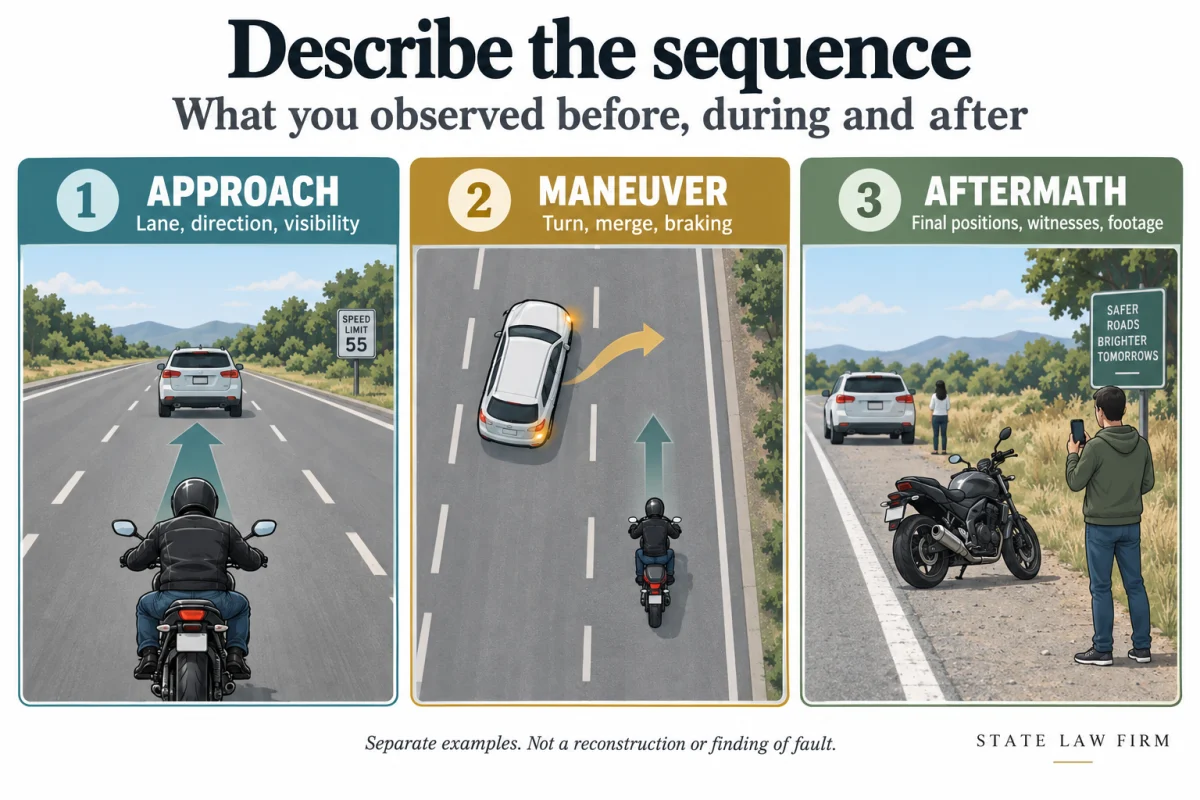
Breaking the account into three parts helps identify missing evidence without treating an uncertain memory as a fact. A passenger or independent witness may have seen a different part of the sequence. Keep each person’s observations separate.
- Approach: Record the road, direction, lane, traffic conditions, and what you could see. Note a blocked sight line or a signal only if you observed it.
- Maneuver: Describe the turn, merge, lane change, braking, or other movement you remember. Explain whether you saw contact, felt an impact, or took evasive action. Do not guess a speed or distance to complete an account.
- Aftermath: Identify where the motorcycle and vehicles came to rest, witnesses who stopped, cameras you noticed, and the responding agency. A final resting position does not by itself explain every earlier movement.
A driver turning across a rider’s path, a vehicle changing lanes, road debris, or a possible equipment problem presents different investigation questions. A collision involving a commercial vehicle may also require identifying the driver, employer, and vehicle owner. None of these circumstances alone establishes fault. Do not return to a dangerous roadway or recreate a maneuver to obtain evidence.
Request the Report From the Agency That Investigated
San Bernardino Police Department: The city’s Records Bureau describes its report-request process, photo identification requirement, and applicable charges. Its current guidance asks people to wait 10 days after a collision before requesting a traffic report. Check availability and current instructions with the department. That report-request timing is not permission to delay a required DMV filing or a legal claim.
California Highway Patrol: For a CHP investigation, eligible parties can use the CHP 190 request process, with the required identification and fees. CHP explains that it cannot supply a collision report investigated by another police department. Use your incident card, responding officer’s information, or insurer correspondence to identify the correct agency.
Separate DMV reporting: The DMV’s SR-1 instructions require a report within 10 days when someone is injured or killed, or property damage exceeds $1,000. The filing is separate from a police, CHP, or insurance report and may be completed by the driver or an authorized insurance or legal representative. Ask promptly about the requirements for your circumstances rather than waiting for the collision report.
Keep the Report, Footage, and Insurance File Separate
Different records answer different questions. An agency report can organize incident information; original footage may show movement and surrounding conditions; an insurance file records coverage documents, communications, and notices. One does not replace the others, and each may be incomplete.
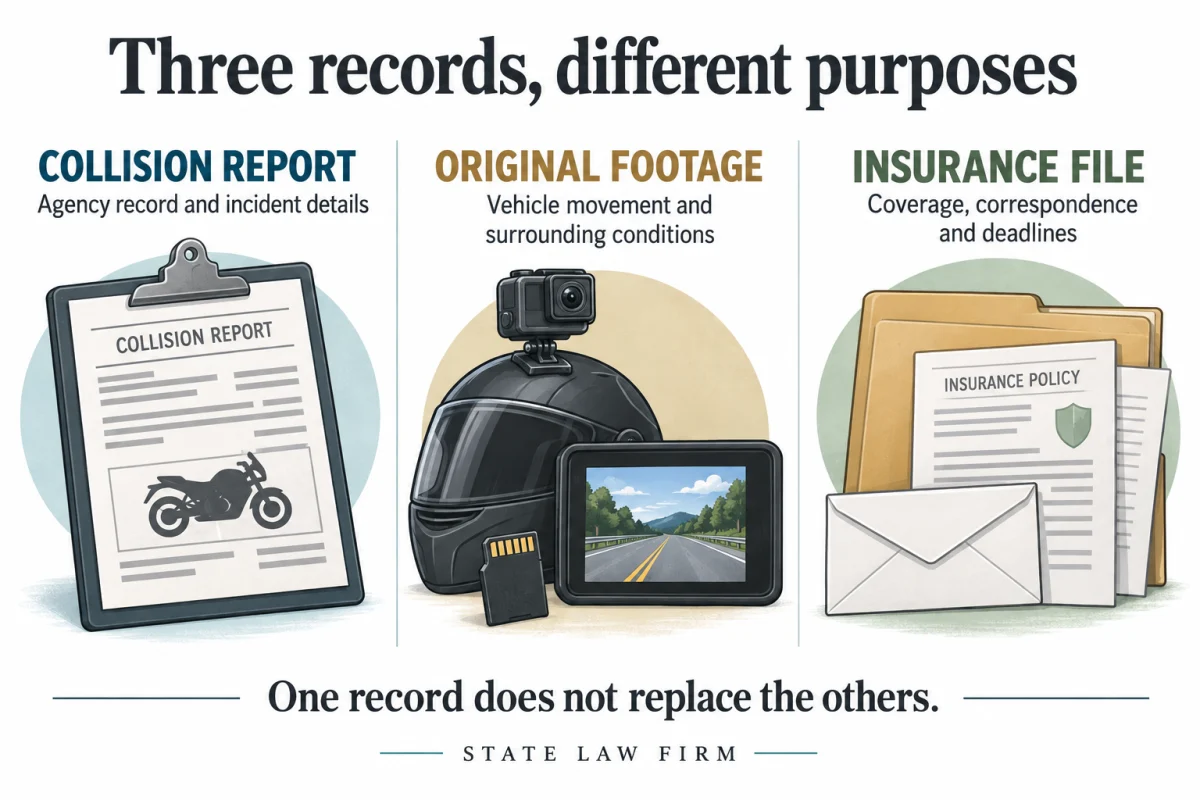
- Collision report: Keep the report number and any supplements. Identify specific factual discrepancies for discussion instead of editing the report itself.
- Original footage: Preserve the unedited helmet-camera or dashcam file and device information, including any known clock error. Keep an original copy before making clips. Tell counsel promptly about nearby cameras; access and retention are not guaranteed.
- Insurance file: Save the policy, declarations, claim numbers, letters, messages, and proposed releases. Record who contacted you and which insurer they represent. A coverage question is different from a finding of fault.
The motorcycle, helmet, clothing, and accessories may also contain relevant evidence. Keep towing and storage paperwork, photographs, repair estimates, and purchase or maintenance records. Flag a salvage, storage, inspection, or disposal notice promptly so preservation can be discussed before the item changes. Keeping damaged safety gear as evidence does not mean it is safe to use. Read our evidence-preservation resource for more context.
Lane Splitting, Helmets, and Disputed Fault
Vehicle Code section 21658.1 defines lane splitting for two-wheeled motorcycles moving between rows of vehicles. That definition does not decide fault in an individual collision. The vehicle paths, surrounding traffic, visibility, and other evidence still matter. Avoid treating a driver’s statement that the rider was lane splitting as the complete explanation.
California’s helmet law applies to motorcycle drivers and passengers. A question about helmet use should be discussed honestly with counsel, along with the injury evidence; it is not a substitute for examining how the collision occurred. California’s comparative-fault framework can reduce damages according to an injured person’s share of responsibility. A disputed allegation is not itself a final allocation of fault. See Judicial Council instruction 405.
Document the Effects on Your Health and Work
Keep treatment records, bills, appointment information, work restrictions, and a factual account of changes in daily activities. Wage statements, missed-shift records, and receipts can help explain an economic loss. If care is continuing, distinguish current expenses from a provider’s documented recommendations for future treatment. Let qualified clinicians address medical needs; do not delay care to assemble a claim file.
The losses that may be pursued depend on responsibility, the injuries, supporting evidence, and available coverage. No online checklist can determine a settlement amount. A passenger should discuss their own injuries and potential claims, even when they know the rider. If a family member died, our San Bernardino wrongful death page addresses the separate questions families may need to raise.
Do Not Confuse a Report Request With a Claim Deadline
Code of Civil Procedure section 335.1 generally provides two years for a personal injury lawsuit, but exceptions and different rules may apply. A claim involving a public entity can require an earlier claim presentation, generally within six months after accrual for personal injury under Government Code section 911.2, followed by separate lawsuit requirements. Ask for an individualized deadline review if a public vehicle or roadway condition may be involved.
A police report, road-maintenance complaint, insurer conversation, or website inquiry is not the same as filing a lawsuit or presenting a required government claim. Do not assume that waiting for records or continuing negotiations protects a deadline.
Meet the Attorneys at State Law Firm
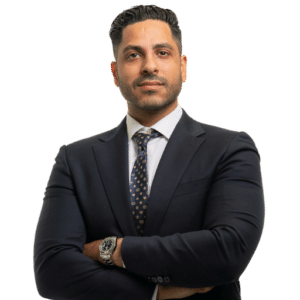
Eddie Tehrani
Eddie Tehrani founded State Law Firm after working in Los Angeles law offices handling personal injury and civil litigation. Review his background and discuss the firm’s approach to your motorcycle injury questions.
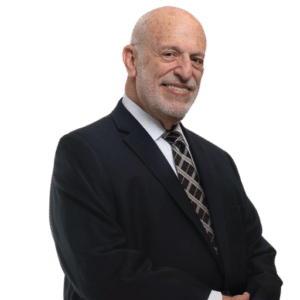
Arnold Gross
Arnold Gross’s firm biography describes personal injury trial work and mediation and arbitration experience. Review the team’s backgrounds and ask how your matter would be handled.
State Law Firm serves San Bernardino clients from its Sherman Oaks office at 15490 Ventura Blvd #205, Sherman Oaks, CA 91403. This page does not identify a San Bernardino office. Confirm consultation and meeting arrangements through our Locations page or call (877) 659-9223.
Frequently Asked Questions
Can I request a consultation before the collision report is ready?
Yes. Bring the date, location, responding agency, incident number if known, and any immediate notices. A pending report need not prevent an initial discussion. Do not wait for it to address a deadline or a risk that evidence will be lost.
Does lane splitting automatically make the rider responsible?
No. The circumstances and evidence need to be evaluated. Vehicle movement, visibility, traffic conditions, and each person’s conduct matter; the phrase “lane splitting” does not decide the claim.
Can a motorcycle passenger ask about a claim?
Yes. A passenger can discuss their own injuries, observations, and insurance questions. Responsibility may involve another driver, the rider, or another party depending on the facts. Knowing the rider does not replace an individual review.
What if my motorcycle is being held in storage?
Keep the storage location, contact information, invoices, and every notice. Flag any inspection, repair, transfer, or disposal deadline promptly. Discuss preserving relevant evidence and managing the vehicle with counsel and the insurer; do not assume it can remain untouched indefinitely.
What if the other driver left or may not have insurance?
Report the incident and preserve the details you have, without chasing a driver. Provide your own policy and any insurer notices for review. Whether uninsured or underinsured motorist coverage or another claim is available depends on the policy, evidence, and applicable requirements.
Where is the office and how do I get started?
The office is in Sherman Oaks, not San Bernardino. Call (877) 659-9223 or use the consultation form to describe the crash and ask about arrangements. The initial consultation is free; discuss representation, fees, and costs before entering an agreement.
Discuss Your San Bernardino Motorcycle Accident
Have the collision date, exact location, agency information, and any time-sensitive notices available if you can. You do not need a complete evidence file to ask an initial question. Request a free consultation or call (877) 659-9223. For broader rider and passenger information, visit our motorcycle accident practice page.
Related legal resources: Motorcycle accident practice, Palm Springs motorcycle accident attorneys, Pasadena motorcycle accident lawyers, Long Beach motorcycle accident attorneys, Santa Clarita motorcycle accident lawyers, Free consultation.