English
  Spanish
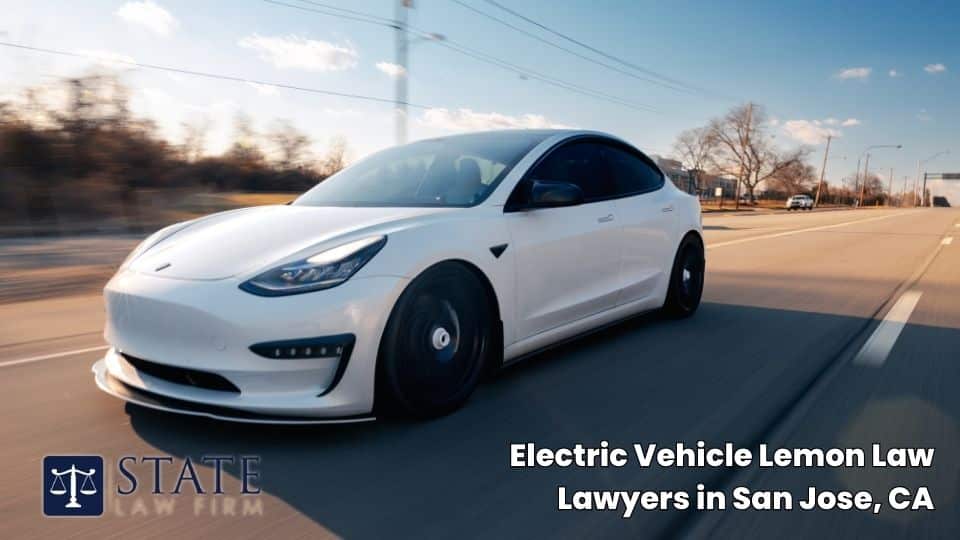
San Jose drivers tend to adopt new tech early, and that includes electric vehicles. When an EV starts acting up, it can feel less like “a car with a problem” and more like “a device that won’t work when you need it.” The good news is that California has strong consumer warranty protections that can apply to EVs, including buyback or replacement when the manufacturer cannot fix a serious defect within a reasonable number of chances.
At State Law Firm, this is the mindset we bring to EV lemon law claims: translate your repair history into a clear legal story, push the right remedy, and keep the process moving. If you want to explore the topics discussed here, start with our Lemon Law articles. For a real EV-specific example that comes up in warranty and defect disputes, our guide on electric vehicle fire lawsuits in California adds helpful context.
Why EV lemon law claims feel different than traditional car disputes
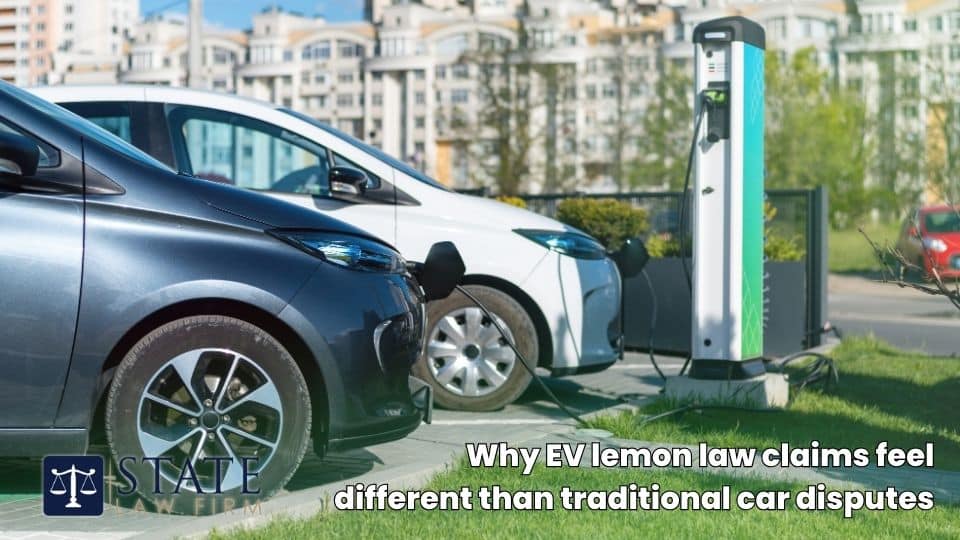
EV defects often show up as tech failures that are intermittent, software-driven, or tied to charging behavior. That can make the dealership’s repair notes look vague, even while the problem is very real to the driver. On the safety side, high-voltage battery systems introduce unique risks, and regulators have repeatedly focused on battery defect investigations, recalls, and fire scenarios connected to battery issues.
From a lemon law perspective, this matters because “proof” in an EV case is rarely just a broken part you can point to. It is usually a repeat pattern: warning lights, charging failures, “reduced power” events, unexplained range drops, thermal management problems, recurring check-engine equivalents, or driver-assist malfunctions that come and go. If you are seeing sensor or safety-system irregularities that the dealer cannot replicate consistently, our article on cold weather and safety sensor malfunctions is a good example of how environment plus technology can lead to real-world failures that still need accountability.
EV problems can also blur the line between “warranty defect” and “product safety issue.” Federal safety agencies have outlined how lithium-ion battery failures can escalate into thermal runaway scenarios, and they have flagged responder and public hazards in certain conditions. That broader safety backdrop can increase urgency in a serious EV defect case, especially when the defect affects safe operation or creates elevated fire risk.
California lemon law fundamentals that EV owners in San Jose should know
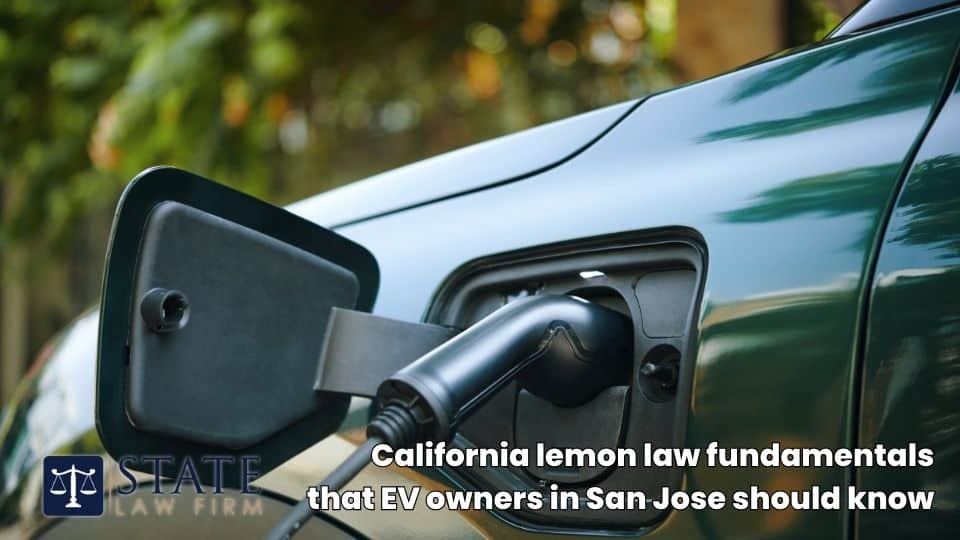
California’s core lemon law framework falls under the Song-Beverly Consumer Warranty Act and the Tanner Consumer Protection Act. In plain terms, if a vehicle has a serious warranty-related defect and the manufacturer or its authorized repair facilities cannot conform the vehicle to the express warranty after a reasonable number of repair opportunities, the manufacturer can be required to provide restitution (a repurchase) or a replacement.
California also provides presumption guidelines that help show when “reasonable attempts” have occurred. The state’s consumer guidance highlights a common presumption window of 18 months or 18,000 miles and uses benchmarks such as:
- Four or more repair attempts for the same issue
- Two or more attempts for a defect that could cause death or serious injury
- More than 30 total days out of service for warranty repairs (not necessarily consecutive)
These are guidelines, not magic words, but they are important when building an EV lemon law case.
If the case results in a buyback, the repurchase amount in California typically includes what you paid for the vehicle (including certain fees and taxes), with a reduction for the value of use before the first repair visit for the defect. The calculation approach multiplies the mileage before the first repair by the purchase price and divides by 120,000, then subtracts that from the restitution amount.
Fees matter too. Under California’s lemon law remedies, prevailing buyers can seek recovery of reasonable attorney’s fees and costs, and civil penalties may be available in willful violation scenarios up to a multiplier tied to damages in the statute. This fee-and-penalty structure is one reason many consumers pursue claims through counsel rather than trying to negotiate alone with a manufacturer.
If you want a plain-English baseline before talking to counsel, these guides are a good starting point: how to tell if your car may be a lemon, what the lemon law claims process looks like, and what “buyback” means in practice. If you are cost-sensitive, you can also review the cost of hiring a lemon law attorney and the related breakdown on California lemon law attorney fees.
What usually qualifies as an EV lemon in California
In real EV lemon law evaluations, the question is not “Is it annoying?” It is closer to “Does this defect substantially impair use, value, or safety — and does it remain unresolved after reasonable repair opportunities?” The state’s consumer guidance emphasizes serious warranty defects and repeated attempts without a successful fix. Those same principles apply whether the vehicle runs on gasoline or a high-voltage battery.
For EVs specifically, common problem areas that show up in buyback conversations include:
- Battery faults
- Charging failures (AC or DC fast charging)
- Repeated power limitation events
- Drivetrain and propulsion failures
- Thermal management issues
- Persistent warning indicators tied to high-voltage components
- Software or driver-assist failures that impact safe operation
Regulators have documented that battery-related defects and their safety consequences remain an active investigation and recall area, which reinforces why certain battery problems are treated as more than a minor inconvenience.
Safety severity can change the tone of the case. If the defect is dangerous or plausibly tied to serious injury risk, the presumption guidance can become easier to satisfy because fewer failed repair attempts may be enough. For more on that concept, see our article on California lemon law qualifications for dangerous vehicle defects.
Used EVs deserve special attention. California’s consumer-facing materials often describe coverage in terms of vehicles that come with the manufacturer’s new vehicle warranty, including certain used categories like dealer-owned vehicles and demonstrators. However, the Supreme Court of California has also addressed statutory definitions of what qualifies as a “new motor vehicle” for refund-or-replace remedies in disputed used-vehicle scenarios, making the details of how the warranty was issued with the sale highly relevant. If you are in a used EV situation, our post on California lemon law and used cars is a good starting point, but you will also want an attorney to apply the most current law to your specific facts.
How to build a strong EV lemon law file that manufacturers take seriously

In EV lemon law work, the repair timeline is the backbone. Your goal is to make the story easy to prove: “Here is the defect, here is when it first appeared, here are the repair attempts, here is what the dealer documented, and here is how the problem persists.” California’s presumption guidelines are built around repair attempts and time out of service, so your paperwork is not busywork — it is the case.
For EVs, it also helps to keep additional supporting evidence that matches how these vehicles behave in the real world. Examples include photos of dashboard warnings, short videos showing charging failures, screenshots from the vehicle app, timestamps of “reduced power” events, and notes about conditions when the defect triggers. This is especially useful when the dealership writes “could not duplicate,” which is common in intermittent tech issues. The legal standard is not “the dealer saw it once” — it is whether the manufacturer had a reasonable opportunity to repair and failed to conform the vehicle to warranty.
Be aware of arbitration programs. California’s consumer guidance notes that manufacturers may offer state-certified arbitration programs, and if one is offered, you may need to request arbitration to claim the benefits of the Lemon Law presumption while still retaining the right to accept or reject the arbitrator’s decision. That is a technical step that can affect leverage, timing, and strategy, so it is worth discussing early with counsel rather than treating it as an afterthought.
If you are ready to talk to an attorney, the fastest next move is a consultation with your repair history in hand. You can start at our free consultation page. If you want to vet the people behind the firm first, browse our attorneys, read client testimonials, or review case studies.
What an EV lemon law lawyer does in a San Jose claim
An effective EV lemon law strategy is usually built around speed plus clarity: quickly confirm eligibility, isolate the defect, compute exposure (refund, replacement, incidental damages, use offset), then pressure the manufacturer to act. California’s remedy structure includes restitution or replacement after reasonable repair opportunities, and it commonly includes costs that show up on real buyers’ paperwork — not just the sticker price.
There is also a newer procedural layer that matters for many cases, especially if civil penalties are in play. California enacted procedural rules for certain vehicle restitution and replacement actions that include pre-suit notice requirements for civil penalties, along with timing windows and settlement mechanics. One key requirement is that at least 30 days before filing an action seeking civil penalties, the consumer must send written notice with identifying details and a demand for repurchase or replacement. If the manufacturer makes a compliant offer within set timeframes and completes the repurchase or replacement within the statutory window, civil penalty requests may be restricted.
Deadlines can also be tighter than many drivers expect. The statutory procedure includes a shorter time to commence covered actions: within one year after expiration of the applicable express warranty, and not later than six years after original delivery, subject to tolling provisions described in the statute. In other words, waiting “until it gets worse” can be a legal mistake, even when the car is still misbehaving.
For San Jose drivers specifically: local commuters often rely on fast charging networks and rack up miles quickly across the South Bay. That makes it even more important to document the first repair presentation for the defect, because the buyback use-offset calculation in California ties to mileage before the first repair visit for the problem.
If your EV problem created a crash risk or an actual collision — for example, sudden loss of propulsion, driver-assist malfunction, or braking and acceleration irregularities — you may also need an injury-focused legal approach alongside any warranty dispute. For help on that front, see our San Jose car accident lawyers page, the personal injury section, our defective products representation, and our guidance on self-driving and driver-assist accidents.
FAQ for EV lemon law in San Jose
Do I need exactly four repair attempts for the same problem?
Not necessarily. California’s presumption guidelines commonly reference four attempts (or two for a serious safety defect, or 30 days out of service), but the core legal idea is “reasonable repair opportunities.” The presumption is a tool, not a ceiling.
If the dealership says “no codes” or “could not duplicate,” am I stuck?
Not automatically. Intermittent EV defects are common. What matters is whether the manufacturer had a reasonable chance to repair and still failed to conform the vehicle to warranty after repeated visits and time out of service. That is exactly why documentation beyond a single diagnostic snapshot can be so persuasive.
How is a California EV lemon law buyback amount reduced for usage?
The calculation uses a mileage-based deduction tied to miles driven before the first repair attempt for the defect and a 120,000-mile divisor. This is why the date and odometer reading of the first repair visit matters so much.
Do I have to go to court?
Not always. California’s consumer guidance explains that many disputes can flow through arbitration programs, and state-certified arbitration can be part of claiming the presumption benefits while still allowing the consumer to accept or reject the decision.
Do lemon law cases really include attorney’s fees?
California’s statute provides for recovery of reasonable attorney’s fees and costs for prevailing buyers, and civil penalties may be available for certain willful violations. The specific facts and procedural posture control the exact recovery.
Where do I start?
Begin with a free consultation. If you prefer to do some homework first, browse our FAQs, learn about the firm, and check our office locations.
This article is general information and not legal advice. Reading this does not create an attorney-client relationship. For guidance specific to your situation, schedule a free consultation.
Related legal resources: California Lemon Law resources, Lemon Law Lawyers for Defective Used Cars in Riverside, CA, Los Angeles Lemon Law Attorneys, Free consultation.