English
  Spanish
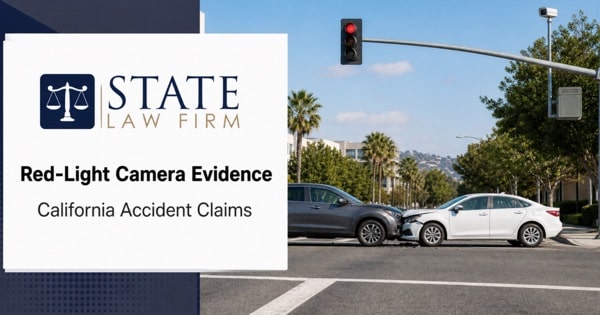
A red-light collision often creates a direct factual dispute: each driver says the light was green. Photographs, video, and data generated by an automated enforcement system may provide a more objective view of the signal phase and the vehicles’ movements. That evidence can be important, but it must be evaluated alongside the rest of the crash record.
Direct answer: Red-light camera evidence can help prove fault in a California car accident by showing the signal phase, when a vehicle crossed the limit line, its direction of travel, and the sequence before impact. It does not automatically decide liability. The recording must relate to the correct event, be sufficiently reliable, and connect the traffic violation to the collision and injuries.
California began allowing local governments to use an alternative automated camera program for red-light violations in 2026. As camera programs expand, injured people may encounter more photographic and system-generated evidence after intersection crashes. This guide explains what those records may show, their limits, and what other proof can strengthen an injury claim.
What Is Red-Light Camera Evidence?
Red-light camera evidence generally refers to photographs, video, and computer-generated information captured by an automated traffic enforcement system. Unlike an ordinary traffic-monitoring camera, an enforcement system is designed to document specified traffic violations.
Depending on the system, its records may include:
- Images of a vehicle near the limit line and inside the intersection
- A short video showing the vehicle’s approach and movement
- The date, time, and intersection location
- The amount of time the signal had displayed red
- The vehicle’s license plate
- Other system-generated data associated with the event
The exact material varies. Some intersection cameras monitor traffic conditions without continuously recording or retaining identifiable footage. Private security cameras, dashcams, transit cameras, and doorbell cameras are separate sources that may capture the same collision from different angles.
The California Department of Motor Vehicles’ 2026 law summary explains that SB 720 permits local governments to use an alternative automated camera program for red-light enforcement and treats recorded violations under that program as civil penalties. A civil penalty and a personal injury claim serve different purposes. One addresses an enforcement violation; the other requires proof of civil responsibility and compensable harm.
What Can a Red-Light Camera Help Prove After a Crash?
A useful recording may help investigators build a timeline rather than rely only on competing recollections. The strongest evidence typically shows the signal and the relevant vehicle in the same sequence.
The signal phase and limit line
California Vehicle Code section 21453 generally requires a driver facing a steady circular red signal to stop at the marked limit line, before entering the near-side crosswalk if there is no limit line, or before entering the intersection if neither exists. Camera images may show whether the vehicle was before or beyond that point while the light was red.
The order and direction of movement
Video can show whether a vehicle traveled straight, turned, or entered after cross traffic began moving. It may also help place other road users, including pedestrians or bicyclists, within the sequence.
Vehicle identification
A clear license plate can connect a vehicle to the event. It does not always establish who was driving. Ownership, driver identification, permissive use, and insurance coverage may require separate evidence.
Timing and possible evasive action
The recording may reveal braking, swerving, acceleration, or how much time separated intersection entry from impact. Perceived speed and distance can be distorted by camera angle or frame rate, so technical conclusions should not be drawn from appearance alone.
Why Camera Footage Does Not Automatically Decide Fault
Running a red light can be powerful evidence of negligence, but a traffic violation is not the entire civil case. An injured claimant must still connect the conduct to the collision and prove resulting losses.
Important limitations may include:
- The camera does not show the impact or the other vehicle.
- The signal is outside the frame or difficult to see.
- The timestamp or intersection information is disputed.
- A plate is visible, but the driver cannot be identified.
- Weather, glare, darkness, or image quality obscures details.
- The recording begins too late to show the full approach.
- The other driver may also have been speeding, distracted, or entering unsafely.
California follows pure comparative fault. More than one person can share responsibility, and a claimant’s recovery may be reduced by the percentage of fault assigned to that claimant. For example, one driver may have entered on red while another was speeding or failed to react reasonably to a visible hazard. The camera must be considered with all available evidence rather than treated as a complete verdict.
This is also why a traffic citation does not conclusively resolve an insurance claim or lawsuit. A citation may be relevant, but civil fault depends on the admissible evidence and the facts of the collision. Conversely, the absence or dismissal of a citation does not necessarily prove that the cited conduct did not occur.
How Is Automated Camera Evidence Evaluated in California?
Before a photograph, video, or system record is used as evidence, the party offering it may need to show that it is what the party claims it is. This process is called authentication.
In People v. Goldsmith, the California Supreme Court considered automated red-light camera evidence in a traffic prosecution. The court concluded that the evidence in that case was sufficiently authenticated and that automatically generated photographs, video, and contemporaneously recorded computer data were not hearsay statements from a person.
Goldsmith does not mean every image is automatically reliable or controlling in a personal injury case. The purpose for which evidence is offered matters, and questions about completeness, accuracy, alteration, chain of custody, and system operation can affect admissibility or weight. Civil claims may also involve different parties, records, objections, and factual issues than a traffic prosecution.
Useful foundational material may include:
- The original file and associated metadata
- Agency records identifying the camera and location
- Evidence explaining how the system captures and stores information
- Records connecting the event to the correct date and time
- Testimony or certifications addressing the recording’s accuracy
- An unbroken copy of the full clip rather than an edited excerpt
What Other Evidence Can Strengthen a Red-Light Accident Claim?
Camera evidence is most persuasive when independent sources support the same timeline. A thorough intersection investigation may include:
- Witness statements: Independent witnesses may describe which signal was red, where the vehicles were, and what they observed before impact.
- Scene photographs: Images can document limit lines, crosswalks, sight obstructions, traffic controls, debris, skid marks, and final vehicle positions.
- Vehicle damage: The location and direction of damage may help reconstruct the angle and sequence of impact.
- Dashcam and private surveillance footage: Nearby businesses, homes, buses, rideshare vehicles, and other drivers may have captured a wider view.
- Signal and intersection records: Timing plans, maintenance records, and agency documentation may become relevant when signal operation is disputed.
- Vehicle data: Available event data may provide information about speed, braking, throttle, or other pre-impact activity.
- Medical and financial records: Fault evidence proves how the crash occurred. Separate records are still needed to establish injuries, treatment, income loss, and other claimed damages.
Readers dealing with a side-impact crash can also review State Law Firm’s guide to fault and evidence after a T-bone accident.
How Can You Preserve Camera Evidence After an Intersection Accident?
Do not assume every visible camera recorded the crash or that a recording will remain available. Retention practices differ among agencies, businesses, and devices.
- Identify every possible camera. Photograph the intersection and note cameras on signal poles, nearby buildings, homes, buses, and vehicles.
- Record the exact event details. Preserve the date, time, direction of travel, intersection, police report number, and vehicle descriptions.
- Ask about retention and preservation. Contact the responsible agency or private owner promptly. A request for access may not itself require the holder to preserve material.
- Keep the original files. Avoid editing, compressing, or posting the only copy. Save the complete recording and available metadata.
- Preserve related proof. Keep photographs, witness information, vehicle records, medical documentation, and insurance correspondence.
For the detailed procedural search job, see SLF’s existing guide on how to obtain traffic camera footage after an accident. When important footage may be overwritten or disputed, a targeted preservation request and case-specific legal review may be useful. SLF’s resource on preserving evidence in personal injury claims explains why relevant material should be protected when litigation is reasonably foreseeable.
When May Legal Review Be Useful?
Legal review may be particularly helpful when both drivers claim a green light, a camera operator has not responded, the available clip is incomplete, multiple vehicles were involved, or an insurer discounts the recording. An attorney may evaluate the footage with the traffic rules, physical evidence, witness accounts, and proof of injury.
A Sherman Oaks car accident lawyer may also help identify the correct record holder, pursue evidence through appropriate procedures, and assess whether multiple parties share fault. State Law Firm offers free consultations for California personal injury matters. Contact the firm at (877) 659-9223 to discuss the circumstances of a collision. No outcome can be promised, and available claims depend on the evidence, applicable law, insurance coverage, and deadlines.
Frequently Asked Questions About Red-Light Camera Evidence
Does a red-light camera ticket prove the other driver caused my crash?
No. A ticket may support the claim that a traffic rule was violated, but it does not automatically prove causation, driver identity, injuries, or the full allocation of civil fault. The camera records and other crash evidence must be evaluated together.
Can camera evidence be used if it does not show the collision?
Potentially. Images showing the signal phase, vehicle position, license plate, or intersection entry may still be relevant even if the impact is outside the frame. The value of the evidence depends on whether it can be reliably connected to the collision timeline.
Are traffic-monitoring cameras the same as red-light enforcement cameras?
No. Enforcement systems are designed to document specified violations. Traffic-monitoring cameras may be used to observe roadway conditions and may not record, retain, or provide identifiable footage. The responsible agency can explain the purpose and retention practices of a particular camera.
What if the red-light footage was deleted?
Other evidence may still establish what happened, including witness accounts, dashcam recordings, private surveillance, vehicle damage, event data, scene photographs, and signal records. Whether deletion has legal consequences depends on who controlled the evidence, when preservation obligations arose, and the surrounding facts.
Can both drivers share fault in a red-light collision?
Yes. California’s comparative-fault system permits responsibility to be divided when more than one person’s conduct contributed to the crash. A driver who had the green signal may still face an argument about speeding, distraction, or failure to respond reasonably to a visible danger.
How quickly should I look for intersection footage?
As soon as reasonably possible. There is no single retention period for every public or private camera system. Promptly identifying cameras and asking the responsible entity about preservation may reduce the risk that routine overwriting eliminates relevant material.
Red-Light Camera Evidence Is One Part of the Liability Picture
Automated photographs, video, and timing data can provide important objective evidence when drivers disagree about a traffic signal. Their value depends on what the system captured, whether the material can be reliably connected to the crash, and how it fits with physical evidence and witness accounts. Preserving the original recording and the surrounding crash record gives an injured person a stronger foundation for a fair investigation.
This article is provided for general informational purposes only and does not constitute legal advice. Reading this content or contacting State Law Firm does not create an attorney-client relationship. Legal rights, deadlines, and available claims depend on the specific facts and circumstances of each matter.