English
  Spanish
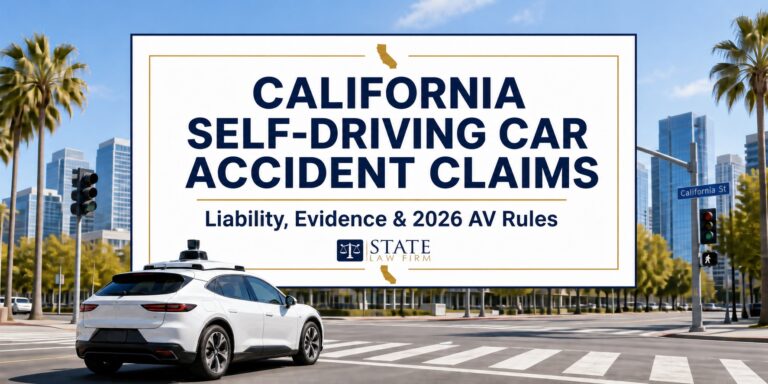
California’s 2026 autonomous-vehicle rules give police a formal way to document traffic violations committed while automated driving technology is engaged. For someone injured in a self-driving car accident, that notice may become useful evidence, but it does not automatically prove negligence or guarantee compensation. A civil claim still depends on what caused the crash, who controlled or designed the vehicle, what evidence exists, and how the collision harmed the injured person.
Depending on the facts, responsibility may involve an autonomous-vehicle manufacturer, a fleet or ride operator, a human driver, a component or software company, another road user, or more than one party. Preserving the vehicle’s electronic data and obtaining official records early can be especially important.
What Changed for Autonomous Vehicles in California in 2026?
California created a formal enforcement process for alleged traffic violations by autonomous vehicles. Under California Vehicle Code section 38752, a peace officer who observes an alleged Vehicle Code or qualifying local traffic violation may issue a Notice of Autonomous Vehicle Noncompliance when the autonomous technology was engaged.
The California DMV’s updated autonomous-vehicle regulations made the notice process operative beginning July 1, 2026. The notice identifies core facts such as the alleged violation, date, time, location, and vehicle license plate. The manufacturer must transmit an issued notice to the DMV within the prescribed period, generally 72 hours under the statute and regulations, with faster reporting for certain priority-review situations.
The rules also strengthened requirements involving first-responder communication, emergency interactions, testing, deployment, and incident reporting. The California DMV autonomous-vehicle regulations page maintains the current regulatory materials.
A noncompliance notice is not the same as a conventional traffic ticket
A driverless vehicle cannot receive and sign a citation the way a human driver can. The notice creates an official path for documenting alleged unlawful operation and bringing it to the DMV’s attention. It can help identify the vehicle, manufacturer, location, time, and alleged conduct.
However, the statute expressly states that issuing a notice does not create a presumption that the autonomous vehicle is unsafe. It also preserves the manufacturer’s ability to dispute the nature or occurrence of the alleged violation. An injury claim therefore requires additional proof.
How Can an AV Noncompliance Notice Affect an Injury Claim?
A notice may provide an important investigative lead when the reported violation relates directly to the crash. Examples could include an autonomous vehicle allegedly running a red light, failing to yield, making an unsafe movement, or disregarding an officer’s lawful direction shortly before a collision.
Depending on admissibility and the surrounding evidence, the notice may help establish:
- that autonomous technology was reportedly engaged;
- the vehicle, manufacturer, date, time, and location involved;
- the traffic rule the officer believed was violated;
- the identity of an observing officer or agency;
- a basis for requesting related reports, video, communications, and DMV records; and
- a timeline to compare against vehicle and fleet data.
The notice alone may not establish why the vehicle behaved as it did, whether the alleged violation caused the collision, or the amount of an injured person’s damages. Those issues usually require the complete evidence record.
Who May Be Liable for a Self-Driving Car Accident?
Liability depends on the vehicle’s automation level, whether the automated driving system was engaged, who had operational control, and what actually failed. California defines an autonomous vehicle by reference to higher levels of driving automation, so an ordinary driver-assistance feature is not necessarily treated the same as a truly driverless system.
Autonomous-vehicle manufacturer or developer
A manufacturer or developer may face scrutiny when a crash appears connected to the automated driving system, perception sensors, mapping, decision-making software, remote assistance, inadequate testing, or an unsafe operational design. A claim must connect a legally recognized defect or negligent act to the collision and resulting injury.
Fleet or ride operator
A company that deploys, maintains, dispatches, or remotely supports autonomous vehicles may bear responsibility for negligent maintenance, unsafe deployment, deficient monitoring, or other operational conduct. The precise relationships among the manufacturer, permit holder, fleet owner, and operator matter.
Human driver or safety operator
Some vehicles require a human to supervise or retake control. A human driver may share responsibility if the system was not engaged, the driver ignored a takeover request, misused the technology, or otherwise acted negligently. Marketing language such as “self-driving” does not determine the vehicle’s legal capabilities.
Component, software, or maintenance company
A defective camera, lidar unit, braking component, software update, tire, or other component may contribute to a crash. Maintenance contractors and technology suppliers may become relevant when their work or product helped cause the failure.
Other drivers, cyclists, pedestrians, or public entities
An autonomous vehicle does not eliminate the possibility that another road user caused or contributed to the collision. Dangerous road conditions, malfunctioning traffic signals, or roadway design may also require investigation. Claims involving a public entity have special procedures and potentially much shorter claim-presentation deadlines.
What Evidence Can Prove an Autonomous-Vehicle Accident Claim?
These cases can involve evidence that does not exist in a conventional crash. Some records may be held only by the manufacturer, fleet operator, technology vendor, or government agency. A prompt preservation request can help reduce the risk that relevant data is routinely overwritten or lost.
Important evidence may include:
- the Notice of Autonomous Vehicle Noncompliance and related agency records;
- police collision reports and officer body-camera or dashboard video;
- onboard camera, sensor, event, braking, steering, and acceleration data;
- automated-driving-system status and disengagement records;
- software versions, update history, fault codes, and diagnostic logs;
- remote-assistance communications and operational instructions;
- fleet maintenance, inspection, and repair records;
- DMV collision reports and permit information;
- nearby surveillance, traffic-camera, or witness video;
- witness statements and photographs of the scene;
- physical vehicle and roadway evidence; and
- medical records connecting the collision to the claimed injuries.
California requires permitted autonomous-vehicle operators and manufacturers to submit specified collision reports to the DMV. The DMV publishes autonomous-vehicle collision reports, although the public report may not contain every piece of data needed to evaluate a civil claim.
What Should You Do After a Collision With a Driverless Vehicle?
- Call 911 and request a police response. Tell the responding officer if the other vehicle appeared to be operating autonomously and identify any fleet or company markings.
- Seek appropriate medical care. Some injuries are not immediately obvious. Describe your symptoms accurately and follow medical advice.
- Document the vehicle and scene. Photograph the license plate, vehicle identification, company name, sensor array, collision positions, traffic controls, debris, and visible injuries when it is safe to do so.
- Collect witness information. Independent witnesses may have seen the vehicle’s movement before impact or recorded it.
- Preserve trip information. Save ride receipts, app screens, emails, text messages, and the exact pickup, route, and collision time if you were a passenger.
- Avoid speculating about fault. Provide accurate facts, but do not guess about technical failures or give a broad recorded statement before understanding who is requesting it.
- Identify potential data holders quickly. The manufacturer, fleet, app company, public agency, and nearby businesses may possess different records.
The same basic principles discussed in SLF’s guidance on what to do after a California car accident still apply, but the electronic evidence and number of potentially responsible companies can make an AV collision more complex.
Can Comparative Fault Reduce Compensation?
Yes. California generally follows pure comparative negligence. An injured person’s recovery can be reduced by the percentage of fault attributed to that person, while other responsible parties may also be assigned shares of fault. For example, a manufacturer-related system failure and a separate driver’s unsafe maneuver could both contribute to the same collision.
Comparative-fault allegations should be tested against objective evidence rather than accepted based only on an insurer’s characterization. Video, sensor data, signal timing, vehicle positions, and witness accounts may clarify whether an injured driver, cyclist, or pedestrian had a meaningful opportunity to avoid the crash.
What Compensation May Be Available?
Compensation depends on the injuries, available insurance or responsible parties, and proof of loss. Recoverable damages in a supported California personal injury claim may include:
- reasonable past and future medical expenses;
- lost income and diminished earning capacity;
- property damage and other collision-related expenses;
- physical pain, emotional distress, and loss of enjoyment of life; and
- wrongful-death damages for eligible survivors when a crash is fatal.
There is no reliable “average” autonomous-vehicle accident settlement. The value of a claim turns on its specific liability evidence, injuries, prognosis, insurance, and legally recoverable damages.
How Long Do You Have to Bring a California Claim?
California’s general limitations period for an action involving injury caused by another person’s wrongful act or neglect is two years under Code of Civil Procedure section 335.1. Important exceptions can shorten, extend, or otherwise change the applicable deadline.
A claim involving a California public entity generally requires a separate administrative claim much sooner, often within six months for personal injury, subject to specific rules and exceptions. Product, wrongful-death, minor, delayed-discovery, and out-of-state issues can also affect timing. Evidence-preservation concerns may require action long before any filing deadline.
When May Legal Review Be Useful?
Legal review may be helpful when injuries are substantial, fault is disputed, autonomous-system data is controlled by a company, multiple businesses may share responsibility, an insurer requests a broad statement, or a government entity could be involved. An attorney can investigate the vehicle’s operational status, send preservation notices, identify relevant permits and reports, and evaluate which liability theories fit the evidence.
State Law Firm represents people injured in California motor-vehicle collisions. To discuss whether an autonomous-vehicle crash may support a civil claim, you may contact State Law Firm for a consultation.
Frequently Asked Questions About California Autonomous-Vehicle Accidents
Can a driverless car receive a traffic ticket in California?
Beginning July 1, 2026, California’s operative rules allow a peace officer to issue a Notice of Autonomous Vehicle Noncompliance for an alleged violation observed while autonomous technology is engaged. It is a regulatory notice to the manufacturer, not necessarily a conventional citation issued to a human driver.
Does an AV noncompliance notice prove negligence?
No. The notice documents an alleged violation, but California law says its issuance does not create a presumption that the vehicle is unsafe. A civil claim still requires evidence of duty, breach or defect, causation, and damages under the applicable legal theory.
Who is responsible if a Waymo or other robotaxi causes a crash?
Responsibility depends on the facts. Potential parties may include the manufacturer, permit holder, fleet or ride operator, technology or component provider, a human driver, or another road user. The vehicle’s data and operational status are central to the analysis.
Can a passenger bring a claim after a robotaxi collision?
A passenger injured because of another party’s negligence or a legally actionable defect may have a claim. The passenger should preserve the ride receipt, app records, route, vehicle identity, photographs, witness information, and medical documentation.
Are Tesla driver-assistance crashes treated the same as fully driverless crashes?
Not necessarily. A vehicle’s branding does not determine its legal automation level. Liability may differ depending on the system’s capabilities, whether it was engaged, the driver’s duty to supervise, warnings and instructions, and the cause of the collision.
Can autonomous-vehicle data be deleted?
Retention practices vary by company and record type. Because some electronic information may be overwritten in ordinary operations, identifying the relevant companies and requesting preservation promptly can be important.