English
  Spanish
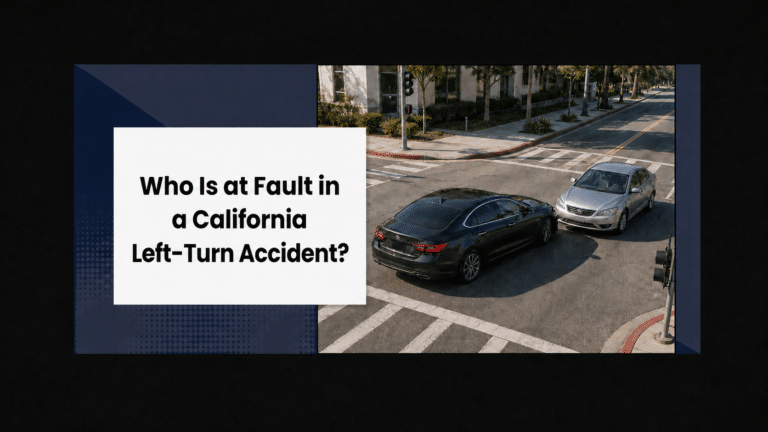
California law generally requires a driver turning left to yield to oncoming vehicles that are close enough to create a hazard. That rule matters, but it does not make the turning driver automatically responsible for every left-turn collision. Signal status, speed, visibility, timing, and the conduct of both drivers may affect fault.
Direct answer: In many California left-turn accidents, the turning driver may be at fault for failing to yield. However, the oncoming driver may bear some or all responsibility if that driver was speeding, entered against a red light, was distracted, or failed to yield after the turn could be completed safely. The available evidence determines how the rule applies.
This guide explains California’s left-turn right-of-way law, when an oncoming driver may share fault, and the evidence that can help resolve conflicting accounts. It is intended for people dealing with an injury claim or insurance dispute after a California intersection crash.
Who Is Usually at Fault in a California Left-Turn Accident?
The driver making the left turn is often the first person an insurer investigates because that driver ordinarily must yield to hazardous oncoming traffic. Under California Vehicle Code section 21801, a driver intending to turn left must yield to vehicles approaching from the opposite direction that are close enough to constitute a hazard during the turning movement.
That duty is not the same as automatic fault. A proper analysis asks what each driver did before the impact. Relevant questions include:
- What signal did each driver face?
- How far away was the oncoming vehicle when the turn began?
- How fast was each vehicle traveling?
- Could either driver see and avoid the developing hazard?
- Had the turning driver already yielded and begun a reasonably safe turn?
A traffic citation, police report, or insurer’s early decision may influence a claim, but none necessarily settles civil responsibility by itself. The physical and electronic evidence must be considered alongside the applicable traffic rule.
What Does California’s Left-Turn Right-of-Way Law Require?
Section 21801 contains duties for both the turning driver and approaching traffic. Subsection (a) requires the left-turning driver to continue yielding until the turn can be made with reasonable safety. Subsection (b) provides that, after the driver has yielded and signaled as required, approaching vehicles must yield to the turning vehicle.
The Judicial Council’s 2026 California Civil Jury Instructions explain that an approaching vehicle is a “hazard” when it is so near or moving so fast that a reasonably careful person would recognize a danger of collision. In a multi-lane intersection, a turning driver may need to make sure no hazardous vehicle is approaching in each open oncoming lane.
Unprotected left turn
An unprotected left turn crosses oncoming traffic without a green arrow stopping that traffic. A circular green signal permits the turn, but the turning driver must still yield to oncoming vehicles that present a hazard. A flashing yellow arrow likewise generally warns the driver to turn cautiously and yield.
Protected green arrow
A green arrow generally permits movement in the arrow’s direction while conflicting traffic faces a red indication. If a collision occurs during a protected turn, evidence showing the signal phase can be central to determining whether the oncoming driver entered against a red light.
When the turn is already underway
Drivers approaching an intersection cannot disregard a turning vehicle simply because they originally had the right-of-way. Section 21801(b) may become important when the turning driver yielded, signaled, and began the turn when it could be made with reasonable safety. The precise timing and position of both vehicles remain factual questions.
When Can the Oncoming Driver Be at Fault?
An oncoming driver may share or bear fault when that driver’s conduct helps cause the crash. Common disputed circumstances include:
- Entering against a red light. Video, witnesses, and signal records may show whether the oncoming driver entered after the signal changed.
- Driving at an unsafe speed. California’s Basic Speed Law prohibits driving faster than is reasonable or prudent for the conditions. Speed can affect whether an approaching vehicle reasonably appeared to be a hazard.
- Distracted or impaired driving. Inattention can delay braking or prevent a driver from recognizing a vehicle already turning through the intersection.
- Failing to respond to a visible hazard. Having the right-of-way does not excuse a driver from using reasonable care to avoid a crash that could reasonably be avoided.
No single fact automatically decides liability. For example, evidence that the oncoming driver was speeding may support shared fault, but it does not necessarily excuse an unsafe turn. Both drivers’ actions must be evaluated together.
Can Both Drivers Share Fault for a Left-Turn Crash?
Yes. California follows comparative fault principles. If an injured person was also negligent and that negligence contributed to the harm, the person’s damages may be reduced according to the percentage of responsibility assigned to that person. The Judicial Council explains this process in CACI Nos. 405 and 406.
There is no dependable “standard” percentage for a left-turn accident. The allocation depends on evidence about the traffic signals, speed, visibility, reaction time, vehicle paths, and other circumstances. An insurer’s initial assessment is also not necessarily the final legal determination.
If an insurer proposes an equal split without addressing important evidence, SLF’s guide to challenging a 50/50 insurance decision explains additional documentation and dispute steps.
What Evidence Helps Prove Fault in a Left-Turn Accident?
The most useful evidence is evidence that answers a specific disputed question: Who had the signal? How fast were the vehicles moving? When did the turn begin? What could each driver see?
Evidence showing who had the right-of-way
- Dashcam or intersection-camera footage
- Video from nearby businesses or homes
- Independent witness statements
- Traffic-signal timing or phase records
- Photographs showing signal placement and lane controls
Evidence showing speed and vehicle movement
- Vehicle damage and impact locations
- Skid marks, debris, and final resting positions
- Electronic data from a vehicle, when available and properly preserved
- Accident-reconstruction analysis in a serious or technically disputed case
The point of impact can help reconstruct the collision, but it rarely proves fault alone. Likewise, severe damage does not by itself establish a particular speed. Those facts require interpretation in context.
Evidence that can disappear quickly
Surveillance systems may overwrite footage, vehicles may be repaired or destroyed, and road conditions can change. A prompt preservation request may be important when camera footage, vehicle data, or physical evidence could affect the claim. Readers dealing with a side-impact collision can also review SLF’s guide to T-bone accident fault and next steps.
What Should You Do After a Left-Turn Collision?
- Address immediate safety. Call 911 when someone may be injured or the scene presents a danger. Follow emergency instructions.
- Seek appropriate medical care. A medical professional can assess symptoms and recommend care. Do not rely on an article to diagnose an injury.
- Document the intersection when safe. Photograph the signals, lane markings, sight obstructions, damage, debris, and vehicle positions.
- Identify witnesses and cameras. Obtain contact information and note nearby businesses, homes, buses, or vehicles that may have recorded the crash.
- Preserve electronic evidence. Save dashcam files and avoid altering potentially relevant vehicle data.
- Exchange required information and make appropriate reports. The California DMV provides official guidance on what to do after a collision.
- Avoid guessing or admitting fault. Describe what you observed without speculating about distances, speed, or legal responsibility.
- Keep claim records. Save insurance correspondence, photographs, repair estimates, medical records, receipts, and wage-loss documentation.
When Can Legal Review Help With a Disputed Left-Turn Claim?
Legal review may be useful when the crash caused a significant injury, the drivers disagree about the signal, video is at risk of being erased, multiple lanes or vehicles are involved, or an insurer assigns fault without addressing contrary evidence. Claims involving a commercial vehicle, rideshare vehicle, or public entity may also present additional insurance and procedural questions.
A lawyer can evaluate the available evidence, identify material that should be preserved, communicate with insurers, and explain how California law may apply to the particular facts. That review cannot guarantee a recovery or a particular fault allocation.
State Law Firm’s California car accident lawyers assist injured people with disputed-liability claims. The firm offers free consultations and can be reached at (877) 659-9223. The decision to hire a lawyer depends on the injuries, evidence, insurance issues, and complexity of the matter.
Frequently Asked Questions About California Left-Turn Accidents
Is the left-turning driver always at fault in California?
No. The left-turning driver generally must yield to hazardous oncoming traffic, but fault depends on both drivers’ conduct. An oncoming driver’s speed, signal violation, distraction, or failure to respond to a visible hazard may support partial or, in some cases, greater responsibility.
Does a green light give me the right-of-way to turn left?
A circular green light generally permits a left turn but does not give priority over hazardous oncoming traffic. The turning driver ordinarily must yield. A protected green arrow presents a different situation because conflicting traffic should face a red indication, subject to the actual signal operation and evidence.
What if the oncoming driver was speeding?
Unsafe speed may affect fault because it changes how quickly the oncoming vehicle reaches the intersection and whether the turning driver could reasonably judge the available gap. Speed must be proven with reliable evidence, and it does not automatically eliminate the turning driver’s duty.
Does the location of vehicle damage prove who caused the crash?
Not by itself. Damage location can help show impact angle and vehicle paths, but it usually must be considered with video, witness accounts, road evidence, signal status, and other information. Technical analysis may be useful in a serious disputed-fault case.
Can both drivers recover if both were partly responsible?
Potentially. California comparative-fault principles generally allow responsibility to be divided, with an injured person’s damages reduced by that person’s assigned percentage of fault. Whether a party has a viable claim also depends on causation, damages, insurance, and procedural requirements.
Can a police report decide civil fault?
A police report may contain useful observations, diagrams, statements, and citation information, but it does not necessarily control an insurer, court, or jury. Its significance depends on what the officer personally observed, the investigation performed, and the other available evidence.
Protect the Evidence Before the Fault Dispute Hardens
California’s left-turn rule provides the legal starting point, not a substitute for investigating the crash. Signal status, speed, visibility, timing, and preserved evidence can change the analysis. If injuries are significant or liability is disputed, an early review can help identify evidence that may otherwise be lost and clarify the available claim options.