English
  Spanish
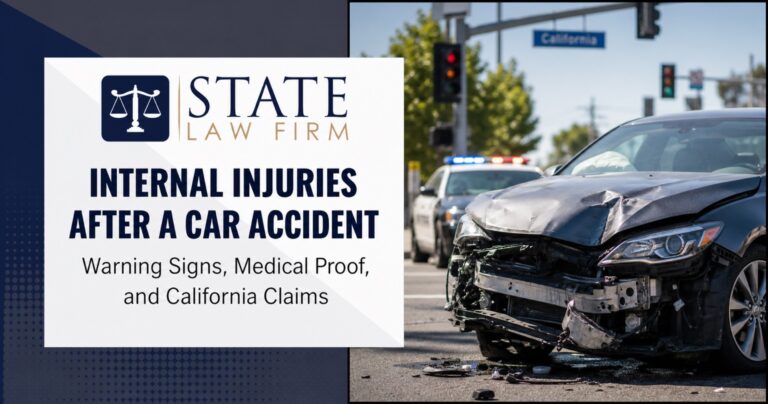
Internal injuries after a car accident may involve bleeding or damage to organs, blood vessels, the chest, abdomen, or pelvis. Some are immediately apparent, while others may initially cause mild or unclear symptoms. Warning signs such as worsening abdominal or chest pain, dizziness, confusion, shortness of breath, fainting, unusual swelling, or blood in urine, vomit, or stool require prompt medical attention. Only a qualified medical professional can diagnose the injury.
A collision can produce substantial force without leaving an obvious external wound. Seat belts, airbags, steering wheels, dashboards, and sudden deceleration can all transfer energy to the body. This article explains warning signs that should not be ignored, how clinicians may evaluate suspected internal injuries, and how medical evidence can help establish causation and damages in a California personal injury claim.
What Internal Injuries Can a Car Accident Cause?
“Internal injury” is a broad description, not a single diagnosis. Depending on the direction and severity of the impact, a collision may injure structures inside the chest, abdomen, pelvis, or head. Possible injuries include:
- Internal bleeding or damage to blood vessels
- Injuries to the liver, spleen, kidneys, or other abdominal organs
- Lung injuries, including a collapsed lung or bleeding around the lung
- Damage to the heart or other structures in the chest
- Bowel, bladder, or pelvic injuries
- Bleeding inside the skull, which is addressed more fully in resources about traumatic brain injuries
The specific injury cannot be identified from symptoms alone. A bruise across the torso may be consistent with restraint loading, but it does not establish what happened beneath the skin. Likewise, a person who has little visible bruising may still need urgent evaluation based on the crash forces, symptoms, medical history, and examination findings.
Warning Signs That Need Prompt Medical Attention
According to MedlinePlus guidance on bleeding, internal bleeding can become life-threatening and requires immediate medical care. Call 911 or seek emergency help if a person develops severe or worsening symptoms after a collision.
Potential warning signs may include:
- Increasing abdominal pain, tenderness, firmness, or swelling
- Chest pain or difficulty breathing
- Dizziness, fainting, confusion, or unusual drowsiness
- Pale, cool, or clammy skin
- A rapid pulse, weakness, or shortness of breath
- Blood in urine, vomit, or stool
- Large or spreading bruises, particularly across the chest or abdomen
- New shoulder pain occurring with abdominal symptoms
This list is not a diagnostic checklist. Other conditions can cause similar symptoms, and serious trauma can present differently from one person to another. Medication that affects clotting, an existing bleeding disorder, age, pregnancy, and other health factors may also affect risk. When emergency symptoms are present, a legal claim should never take priority over medical care.
Can internal bleeding have delayed symptoms?
Yes. Merck Manual explains that internal bleeding may initially cause no symptoms, even though an injured organ may be painful. Symptoms may become more noticeable as bleeding progresses. A delay does not prove that a crash caused an injury, but it is one reason a person should not dismiss new or worsening symptoms after significant trauma.
How Doctors Evaluate and Document Suspected Internal Injuries
Medical professionals determine what evaluation is appropriate. The process may include a history of the collision, a physical examination, vital signs, laboratory testing, and imaging. Depending on the circumstances, clinicians may use ultrasound, X-ray, CT, MRI, or other testing. Each tool answers different clinical questions. For example, CT is often used in acute trauma settings, while MRI may be considered for particular soft-tissue, spinal, joint, nerve, or brain concerns. Our guide to MRI and diagnostic imaging after a car accident explains those distinctions in more detail.
For both treatment and a later claim, the most useful record is usually a continuous medical timeline that documents:
- When and how the collision occurred
- When each symptom began and how it changed
- Relevant examination and vital-sign findings
- Why a particular test or scan was ordered
- The radiologist’s or specialist’s interpretation
- Treatment, hospitalization, procedures, and follow-up care
- Work restrictions and effects on ordinary activities
An abnormal scan is important medical evidence, but it does not independently prove legal causation. Insurers may examine whether the finding is acute or preexisting, whether the reported mechanism is medically consistent with it, and whether there were other possible causes. Treating-provider records and, when needed, qualified expert opinions can connect the clinical findings to the collision more reliably than a scan viewed in isolation.
How Internal Injuries Are Proven in a California Accident Claim
A successful California negligence claim generally requires proof that another party failed to use reasonable care, that the failure caused harm, and that the injured person sustained compensable losses. Internal-injury evidence therefore has two related jobs: proving the medical condition and connecting it to the crash.
Evidence of the collision and force involved
Photos, video, vehicle damage, event-data-recorder information, police documentation, witness statements, and reconstruction evidence may help establish how the impact occurred. Damage to a seat belt, airbag deployment information, or intrusion into the passenger compartment may also be relevant. Severe vehicle damage is not required for an injury claim, and vehicle appearance alone should not be used as a medical conclusion.
Evidence connecting the injury to the crash
Emergency records, imaging reports, lab results, operative notes, specialist opinions, and consistent symptom histories may help establish causation. Prior medical records can also matter when an insurer argues that a condition existed before the collision. California law may permit recovery when a crash aggravates a preexisting condition, but the claimant must still prove the nature and extent of the crash-related harm.
Evidence of the resulting losses
Medical bills, wage records, employer verification, receipts for necessary services, and evidence of daily limitations may document damages. The California Courts Self-Help Guide identifies medical bills, lost wages, ongoing treatment, emotional harm, and future injury-related problems as losses that may be claimed when supported by the facts and evidence.
What Damages May Be Available?
Compensation depends on liability, insurance, the medical evidence, and the effect of the injury. Potential damages in an appropriate California claim may include:
- Reasonable past medical expenses
- Supported future medical care
- Past lost income and loss of future earning capacity
- Physical pain, mental suffering, and emotional distress
- Loss of ability to provide household services
- Other accident-related out-of-pocket losses
The Judicial Council’s California Civil Jury Instructions address medical expenses and other economic and noneconomic damages. A diagnosis does not establish a fixed settlement value. The duration of symptoms, need for surgery or hospitalization, prognosis, effect on work and daily life, available insurance, disputed fault, and quality of the documentation can all affect a claim.
Steps That Can Protect Your Health and Preserve Evidence
- Respond to emergency symptoms. Call 911 when severe pain, breathing difficulty, fainting, confusion, signs of shock, or suspected internal bleeding are present.
- Describe the collision and symptoms accurately. Tell clinicians where the body struck the vehicle and disclose relevant medications and health conditions.
- Follow reasonable medical instructions. Attend recommended follow-up visits and promptly report significant changes.
- Preserve documents. Keep discharge instructions, imaging reports, bills, prescriptions, work notes, and related receipts.
- Save crash evidence. Retain photographs, witness information, insurance correspondence, and the collision report when available.
- Avoid medical or legal conclusions online. Social-media posts may be incomplete or misunderstood and can complicate an insurance investigation.
The California Department of Insurance recommends promptly notifying the insurer, preserving accident information, and documenting losses. Its post-accident consumer guide also explains that medical expenses and other losses may require supporting documentation.
When Legal Review May Be Useful
Legal review may be useful when an internal injury requires hospitalization or surgery, liability is disputed, symptoms appeared after a delay, the insurer challenges medical causation, multiple vehicles or businesses may be responsible, or the available coverage may not address the full loss. Claims involving a public vehicle or government entity may also involve special claim-presentation requirements and shorter procedural deadlines.
California personal injury lawsuits are generally subject to a two-year limitation period under Code of Civil Procedure section 335.1, but important exceptions and shorter deadlines can apply. Do not calculate a deadline from a general article. An attorney can review the responsible parties, evidence, coverage, and rules that apply to the specific matter.
State Law Firm’s car accident practice serves injured people in California from its Sherman Oaks base. If you have questions about a serious crash-related injury, you may contact the firm at (877) 659-9223 for a free consultation. Contacting the firm does not guarantee representation or a particular result.
Frequently Asked Questions
How soon do internal injuries show after a car accident?
Some internal injuries cause immediate symptoms, while others may initially produce subtle or no symptoms. The timing varies by injury and individual circumstances. New or worsening abdominal pain, chest pain, dizziness, fainting, confusion, breathing difficulty, or signs of bleeding require prompt medical attention.
Can a low-speed crash cause an internal injury?
It is possible, but crash speed alone does not diagnose an injury. Occupant position, direction of force, restraint use, contact inside the vehicle, age, medications, and health conditions may all matter. A medical professional must evaluate the person’s symptoms and findings.
What tests can detect internal injuries?
Depending on the suspected injury, clinicians may use physical examinations, vital signs, blood or urine testing, ultrasound, CT, MRI, X-ray, or other procedures. The appropriate test depends on the symptoms, body area, urgency, and clinical judgment.
Does a CT scan prove that the accident caused internal bleeding?
A CT scan may document a medical finding, but it does not alone decide legal causation. Timing, prior health history, crash mechanics, examination findings, radiology interpretation, treatment records, and qualified medical opinions may be needed to connect the injury to the collision.
Can I recover damages if I had a preexisting condition?
A preexisting condition does not automatically prevent recovery. A person may seek compensation for additional harm or aggravation caused by another party’s negligence, but the evidence must distinguish the crash-related change from the earlier condition as reliably as possible.
Should I give the other driver’s insurer a recorded statement?
Use caution before providing a recorded statement to an adverse insurer, particularly when the diagnosis or prognosis is still developing. Policy obligations differ, especially with one’s own insurer. Legal advice can help clarify what must be provided and how to avoid inaccurate speculation.
Takeaway for California Crash Victims
Internal injuries may be serious even when there is no open wound or dramatic initial symptom. Health comes first: seek emergency help for warning signs and follow qualified medical guidance. For a claim, preserve the complete chain of evidence from the collision through diagnosis, treatment, and measurable losses. When causation, coverage, or damages are disputed, a fact-specific legal review can clarify the available options.
This article is provided for general informational purposes only and does not constitute legal advice. Reading this content or contacting State Law Firm does not create an attorney-client relationship. Legal rights, deadlines, and available claims depend on the specific facts and circumstances of each matter.