English
  Spanish
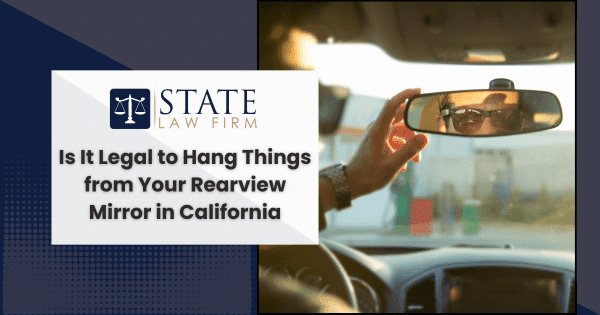
No, California does not automatically make an object illegal merely because it hangs from a rearview mirror. Under California Vehicle Code section 26708, the issue is whether the object obstructs or reduces the driver’s clear view through the windshield or side windows. Size, placement, movement, and the driver’s actual sightline can all matter.
A small object that does not interfere with visibility may not violate the statute. A larger item, several items, or anything that swings into the driver’s line of sight may create a greater risk of a traffic stop or citation. The safest practical choice is to keep the area around the mirror clear while driving.
What Does California Vehicle Code Section 26708 Say?
California Vehicle Code section 26708 contains two related rules. Subdivision (a)(1) generally prohibits driving with an object or material placed, displayed, installed, affixed, or applied on the windshield or side or rear windows. Subdivision (a)(2) separately prohibits driving with an object placed, displayed, installed, affixed, or applied in or on the vehicle if it obstructs or reduces the driver’s clear view through the windshield or side windows.
The law does not provide a list declaring every air freshener, rosary, tassel, charm, or parking pass legal or illegal. The central question is visibility. An officer evaluating a hanging object may consider its dimensions, where it hangs, whether it moves, and how it affects the view of vehicles, pedestrians, cyclists, signals, or other hazards.
Rearview mirrors themselves are expressly exempt. The statute also contains specific exceptions for certain signs, stickers, permits, navigation devices, toll devices, and safety equipment when they are installed in permitted locations and meet the applicable requirements.
When Does Something Hanging From the Rearview Mirror Become Illegal?
An object may violate section 26708 when it actually obstructs or reduces the driver’s clear view. There is no universal size limit for mirror hangers. The same object could present different visibility concerns depending on the vehicle, the length of the cord, the driver’s seating position, and whether the object remains still or swings while the vehicle moves.
Factors that can increase obstruction risk include:
- A large or wide object near the center of the windshield
- A long item that hangs into the driver’s normal sightline
- An object that swings during turns, braking, or acceleration
- Several items whose combined size reduces visibility
- A placard or pass left hanging while the vehicle is moving
- Placement that blocks the view of pedestrians, bicycles, signals, or cross traffic
A small item is not automatically lawful, and a hanging item is not automatically unlawful. The circumstances determine whether the statutory obstruction rule applies.
Can You Hang an Air Freshener From Your Rearview Mirror?
California does not impose a categorical ban on every rearview-mirror air freshener. An air freshener can still become a violation if it obstructs or reduces the driver’s clear view. Tree-shaped air fresheners were central to two California appellate decisions that reached different results because the officers presented different evidence about obstruction.
A vent-mounted or otherwise non-hanging air freshener generally avoids the specific visibility concern created by an item suspended near the center of the windshield. Whatever placement you choose should remain outside the driver’s sightline and should not interfere with vehicle controls or safety systems.
What Have California Courts Said About Hanging Objects?
People v. White: A Hanging Object Is Not Automatically Illegal
In People v. White (2003), an officer saw a tree-shaped air freshener hanging from a rearview mirror. The court concluded that the evidence did not provide a reasonable basis for believing the object obstructed or reduced the driver’s view. The officer had not described specific facts showing an obstruction, and evidence indicated that the air freshener remained stationary and covered only a very small portion of the windshield.
The decision is important because it explains that section 26708 does not flatly prohibit every object hanging from a rearview mirror. Merely seeing a hanging object may not be enough without facts supporting a reasonable belief that it obstructs or reduces the driver’s clear view.
People v. Colbert: Specific Evidence of Obstruction Can Justify a Stop
People v. Colbert (2007) involved another tree-shaped air freshener, but the evidence was more specific. The officer described the item as approximately 4.75 inches tall and 2.75 inches wide at its widest point. He also explained, based on personal experience with a similarly sized object, how its proximity to the driver could block the view of vehicles or pedestrians.
The court upheld the stop because those observations supplied the specific and articulable facts that were missing in White. Together, the cases show why the outcome depends on the object and the evidence of obstruction, not simply on the fact that something was hanging.
People v. Garcia: Size and Movement Can Matter
In People v. Garcia (2011), an officer observed a large object hanging from a rearview mirror from across an intersection. The officer testified that the object could obstruct the driver’s view and could swing when the vehicle turned. The court found sufficient specific and articulable facts to support the stop.
Garcia reinforces the practical lesson from White and Colbert: visible size, placement, and movement can affect whether an officer has an objective basis to believe the statute is being violated.
What About Tassels, Rosaries, Parking Passes, and Other Objects?
Section 26708 does not classify common mirror hangers one by one. This table describes relative obstruction risk, not a guarantee that a particular item is legal or illegal.
| Item | Relative obstruction risk | Why the facts matter | Lower-risk option |
|---|---|---|---|
| Tree-shaped air freshener | Depends on placement | Central placement and movement can affect the driver’s view | Use a vent-mounted product |
| Graduation tassel | Depends heavily on length and movement | It may swing into the sightline during turns or braking | Display it only while parked |
| Rosary or prayer beads | Depends heavily on placement | Length and movement may increase the area affected | Store it securely while driving |
| Plush toy or large ornament | Higher | A larger object is more likely to block part of the forward view | Remove it from the mirror |
| Parking pass or placard | Higher while driving | Passes may be wide, hang low, or move with the vehicle | Remove and store it before driving unless a law requires otherwise |
| Small charm | Depends on the facts | Even a small item may matter if it hangs in the driver’s sightline | Keep the mirror area clear |
| Multiple hanging items | Higher | Combined size and movement can reduce visibility | Remove the items while driving |
What Can Legally Be Mounted on a California Windshield?
Section 26708 includes detailed exceptions for certain items and mounting locations. Depending on the item and the subsection that applies, permitted areas can include a seven-inch square in the lower corner farthest from the driver, a five-inch square in the lower corner nearest the driver, or a limited area at the upper center of the windshield. The statute also addresses GPS devices, electronic toll and traffic-management devices, video event recorders, and certain vehicle-safety technologies.
These exceptions are specific. They should not be read as permission to put any object in those areas. Drivers should review the current text of section 26708 and follow the placement instructions for the particular device. A permitted device must also avoid interfering with an airbag and comply with any other applicable requirements.
Can a Hanging Object Lead to a Traffic Stop or Ticket?
Yes. An officer may stop a vehicle when specific observations create an objectively reasonable basis to believe a hanging object obstructs or reduces the driver’s view. As the California cases illustrate, the officer’s description of the item and its effect on visibility can be important.
A citation does not necessarily mean that every similar object is prohibited. Depending on the circumstances and the instructions on the citation, the alleged violation may be handled as a correctable violation. Drivers should follow the directions on the citation or contact the court listed on it. Court assessments and procedures can change, so this article does not state a universal ticket amount.
Can an Obstructed View Matter After a Car Accident?
A hanging object may become relevant evidence after a collision if there is evidence that it blocked the driver’s view and contributed to the crash. For example, photographs of the vehicle interior, dash-camera footage, witness statements, the position and size of the object, and the driver’s account may help show whether visibility was affected.
A violation of section 26708 does not by itself prove that the hanging object caused an accident. Fault still depends on the evidence, including each driver’s conduct and the connection between the obstruction and the collision. When injuries are significant, responsibility is disputed, or important evidence may disappear, a review by a California car accident lawyer may help clarify the issues and applicable deadlines.
How Can Drivers Reduce Rearview-Mirror Obstruction Risk?
- Keep the area around the rearview mirror clear while driving.
- Remove parking passes and placards when they are not legally required to be displayed.
- Use vent-mounted or other non-hanging accessories when practical.
- Install GPS and toll devices only in locations allowed by the current statute and manufacturer instructions.
- Check visibility from your normal seated driving position.
- Do not place an item on the dashboard if it could block your view or interfere with an airbag.
The simplest approach is also the least ambiguous: do not hang an object where it can enter the driver’s sightline.
Frequently Asked Questions
Is it illegal to have anything hanging from your rearview mirror in California?
No. California law does not automatically prohibit every hanging object. An item can violate Vehicle Code section 26708 if it obstructs or reduces the driver’s clear view through the windshield or side windows.
How large does an object have to be before it becomes illegal?
The statute does not establish a universal size limit for mirror hangers. Size is one factor. Placement, movement, proximity to the driver, the vehicle’s design, and the actual effect on visibility can also matter.
Can you hang an air freshener from your rearview mirror?
An air freshener is not categorically banned, but it may violate the law if it obstructs or reduces clear visibility. A vent-mounted air freshener generally avoids the issue created by an object hanging near the windshield.
Can you hang a rosary or graduation tassel from the mirror?
The law does not create a special exemption or blanket ban for rosaries or tassels. The question is whether the specific item, as displayed, obstructs or reduces the driver’s clear view. Length and movement can increase the risk.
Can police stop you for something hanging from the mirror?
Police may make a stop when specific facts support an objectively reasonable belief that the object obstructs or reduces the driver’s view. California appellate cases show that merely observing a hanging item may not always be enough without facts indicating obstruction.
Does a mirror obstruction automatically make a driver liable for a crash?
No. The obstruction may be relevant evidence, but liability depends on whether it contributed to the collision and on the other facts surrounding the crash.
Get Help After a California Car Accident
If a visibility obstruction may have contributed to a serious crash, preserving evidence and identifying every responsible party can be important. State Law Firm can review the circumstances, explain the available options, and help determine whether legal action may be appropriate. Contact the firm for a consultation. Results depend on the facts of each case, and this article provides general information rather than individualized legal advice.