English
  Spanish
State Law Firm | Serving Encino, California
Encino Personal Injury Lawyer
An injury can raise questions about medical bills, missed work, and who was responsible. State Law Firm helps people in Encino review their options, preserve useful records, and discuss next steps from our nearby Sherman Oaks office.
Free initial consultation
Encino injury matters
Evidence and next-step review
Nearby Sherman Oaks office
Start with the date, exact location, and a short account of what happened. Keep original photos, reports, contact details, and insurer messages. You can request a consultation before every record is available; mention any deadline or public entity involved.
Personal Injury Help for People in Encino
An injury can leave you sorting through medical appointments, missed work, insurance messages, and questions about who was responsible. State Law Firm helps people in Encino review potential injury claims from our nearby Sherman Oaks office. The first conversation starts with your circumstances, not a promised case value.
This is our general Encino injury resource. A collision, fall in an apartment building, and injury at a restaurant may require different records and different legal analysis. The service links below help you find information that fits the event while keeping a direct route to an attorney consultation.
Find the Encino Injury Service That Fits
You do not need to choose a legal category before contacting us. Describe where you were, what you were doing, and what happened. These Encino resources address more specific situations:
- Encino car accidents: vehicle movement, driver information, collision reports, and available recordings. This separate page focuses on car-collision questions.
- Apartment injuries: the exact common area or unit location, the condition involved, and communications with a landlord or manager.
- Bus accidents: the operator, route, vehicle number, and boarding, riding, or street-crossing circumstances.
- Uber crashes: trip receipts, app information, vehicle details, and the stage of the ride when the incident occurred.
- Lyft accidents: pickup or drop-off information, trip records, and communications connected to the event.
- Sidewalk falls: the precise location, surface condition, surrounding property, and potentially responsible entities.
- Pedestrian injuries: crossing location, visibility, traffic movements, and witness or camera information.
- Restaurant injuries: the specific hazard or event, incident report, staff contacts, and available footage.
For another type of injury, review our personal injury practice areas, including the firm’s dog-bite resource. Tell the team if the event happened while you were working. Workers’ compensation and a possible claim involving someone outside the employment relationship require separate assessment; neither benefits nor a second recovery should be assumed.
The Exact Setting Changes the Evidence
Encino is a Los Angeles neighborhood, not a separate city government. The City’s Encino-Tarzana planning information describes this community area. Ventura Boulevard’s commercial corridor and the nearby mix of homes, apartments, shops, and parking areas provide different settings for an injury. A street name alone rarely identifies the people, property, or records that need to be investigated.
For example, an event near Ventura Boulevard and Balboa Boulevard might occur inside a business, at its driveway, or on an adjoining sidewalk. Those are different locations even if the same business address appears on your receipt. Preserve an entrance name, cross street, direction of travel, or photograph showing where the event actually happened. Naming a nearby business does not establish that it controlled the location or caused the injury.
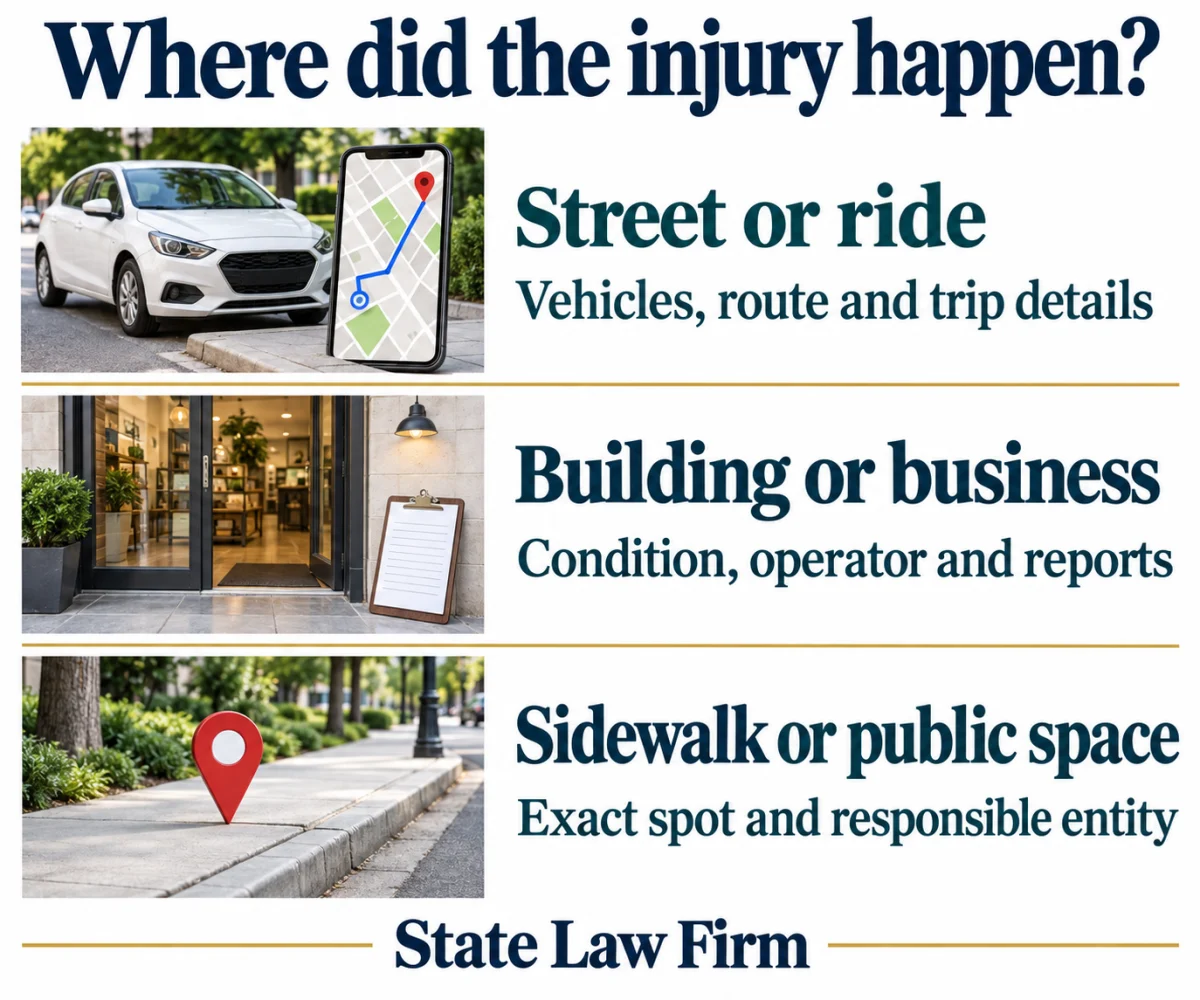
- Street or ride: keep vehicle and driver details, a route or trip record, and the investigating agency’s information.
- Building or business: identify the entrance or area, what condition was involved, who was notified, and any report or maintenance correspondence.
- Sidewalk or public space: record the exact spot and surrounding features. Property control and the correct public or private entity need investigation.
Collect only what you can obtain safely and lawfully. Do not enter a restricted area, move a hazard to stage a photograph, or delay necessary care to gather evidence. A companion may be able to help preserve information that is already available.
What an Injury Claim Review Examines
Being hurt does not automatically establish another person’s legal responsibility. A negligence review considers the applicable duty, the conduct at issue, whether it caused harm, and the evidence of that harm. Other claim types can use different rules. The legal analysis must connect the event to the injury rather than rely only on the fact that an accident occurred.
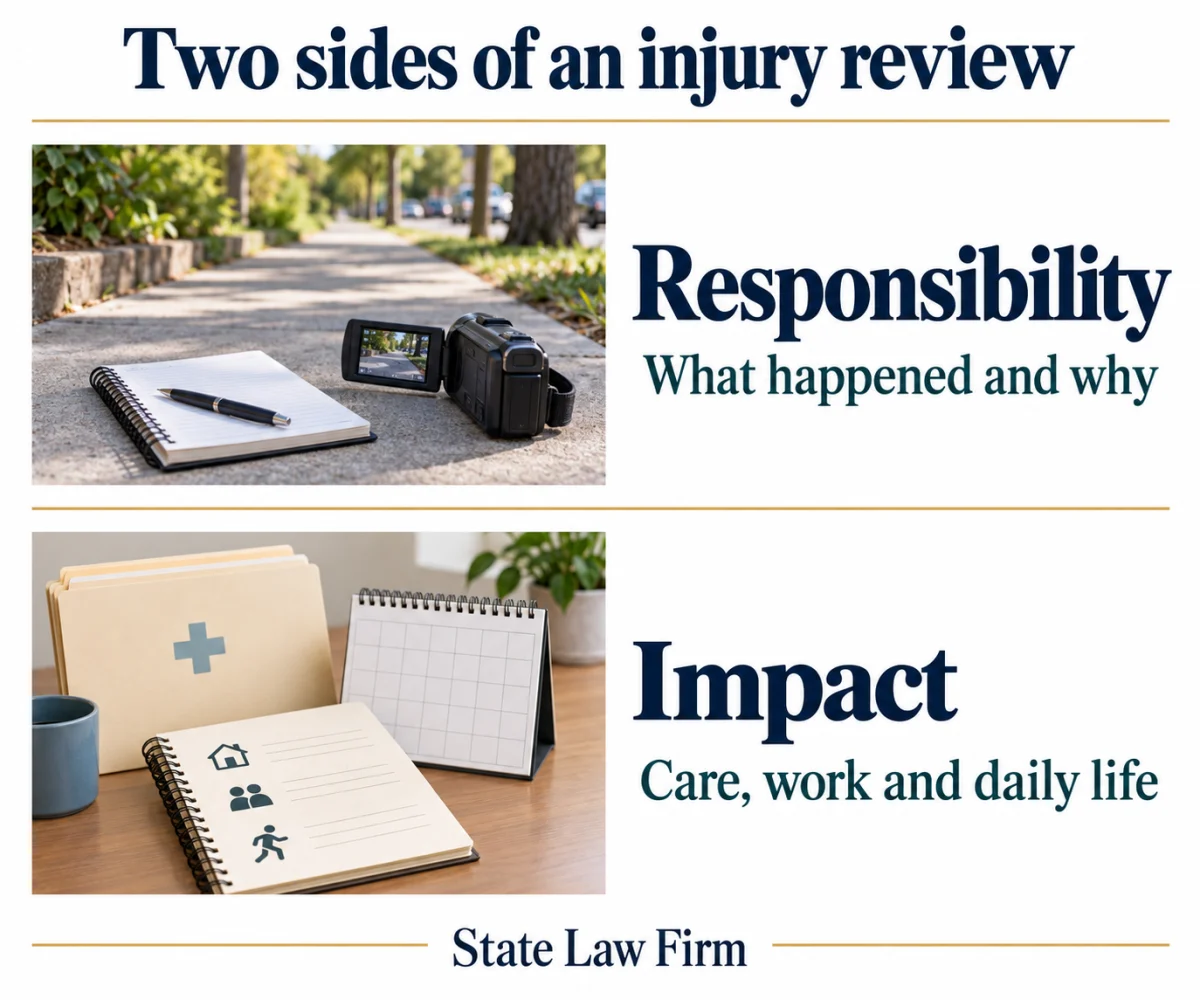
Responsibility: photographs, witnesses, recordings, reports, and property or operator information can help explain what happened and why. A report may contain useful observations, but the team’s assessment also considers other evidence and applicable law. Disputed facts or an allegation that you contributed to the event need careful review; a percentage should not be guessed during an initial call.
Impact: care records, itemized bills, wage information, and a factual account of changes to daily activities help document the injury’s effects. Describe what has changed, when it changed, and any relevant prior condition. Potential compensation may involve financial losses and nonfinancial harm, but the available categories and amount depend on the claim and supporting evidence. Another person’s settlement is not a reliable estimate for your circumstances.
Preserve Records Without Rewriting the Story
Keep original photos and video files, not only cropped screenshots or social-media versions. Make a backup and note who recorded them. A wide view can show the approach to the location, while a closer view can show a surface, vehicle position, or other detail. Do not edit an original recording to make the event appear clearer.
Write a dated account while details are fresh and distinguish what you remember from what someone else told you. Save witness contacts, receipts, ride records, incident numbers, and messages with a property manager or insurer. Let the team know about nearby cameras promptly because recordings may not remain available. Our evidence-preservation resource explains why preserving original material matters.
You can request a consultation with an incomplete file. Identify what is missing and who may hold it. Avoid uploading full medical histories, identification documents, or other sensitive records through a general inquiry form until the team explains an appropriate way to provide them.
Reports, Repair Requests, and Claims Are Different
After a traffic collision: record the agency and report number. Use the LAPD traffic-report instructions when LAPD investigated; a freeway collision may involve a different agency. The DMV’s SR-1 instructions require a report within 10 days when someone is injured or killed, or property damage exceeds $1,000. That requirement is separate from reports to police and insurers.
At a private property: notify the appropriate manager or operator and ask for an incident number or a copy of any report you complete. Keep your own factual account and preserve related messages. A business incident report is not the same as an insurance claim or a lawsuit.
On a public sidewalk or other City property: the City’s sidewalk-reporting information explains repair requests. A repair request addresses a condition; it does not substitute for a properly presented injury claim. The Los Angeles City Attorney’s claims guidance explains the separate process for seeking money damages from the City. The correct entity must be identified before relying on any filing route.
With an insurer: retain claim numbers, letters, emails, and requested response dates. Ask what a proposed authorization or release covers before signing, and answer factual questions accurately. Neither an ongoing investigation nor a settlement discussion should be treated as an extension of a legal deadline.
Check the Deadline for Your Particular Claim
California’s general personal-injury lawsuit limitation is two years under Code of Civil Procedure section 335.1. That is not a universal deadline for every injury matter. The claim type, when it accrued, the parties, and specific exceptions can change the analysis.
For an injury claim involving a public entity, Government Code section 911.2 generally requires presentation of an administrative claim within six months of accrual. Separate lawsuit requirements follow. Tell the team immediately about a public bus, City property, a rejection notice, or any other time-sensitive communication. Do not wait for every record to arrive before checking the applicable deadlines.
Meet the Attorneys

Eddie Tehrani
Eddie Tehrani founded State Law Firm after working in Los Angeles law offices handling personal injury and civil litigation. His background is available on the firm’s attorney page.

Arnold Gross
Arnold Gross’s firm biography describes personal injury trial work and mediation and arbitration experience. Review the team’s backgrounds and ask how your matter would be handled.
Serving Encino from Our Sherman Oaks Office
State Law Firm’s office is at 15490 Ventura Blvd #205, Sherman Oaks, CA 91403. This is the office identified for Encino inquiries, not a separate Encino branch. Call (877) 659-9223 to discuss the initial consultation and confirm meeting arrangements before traveling. See Locations for office information or Contact to reach the team.
Frequently Asked Questions
Can I call if I do not know which type of claim I have?
Yes. Start with the date, exact location, what happened, and your main concern. You do not need to decide whether the matter is a vehicle, property, or another injury claim before requesting a consultation.
Should I wait until I have every report and medical bill?
No. Share what is available and identify missing records. A consultation can address preservation and timing questions while records are pending. Waiting for a complete file does not protect a filing deadline.
Does reporting a sidewalk problem start an injury claim?
A repair request and an injury claim serve different purposes. Preserve any service-request confirmation, but do not assume it satisfies a government-claim requirement. The location, responsible entity, and applicable filing procedure need separate review.
What if the injury happened while I was working?
Tell the team about your employer, work activity, and any existing claim. Workers’ compensation and a possible claim involving another responsible party can involve different rules. The initial review should identify the relevant paths without promising benefits or compensation.
Do you have an office in Encino?
The office listed for this service is in nearby Sherman Oaks at 15490 Ventura Blvd #205. Contact State Law Firm before traveling to confirm the meeting location and arrangements.
Is the initial consultation free?
Yes. State Law Firm offers a free initial consultation. Ask about the scope of representation, the fee agreement, and case costs before hiring the firm. The consultation does not guarantee case acceptance or an outcome.
Request an Encino Injury Consultation
Use the consultation form or call (877) 659-9223. Give a short description of the incident and mention any upcoming deadline or request from an insurer. The team can discuss what information is needed next and how to provide records appropriately.
This page provides general information, not legal advice for a particular situation. Contacting the firm does not by itself create an attorney-client relationship.
Related legal resources: Personal injury practice areas, Personal Injury Lawyers in Santa Cruz, Personal Injury Lawyer Sherman Oaks California, Free consultation.