English
  Spanish
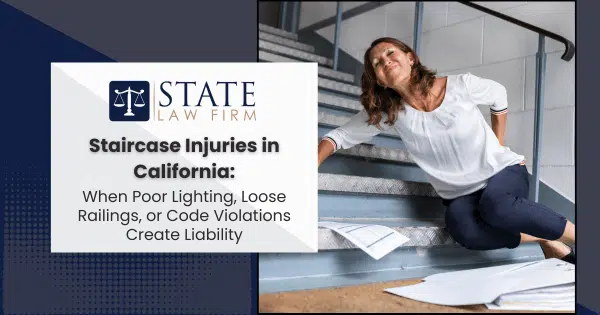
Stairs are meant to connect spaces, not create traps.
Yet in California homes, apartment buildings, stores, and workplaces, staircases can turn routine movement into a sudden fall when lighting is dim, railings are loose, or the structure does not meet basic safety standards.
These cases often come down to one question: was the staircase made reasonably safe for the people expected to use it?
Nationwide, emergency departments treat roughly 1.1 million stair-related injuries per year, a reminder that stairs are among the most common everyday hazards when basic safeguards fail.
Not sure where to begin? This resource on Are E-Bikes Street Legal California Laws and Safety walks you through eligibility, evidence, and recovery options.
Understanding Staircase Injuries in California
A staircase injury is not always a simple “I slipped” story. Stair falls often happen because multiple small failures line up at the wrong moment: a shadow that hides the edge of a tread, a worn strip on a nosing, a handrail that shifts under pressure, or a sudden change in riser height that disrupts a person’s stride.
Common staircase injury scenarios include:
- Missteps caused by low visibility: dim bulbs, broken fixtures, or lighting that creates glare and deep shadows.
- Handrail failures: loose mounts, missing sections, railings set at an unsafe height, or railings that are not continuous where they should be.
- Trips from inconsistent steps: uneven risers or irregular tread depth that forces the foot to land differently step to step.
- Slips from poor traction: smooth materials, worn coatings, wetness, or debris that was not promptly addressed.
- Falls over edges: missing guards on open sides, damaged balusters, or gaps that should not exist.
Actionable guidance if you manage property in California:
- Treat stair safety like a checklist item, not a complaint driven repair. A proactive inspection schedule is often the difference between prevention and liability.
- Document maintenance: keep work orders, inspection notes, and repair invoices. In litigation, your paper trail becomes part of the story.
If you were injured, the key is to avoid assuming it was “just an accident.” A staircase can be dangerous in ways that are not obvious until the evidence is preserved and examined.
Poor Lighting and Its Role in Staircase Accidents
Lighting is one of the most underestimated staircase hazards because the danger is subtle. People can still see “enough,” until they cannot. A missing bulb, a fixture aimed the wrong way, or a hallway light controlled by a timer can create an environment where the edge of each step blends into the next.
Poor lighting contributes to falls in several predictable ways:
- Hidden step edges and nosings: when contrast disappears, depth perception suffers.
- Shadow pockets: one dark step can cause a misread of the entire run.
- Glare: overly bright or unshielded bulbs can wash out detail and create momentary blindness.
- Delayed response time: when someone cannot clearly see the next step, they hesitate, and that hesitation can cause a fall.
Actionable steps for property owners and managers:
- Walk the stairs at night and during low light hours, not just at noon.
- Check for consistent illumination from the top landing to the bottom landing.
- Ensure fixtures are working, secure, and placed to reduce glare.
- Treat repeated “bulb outages” as a systems problem, not an occasional annoyance.
If you were injured in a dim stairwell, your case may turn on what the lighting was actually like at the time of the fall, not what it looked like after the bulb was replaced. A lawyer can help you act quickly to preserve evidence before conditions change.
If the property owner repairs the lighting immediately after the incident, that can make it harder to prove what you experienced. Getting guidance early can help protect your claim.
The Dangers of Loose or Defective Railings
A railing is not decoration. It is a safety device that people rely on instinctively, especially children, older adults, and anyone carrying bags or moving quickly. When a handrail shifts, bends, or comes away from the wall, the body often follows.
Railing related hazards include:
- Loose brackets or mounts that allow the rail to move when grasped.
- Missing handrail sections that leave gaps where a person expects support.
- Improper height or shape that makes the rail difficult to grip.
- Rot, rust, or water damage that weakens structural integrity over time.
- Wobbly stair rails on open sides where a guard should prevent a fall off the edge.
Actionable guidance for property owners:
- Test the rail with firm pressure. If it moves, it is not safe.
- Look for signs of deterioration around fasteners and anchor points.
- Address complaints immediately. A “handrail feels loose” report can become a constructive notice issue if ignored.
- Use qualified professionals for repairs. Quick fixes can fail under real load.
If you were injured and the handrail failed, it is important to document the condition before it is tightened, replaced, or removed. In many cases, the difference between a strong and weak claim is whether the failure can be shown, not merely alleged.
If your fall involved a railing that shifted or broke, consider speaking with a premises liability lawyer before giving a recorded statement to an insurer. Your first description of what happened can shape the claim.
Building Code Violations and Legal Standards for Stairs in California
Building codes exist for a simple reason: predictable design reduces predictable harm. In California, staircases are governed by a mix of rules depending on the property type, including statewide building standards and, in some settings, workplace safety requirements.
While the exact requirements vary by occupancy and context, codes commonly address:
- Handrail height and continuity.
- Guard requirements on open sides to prevent falls from elevated walking surfaces.
- Riser height and tread depth limits designed to keep steps consistent and navigable.
- Uniformity rules to prevent “surprise steps” that disrupt gait.
- Minimum illumination standards for paths of travel and means of egress.
Why code issues matter in injury cases:
- A code violation can be powerful evidence that a staircase was unreasonably dangerous.
- Even when a technical code provision does not apply perfectly, it can still help establish what safe design looks like.
- Code compliance is not always a complete defense. A staircase can be “to code” and still unsafe due to wear, poor maintenance, or changing conditions.
Actionable steps after a staircase fall:
- Photograph the entire stair run, not just one step.
- Capture measurements if you can do so safely, including rail height and any irregular step dimensions.
- Preserve details like missing bulbs, broken covers, or exposed wiring in lighting fixtures.
- Request maintenance records if you are a tenant or visitor and can do so without confrontation.
Tasteful next step: A knowledgeable attorney may work with qualified experts to evaluate code compliance, stair geometry, lighting, and railing integrity. That technical foundation can turn a vague fall story into a clear liability narrative.
Establishing Property Owner Liability for Staircase Injuries
Most staircase injury cases are a form of premises liability. The core idea is straightforward: people who own, control, lease, or manage property have a duty to use ordinary care to keep it reasonably safe.
In practice, liability often turns on several fact specific questions:
- Who controlled the staircase? Owner, landlord, tenant business, property manager, HOA, or public entity.
- Was there a dangerous condition? Poor lighting, loose handrail, uneven steps, missing guards, worn traction, or another hazard.
- Did the responsible party know or should they have known? Actual notice (someone reported it) or constructive notice (it existed long enough that a reasonable inspection would have found it).
- Was reasonable care used? Inspections, repairs, warnings, and maintenance practices matter.
- Did the hazard cause the injury? Medical records, witness accounts, and consistent reporting connect the dots.
California also applies comparative fault principles. That means an insurer may try to shift blame by arguing the injured person was not watching, was distracted, wore the wrong shoes, or used the stairs improperly. Even when a person shares some fault, that does not automatically end the case. The facts simply become more important.
Actionable guidance that protects your claim:
- Avoid casual admissions like “It was my fault” at the scene. You can acknowledge you fell without surrendering the legal question of why.
- If the property is commercial, ask whether incident reports, maintenance logs, or surveillance footage exist and request preservation.
- Keep your timeline clean: seek medical care promptly and describe how the injury happened accurately and consistently.
If you suspect the staircase was unsafe, a consultation can help you understand whether the evidence supports a claim and how to preserve it before it disappears.
Your Rights After a Staircase Injury: Steps to Take in California
The hours and days after a staircase fall matter. Evidence changes quickly. People forget what they saw. Repairs happen. A strong claim often begins with practical steps taken early.
Step 1: Get medical care and create a clear record
Even if you believe you can “walk it off,” staircase injuries can involve fractures, head trauma, and soft tissue damage that worsens over time. Medical records also document causation, symptoms, and progression.
Step 2: Report the incident and identify the decision maker
If the fall happened at a business or apartment building, report it to management and request a copy of any incident report. If it happened on public property, identify the agency in control.
Step 3: Photograph and document before anything changes
Capture:
- The full stairwell from top to bottom.
- Lighting conditions, including dark zones, broken fixtures, or glare points.
- The handrail and its attachments, especially if it moved or failed.
- Any irregular steps, worn traction, or debris.
If possible, take a short video walking the approach path so the viewer can see what you saw.
Step 4: Preserve witnesses and surveillance
Get names and contact information for anyone who saw the fall or saw the condition beforehand. If cameras are present, ask for preservation immediately. Many systems overwrite footage quickly.
Step 5: Be careful with insurance communications
Insurance adjusters may sound friendly while seeking statements that reduce payout. You can provide basic information, but consider speaking with counsel before giving a recorded statement or signing authorizations that allow broad access to your medical history.
Step 6: Know the deadlines that can quietly end a case
In many personal injury cases, California law imposes a time limit to file. When the responsible party is a public entity, additional claim deadlines may apply and can be significantly shorter. Missing a deadline can bar recovery regardless of how strong the facts are.
Tasteful next step: State Law Firm offers free consultations and works on a contingency fee basis in many cases, meaning you do not pay attorney fees unless there is a recovery. If a stair fall disrupted your life, a short call can help you understand your options and next steps.
Protecting Yourself and Seeking Justice After a Staircase Injury in California
Staircase injuries are rarely random. Poor lighting, loose railings, and preventable code related hazards often leave a trail, but only if the trail is preserved. If you were hurt, focus on health first, then documentation, then timely legal guidance that helps you protect evidence and pursue fair compensation.
A stair fall case becomes stronger when you can show a clear hazard, control by the responsible party, and a reasonable opportunity to fix or warn. The sooner you document conditions and get advice, the better your chances of turning a painful moment into a just result.