English
  Spanish
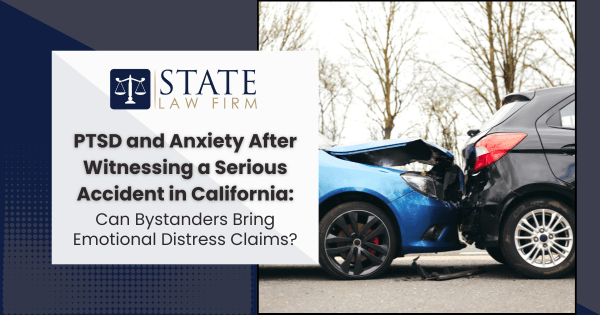
Not every injury from a serious accident is visible. Sometimes the body walks away, but the mind stays trapped in the sound of impact, the sight of blood, or the terrible instant when a loved one stops responding. In California, a bystander may be able to bring an emotional distress claim when those facts meet a narrow legal standard, and if the trauma followed a roadway collision, our El Monte car accident lawyers can help assess whether your situation fits that rule. According to the National Institute of Mental Health, an estimated 3.6 percent of U.S. adults had PTSD in the past year.
Bystander Claims in California: The Core Requirements
California does allow certain bystanders to recover for emotional harm after witnessing a serious accident, but the rule is not as broad as many people assume. This is not simply a claim for being upset, shaken, or unable to sleep for a few nights. The law asks a more exacting question: were you closely connected to the injured person, did you perceive the event as it happened, and did that experience cause serious emotional distress?
At its core, a bystander emotional distress claim turns on a few practical issues:
- Someone else’s negligence must have caused the injury or death
- You must have been present for the injury-producing event in a legally meaningful way
- You must have understood, in that moment, that the event was causing harm to the victim
- Your emotional suffering must be serious, not minor or fleeting
- The event must be a substantial factor in causing that suffering
That matters because California does not treat negligent infliction of emotional distress as a free-standing tort with loose edges. It is still a negligence claim. The legal label may sound abstract, but the proof is very concrete. Courts want timelines. They want details. They want to know what you perceived, when you perceived it, who was hurt, how you knew, and what changed in your life after that moment.
For many families, the hardest part is that the emotional truth feels obvious while the legal standard does not. A mother who hears her child scream during a collision may be deeply traumatized. A spouse who watches emergency crews cut a partner from a crushed vehicle may be unable to work, sleep, or function afterward. Those facts can support a claim, but the claim becomes stronger when the story is disciplined and documented early.
That is one reason early legal help matters. The right lawyer is not only preparing a lawsuit. They are preserving the sequence of events before memory blurs, records disappear, and insurers start reframing the trauma as ordinary stress.
PTSD vs “Normal” Stress: What Must Be Proven
After a violent accident, fear, shock, crying, panic, and sleeplessness are human reactions. The law knows that. What it does not compensate automatically is every painful reaction that follows a disturbing event. To recover, the distress generally must be serious enough that an ordinary, reasonable person would have difficulty coping with it.
That is where the difference between temporary distress and a medically grounded trauma claim becomes important. PTSD is not just feeling rattled. As the National Institute of Mental Health’s PTSD overview explains, trauma-related conditions can involve intrusive memories, avoidance, heightened reactivity, sleep disruption, fear, and functional impairment. The DSM-5 PTSD criteria summarized by NCBI also make clear that trauma can arise from witnessing a catastrophic event happen to another person, not only from being physically struck yourself.
In practice, that means a strong bystander claim often includes more than a personal statement that “I have not felt the same since.” Helpful proof may include:
- A diagnosis of PTSD, acute stress disorder, anxiety disorder, or trauma-related depression
- Therapy or psychiatric treatment that began after the event
- Medication records tied to panic, insomnia, or intrusive symptoms
- Notes showing flashbacks, avoidance, hypervigilance, or impaired daily functioning
- Evidence that the symptoms lasted and interfered with work, parenting, relationships, or basic routines
A diagnosis is not everything, but it matters. Juries and insurance carriers tend to take trauma more seriously when it is grounded in treatment rather than described only in hindsight. On the other hand, the absence of a formal PTSD diagnosis does not always defeat the claim. A person may still have serious emotional distress even if the final label is anxiety, acute trauma response, or another documented condition.
The key is seriousness, duration, and connection. Your records should tell a coherent story: this event happened, you perceived it in real time, your symptoms followed, and your life changed in measurable ways.
What Counts as a Qualifying Relationship and Event
This is where many claims are won or lost.
California generally reserves bystander recovery for people who are closely related to the injured victim. The closer and more obvious the relationship, the cleaner the legal argument usually becomes. Parents, children, and spouses often present the most straightforward cases. More attenuated relationships can trigger harder legal fights, especially if the defense believes the plaintiff is trying to stretch sympathy into liability.
The event itself also matters. The law is usually strongest when the plaintiff perceived the accident while it was happening, not when the plaintiff arrived later and saw only the aftermath. That distinction can feel harsh, but it remains central. Seeing a loved one already injured at a hospital is emotionally devastating. Legally, it is not always the same as perceiving the injury-producing event itself.
Recent California developments also matter here. In Downey v. City of Riverside, the California Supreme Court clarified that a bystander does not need to understand the defendant’s precise negligent role in real time. What matters is awareness that the event is injuring the loved one. That is an important point. In plain English, the law does not require a traumatized family member to perform legal analysis in the middle of catastrophe.
So what tends to strengthen this element?
- You saw or heard the accident unfold as it happened
- You immediately understood that your loved one was being seriously hurt
- Your perception was direct and contemporaneous, not something reconstructed later
- The relationship was close enough that the emotional harm was foreseeable
This area is especially fact-sensitive in phone and technology cases. Real-time audio or video may help, but the details matter. If you are unsure whether your experience qualifies, do not assume it is too unusual to pursue. Some of the most important emotional distress cases turn on nuance, not on whether the trauma looked conventional from the outside.
Evidence Checklist: How to Build the Claim
Emotional distress cases are often undervalued because people treat them as soft. They are not soft. They are evidence-driven. The strongest claims are built like any other serious personal injury case, with records that make the invisible visible.
Here is the kind of proof that often matters most:
- Mental health records: therapy notes, psychiatry records, diagnosis, prescriptions
- Treatment timeline: when symptoms began, when treatment started, how symptoms progressed
- Accident records: police report, traffic collision report, incident report, 911 records
- Your own account: a clear statement of what you saw or heard and how you understood it in the moment
- Witness corroboration: statements from people who observed your reaction immediately after the event
- Relationship proof: documents or testimony showing the closeness of the relationship
- Daily-life disruption evidence: missed work, academic decline, caregiving problems, social withdrawal, sleep disruption
- Before-and-after evidence: testimony from family, friends, coworkers, or supervisors showing the change in functioning
Keep everything. Save texts sent right after the accident. Save call logs. Save intake forms from doctors and therapists. Save calendar gaps, canceled plans, and workplace write-ups if the trauma affected your performance. In a case like this, ordinary details often become the most persuasive proof.
And if the accident left you stranded, displaced, or forced to make improvised decisions in the immediate aftermath, preserve that too. Our guide on is it illegal to sleep in your car in California can help answer one common post-crash question people face during those chaotic first hours.
One more point deserves emphasis: do not wait too long to seek help. A delayed treatment history gives the defense room to argue that the symptoms came from something else. Early care protects your health first, but it also protects the credibility of your case.
Damages and Common Defenses
A successful bystander claim may allow recovery for emotional harm that is real, serious, and lasting. In the right case, damages can include mental suffering, grief, anxiety, humiliation, loss of enjoyment of life, therapy expenses, psychiatric care, medication costs, and wage loss if the condition disrupted work.
But defendants rarely concede these claims easily. Common defenses include:
- You were not closely related enough to the victim
- You did not actually perceive the injury-producing event
- You saw only the aftermath
- Your symptoms do not rise to the level of serious emotional distress
- Your anxiety or PTSD came from a preexisting condition or another stressor
- The treatment gap suggests the trauma was exaggerated or unrelated
- The event was tragic, but legally outside the narrow bystander rule
The preexisting-condition defense is especially common. Many people had some history of anxiety before the accident. That does not automatically end the claim. But it does mean causation must be handled carefully. A good case distinguishes baseline stress from a post-accident collapse in functioning. That usually requires clean records, thoughtful expert treatment, and a timeline that shows what changed and when.
This is also where insurers often try to minimize the claim by calling the reaction “understandable but not compensable.” That phrasing can sound reasonable while doing serious damage. Emotional injury becomes compensable when the facts, the relationship, and the evidence line up under California law.
If that fight is already beginning in your case, speaking with State Law Firm early can make a real difference. Our El Monte car accident lawyers can evaluate the scene, preserve records, and frame the claim before the defense turns a life-changing trauma into a paperwork dispute.
Takeaway
California does recognize emotional distress claims for certain bystanders, but only when the facts fit a narrow and carefully developed rule. If you witnessed a loved one’s serious accident and the event left you with PTSD, anxiety, panic, or a profound change in daily functioning, your suffering may be legally actionable even if you were never physically struck. The strongest claims are the ones that move quickly, document deeply, and tell the truth with precision.