English
  Spanish
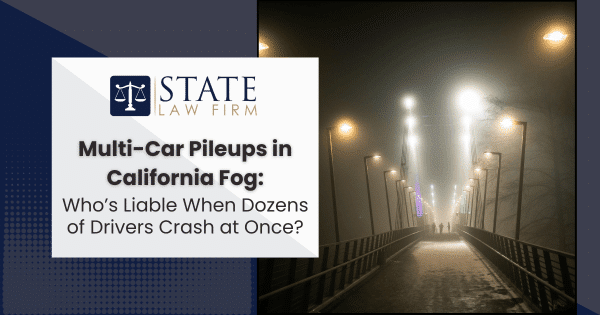
Fog changes everything in a matter of seconds. A stretch of highway that felt routine one moment can become a wall of white the next, and once one driver brakes too late, the crash can spread vehicle by vehicle with terrifying speed. In California, those cases are rarely simple because a pileup is not just one collision. It is usually a chain of decisions, reactions, and missed chances to avoid impact.
That is why liability in a fog crash often turns on details most people do not think about in the moment, including speed for conditions, following distance, lighting, braking, lane position, and whether a driver had enough room to stop safely. If you were hurt in one of these wrecks, speaking with experienced El Monte car accident lawyers early can make a major difference in how evidence is preserved and how fault is assigned.
A statistical reality makes the danger plain: fog-related crashes remain a serious roadway problem nationwide, with tens of thousands of crashes, hundreds of deaths, and many more injuries each year. In other words, fog pileups are not rare freak events. They are exactly the kind of high-damage, high-dispute cases where early legal strategy matters.
Multi-Car Pileup vs. Chain Reaction Crash: What Counts as a Multi-Vehicle Accident
People use terms like multi-car pileup, chain reaction crash, and multi-vehicle collision interchangeably, but they often describe slightly different versions of the same problem.
A multi-car pileup usually refers to a large crash involving several vehicles, often on a freeway, where visibility is low and impacts happen in rapid sequence. A chain reaction crash usually describes the mechanics of how it happened. One impact leads to another, then another, until multiple drivers are involved. In practice, a fog pileup is often both.
What matters legally is not the label. What matters is whether each driver acted reasonably for the conditions.
In California, the key question is rarely, “Who hit whom first?” The better question is, “Whose conduct helped create or worsen the chain of impacts?” In a fog case, that can include:
- A driver going too fast for visibility
- A driver following too closely
- A driver failing to use proper lights
- A driver stopping abruptly without enough warning
- A driver changing lanes blindly to escape the fog bank
- A driver who collides once, then causes secondary impacts
That is why these cases are more complicated than a typical two-car rear-end collision. There may be one initial trigger, but there can also be many contributing causes. A driver who never made the first contact can still share responsibility if their own unsafe driving made the crash worse.
For injured pedestrians or drivers trying to understand what happened, the important point is this: a pileup is not treated as one giant blur. It gets broken apart, impact by impact, decision by decision, and driver by driver.
Who Is Responsible in a Multi-Car Accident in California
California does not decide pileup cases by instinct or by whoever seems most unlucky. Fault is assigned based on negligence, and negligence in fog usually comes down to whether a driver adjusted to the conditions the road was actually presenting.
That means the posted speed limit is not the whole story. On a clear afternoon, one speed may be reasonable. In dense fog, the exact same speed may be dangerous. The same is true for following distance. Space that feels normal in clear weather may be far too short when visibility drops and traffic suddenly compresses.
Because of that, responsibility in a multi-car accident is often shared. One driver may bear the largest portion of fault, but several others may also be assigned percentages if they contributed to the crash. California’s comparative fault rules make that especially important. In real terms, that means your case may involve multiple negligent drivers, multiple insurance companies, and multiple arguments about percentages of blame.
The middle-car problem is a perfect example. Suppose you are driving carefully, someone slams into the back of your car, and the force pushes you into the vehicle ahead. Are you at fault for the front impact? Not automatically.
Sometimes the rear driver bears most or all of the blame because they set the whole chain in motion. But not always. If the middle driver was also following too closely, speeding into the fog, or making an unsafe stop, that driver may still share fault. The law does not assume the middle driver is innocent, and it does not assume the middle driver is guilty. It looks at conduct.
That is one reason statements made at the scene matter. So do photos, damage patterns, and vehicle positions. In a pileup, liability is usually built from physical details, not from broad assumptions.
Fog Pileups: Why Fault Is Often Shared Across Multiple Drivers
Fog accidents create one of the clearest examples of shared fault because they magnify ordinary bad habits into major crash triggers.
A driver who is merely careless on a clear day can become extremely dangerous in low visibility. Tailgating becomes catastrophic. Drifting lanes becomes catastrophic. Delayed braking becomes catastrophic. So does overconfidence.
California drivers are expected to adapt. That includes slowing down, increasing following distance, using proper headlights, and making sure they can stop within the distance they can actually see. The law and the driving rules both point in the same direction: the road does not care what the speed limit says if visibility has collapsed.
That is why the most common causes of fog pileups are so predictable:
- Following too closely: When one driver brakes, the next driver has no room to react.
- Unsafe speed for conditions: Even a legal speed can be negligent in thick fog.
- Sudden stops: Braking hard without adequate warning can spark a rear-end sequence.
- Poor lighting choices: Drivers who fail to use proper low-beam headlights can become nearly invisible to traffic behind them.
- Lane changes in panic: Some drivers try to escape the danger by darting sideways, which spreads the crash instead of avoiding it.
This is also why a driver can be only partly at fault and still face exposure. Fog pileups are rarely resolved with a single neat answer. More often, liability is layered.
If the crash happened on a local road or freeway in poor visibility, a strong case begins with proving what the conditions were, what each driver could see, and what a careful driver would have done differently. That is where an attorney can shift the outcome. A well-built claim does not just say a pileup happened. It shows why it happened.
Whose Insurance Pays in a Multi-Car Accident and How Fault Is Proven
One of the first questions after a pileup is simple: who pays?
In a multi-vehicle case, the real answer is often more complicated than people expect. There may be claims against several drivers at once, and several insurance carriers may investigate the same crash. Each carrier may try to push blame elsewhere, especially when injuries are serious and property damage is extensive.
That is why proving fault quickly matters. The strongest pileup claims usually rely on a combination of physical evidence, official records, and timing.
A good evidence file often includes:
- The CHP or police traffic collision report
- Scene photographs and video
- Dashcam footage
- Damage patterns showing direction and sequence of impact
- Witness names and recorded statements
- 911 call timing
- Tow yard and vehicle preservation letters
- Black box or event data recorder information when available
- Medical records that clearly connect injuries to the collision timeline
In a fog pileup, the pattern of damage can tell an important story. Rear crush, front crush, side transfer, and angle of impact may help show whether a vehicle was pushed, whether it braked late, or whether it struck multiple cars independently. Electronic vehicle data can also become important in serious cases because it may help show speed, braking, or driver inputs in the seconds surrounding impact.
This is not a case type where you want to wait and hope insurers sort it out fairly. The longer a pileup case sits, the more likely key evidence disappears. Vehicles are repaired. Salvage yards move inventory. Witnesses forget details. Digital footage gets overwritten.
If liability is being disputed, getting legal help early is often the difference between a vague claim and a pressure-tested one.
What to Do Right After a Pileup
The minutes after a fog pileup are chaotic, but they matter.
Your first job is safety. Get medical help, move only if it is safe to do so, and follow emergency instructions. After that, think like someone preserving a case, because multi-car crashes are won or lost on details gathered early.
Here are the most important steps:
- Get checked out immediately. Adrenaline hides injuries. A same-day medical record helps both your health and your claim.
- Call 911 and cooperate with responding officers. A formal report can become a key anchor in a disputed liability case.
- Photograph everything you can safely photograph. Vehicle positions, fog density, skid marks, debris, lane markings, visible injuries, and plate numbers all matter.
- Collect witnesses fast. In pileups, neutral third-party accounts can be incredibly valuable.
- Do not guess about fault at the scene. Give facts, not conclusions.
- Notify your insurer promptly. But do not assume the first version of events will be the final one.
- Preserve the vehicle. If the damage pattern matters, repairs or disposal can destroy critical proof.
- Keep a clean medical timeline. Follow-up treatment gaps can create unnecessary defense arguments.
One more practical point matters too. If the crash leaves you stranded for hours or overnight, do not make assumptions about where you can safely or legally remain in your vehicle. Our guide on whether it is illegal to sleep in your car in California laws explains why the answer can depend heavily on location and circumstances.
A tasteful but important truth is this: serious pileup cases tend to get more adversarial as damages rise. The earlier you protect the evidence, the harder it is for others to rewrite the story.
Takeaway
Fog pileups are rarely single-fault cases. In California, liability often gets divided among multiple drivers based on speed, following distance, braking, lighting, lane choice, and the sequence of impacts. If you were injured in a multi-car crash, the smartest move is to treat the case as urgent from day one, because the evidence that proves fault is often the evidence most likely to disappear.
For State Law Firm, this is where careful legal work matters most: finding the real story inside a chaotic scene and making sure the right people are held responsible.
To support the article’s references to official rules and safety guidance, the embedded external links used in the draft are: