English
  Spanish
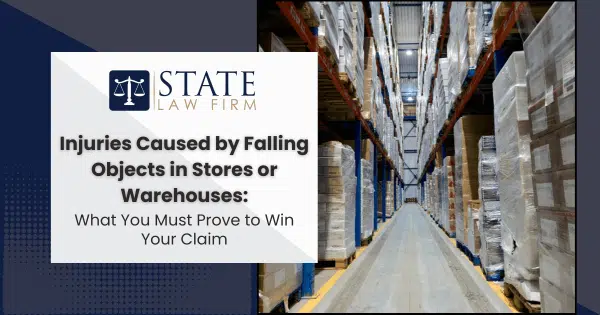
A fall can turn an ordinary errand or a routine shift into a serious medical and financial crisis. In stores, it is often a top-shelf item, a shifting endcap display, or a product that was stacked for speed instead of safety.
In warehouses, the risks multiply with pallets, racks, forklifts, and fast-moving operations where one unstable load can start a chain reaction.
Not sure where to begin?
This resource on Navigating Elder Sexual Abuse walks you through eligibility, evidence, and recovery options.
One reason these cases matter is how often “struck-by” incidents occur in real life: in private industry in a single year, tens of thousands of workers suffered injuries serious enough to require time away from work after being struck by falling objects or equipment.
That same hazard shows up in retail aisles and warehouse walkways, where the forces are simple and unforgiving: gravity, momentum, and a lack of margin for error.
Common injury types include:
- Head injuries and concussions
- Neck, back, and shoulder injuries from impact or twisting during a reflexive attempt to catch the item
- Fractures to the wrist, hand, arm, or foot
- Facial injuries, dental trauma, and eye injuries
- Soft tissue injuries that worsen over time, especially if the spine is involved
A key point for your claim is this: the harm is not limited to the moment of impact. Many people feel “fine” at first, then develop headaches, dizziness, cognitive fog, or radiating pain days later. The law allows recovery for the full scope of harm, but only if you can prove it with clear, organized evidence.
The Legal Duty of Care Owed by Stores and Warehouses
Premises liability law is built on a straightforward principle: a business must use reasonable care to keep its property in a reasonably safe condition. That duty typically includes three practical obligations:
- Reasonable inspection: looking for hazards before they hurt someone
- Reasonable correction: fixing or removing hazards within a reasonable time
- Reasonable warning: alerting people when a hazard cannot be immediately corrected
In the falling object context, “reasonable care” often comes down to decisions that are easy to explain to a jury because they are easy to picture:
- Was the merchandise stacked too high?
- Was the display stable, level, and secured?
- Were heavy items placed on higher shelves without adequate safeguards?
- Were racks overloaded or damaged?
- Were employees trained to build displays and secure loads safely?
- Was the aisle design inviting customers to reach or pull items in a way that predictably triggers collapse?
Warehouses have additional layers. Even if the injured person is an employee, there may be liability beyond workers’ compensation if a third party contributed to the danger, such as a negligent vendor, an outside logistics company, or a defective pallet jack or racking system. If the injured person is a visitor, delivery driver, or contractor, the same reasonable care framework usually applies, and the evidence often lives in operational records.
Key Elements to Prove in a Falling Object Injury Claim
To win your claim, you generally must prove four connected elements. Think of them as a chain. If a link is missing, the defense will pull the case apart at that weak point.
1. Duty
You must show that the store, warehouse, or responsible party owed you a duty of reasonable care under the circumstances. This is often the easiest element because businesses inviting customers in, or running work operations where people must be present, typically owe clear safety duties.
2. Breach
Breach is where the case is won or lost. You must show the defendant failed to act with reasonable care, such as by:
- Creating an unstable display
- Failing to secure merchandise or loads
- Ignoring damaged shelving, broken restraints, or leaning stacks
- Failing to train employees on safe stacking and safe material handling
- Failing to inspect with reasonable frequency given the risk
In many falling object cases, breach can be proven by the condition itself. A collapsed display is often a physical confession. The defense will still argue it was a freak accident, but unsafe design leaves fingerprints.
3. Causation
You must prove the breach was a substantial factor in causing your injuries. The defense may argue you caused the collapse by pulling the item the “wrong way,” or that your symptoms come from something else. Causation is not about perfect certainty. It is about credible proof that connects what fell, how it fell, and what it did to your body.
4. Damages
You must prove losses. That includes medical bills, lost income, reduced future earning capacity, out-of-pocket expenses, and non-economic harm like pain, suffering, and loss of enjoyment of life. The value of your claim rises or falls with the clarity of your documentation.
Gathering Evidence After an Accident Involving a Falling Object
Evidence is the difference between a story and a case. The sooner you act, the more likely you are to preserve what matters.
Step 1: Document the scene immediately
If you can do so safely:
- Photograph the item that fell, the shelf or display, and the surrounding aisle
- Capture warning signs (or the absence of them)
- Take wide shots and close-ups, including product tags, shelf labels, pallet markings, and any visible damage
- Note lighting, crowding, and whether the display was in a high-traffic area
If you are in too much pain, ask a friend, family member, or coworker to take photos. If you are alone, do not risk further injury. Your health comes first.
Step 2: Identify witnesses while they are still there
Witness names and contact information matter because memories fade fast. Employees rotate shifts. Shoppers disappear into the parking lot. A short witness statement can later become the difference between “no one knows what happened” and “we can prove how it happened.”
Step 3: Make an incident report, but keep it factual
Ask the manager or supervisor to create an incident report and request a copy or a reference number. Keep your description accurate and straightforward:
- What fell
- Where you were
- What were you doing
- What you felt and what you observed
Avoid guessing. Avoid arguing. Avoid accepting blame. Your goal is to create a timestamped record.
Step 4: Preserve video and records before they disappear
Many stores and warehouses have surveillance footage, but it is not kept forever. If the business controls the video, you should act quickly to request preservation. The same is true for inspection logs, maintenance records, training materials, and prior incident reports.
Step 5: Get prompt medical care and follow through
A falling object can cause concussion symptoms, spinal injuries, or internal damage that is not obvious at first. Medical records do more than support treatment. They also create the timeline that insurers and juries rely on when evaluating credibility.
If your symptoms change, return for care. If you are referred to specialists, follow up. If you are given restrictions, take them seriously. Consistent care is both good medicine and strong evidence.
The Role of Notice: Actual vs. Constructive Knowledge in Your Case
Businesses are not automatically liable because something went wrong. The law typically requires proof that the business knew, or should have known, about the dangerous condition and had time to fix it or warn about it.
- Prior complaints, prior incidents, employee observations, or internal reports can show actual notice.
- Constructive notice can be shown when the condition existed long enough that reasonable inspections would have discovered it.
Falling-object cases often involve an additional path: the creation of the hazard. If employees built the display, stacked the merchandise, or arranged the warehouse load, the defense cannot hide behind “we did not know.” When the business creates the danger, knowledge is often inferred from the act itself.
Notice that proof is practical. It can come from:
- Evidence of recurring instability, leaning stacks, or prior collapses
- Photos showing obvious overstacking, damaged shelving, or missing restraints
- Records showing weak inspection practices or gaps in inspection timing
- Testimony that the area was known to be hazardous, especially where restocking is frequent
The Importance of Causation and Documenting Your Injuries
Causation is where the defense tries to rewrite the story. They may argue:
- You were not hit, you merely “bumped” something
- You had a preexisting condition
- Your symptoms appeared too late
- You exaggerated your limitations
You answer those arguments with methodical proof.
Helpful causation documentation includes:
- Emergency care records, urgent care notes, or primary care records soon after the incident
- Imaging and specialist evaluations when appropriate
- A symptom journal that tracks headaches, dizziness, sleep disruption, pain levels, numbness, and functional limitations
- Work restrictions and wage documentation if you missed time or could not perform your normal duties
- Physical therapy notes that show objective limitations and progress
If a concussion is suspected, take it seriously. Many people underestimate head injuries because they expect dramatic symptoms. In reality, concussion symptoms can be subtle, delayed, and persistent. Prompt evaluation protects your health and strengthens the causal link between the impact and the symptoms.
Pitfalls That Can Hurt Your Chances—and How to Avoid Them
Avoidable mistakes can undermine premises liability claims. Here are common pitfalls and how to protect yourself against them.
Pitfall 1: Waiting too long to get medical care
Delays create doubt. Insurers treat gaps as an invitation to deny. Even if you hope the pain will pass, get evaluated promptly.
Pitfall 2: Failing to preserve evidence
Video gets overwritten. Displays get rebuilt. Pallets get moved. The hazard can vanish in hours. Document early and request preservation quickly.
Pitfall 3: Giving recorded statements without counsel
Insurance adjusters are trained to obtain soundbites that reduce value or shift blame. You can provide basic facts, but protect yourself before speaking at length.
Pitfall 4: Minimizing symptoms at the scene
Many people say “I’m okay” out of politeness or adrenaline. If your symptoms evolve later, that early minimization becomes an argument against you. Be truthful. If you do not know how serious it is yet, say so.
Pitfall 5: Missing deadlines
Deadlines can be strict, and they vary depending on who is responsible. Claims involving public entities can have much shorter notice requirements. Employees may face different reporting rules than customers. Acting early protects your options.
Seeking Compensation After an Injury Caused by a Falling Object
A strong claim is not built on outrage. It is built on proof. Here is a practical path forward.
- Prioritize medical care and follow treatment recommendations.
- Secure evidence: photos, witnesses, incident report details, product identifiers, and preservation requests for video.
- Track your losses: missed work, reduced hours, medical expenses, and out-of-pocket costs.
- Avoid common traps: social media posts about the incident, casual admissions of fault, and rushed settlements before you understand the prognosis.
- Get legal guidance early when injuries are significant or liability is disputed.
At State Law Firm, we approach falling object cases with the discipline they demand. We look for the operational truth: how the display was built, how the load was handled, what inspections occurred, and what the records reveal. If you were injured in a store or warehouse, we can help you understand your options, preserve key evidence, and pursue compensation that reflects the full impact of the injury.
Protect Your Rights—What to Do If A Falling Object Injures You in a Store or Warehouse
Falling object injuries are often preventable, and that is exactly why the law takes them seriously. To win your claim, you must prove duty, breach, causation, and damages with clear evidence that connects the hazard to the harm. Start with medical care, preserve the scene, secure witnesses, and act quickly to protect video and records. Then, build the case with patience and precision.
A falling object case is winnable when you treat it like a record-building mission from day one: document the hazard, document your injuries, and move quickly before evidence disappears.