English
  Spanish
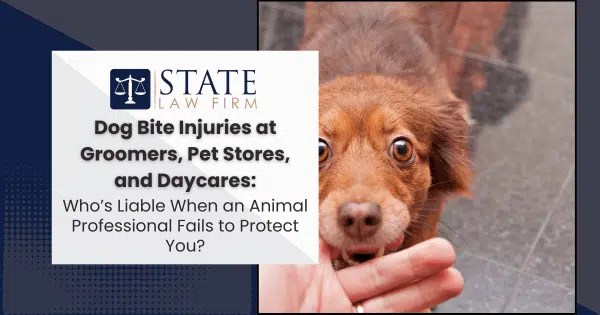
A dog bite at a groomer, pet store, or daycare can feel especially unsettling because the whole point of the business is supposed to be control, supervision, and safety. When a business invites customers, families, and pets into a professional setting, the law may look beyond the dog itself and examine whether the people running the facility failed to prevent a foreseeable injury. If you are trying to understand your options after a serious bite, our El Monte car accident lawyers page is one place to start learning how California injury claims are evaluated.
According to the World Health Organization’s animal bites overview, approximately 4.5 million people are bitten by dogs each year in the United States.
Dog Bites in Professional Settings: Why Liability Can Expand
A bite in a professional animal setting is not always just a one-defendant case. That is what surprises many people. If a dog bites someone in a private home or on a sidewalk, the first legal question is often whether the owner is responsible. But when the bite happens in a grooming salon, retail pet store, boarding facility, or daycare, the analysis can widen fast.
Why? Because these businesses are not passive bystanders. They market themselves as places that know how to handle animals, screen risk, manage traffic, separate unsafe dogs, train staff, and protect visitors. Once a company takes custody of animals or invites members of the public onto the premises, its own conduct matters.
That can change the shape of the case in several ways:
- The business may have accepted a dog it should not have accepted.
- Staff may have ignored warning signs such as lunging, snapping, or leash-reactivity.
- The facility may have mixed incompatible dogs together.
- A waiting area may have been too cramped, chaotic, or poorly controlled.
- Employees may have failed to muzzle, restrain, separate, or warn.
In other words, the bite may be the final event, but the legal story often starts earlier. A professional animal business can create danger long before teeth ever touch skin.
That matters because a strong claim is often built not just on what happened in the instant of the bite, but on what should have happened in the minutes, days, or even weeks before it. Intake forms, prior complaints, temperament notes, camera footage, and staffing decisions can all become important. In many cases, the real issue is not whether the dog bit someone, but whether the professionals in charge let a preventable risk develop in plain sight.
Who May Be Responsible After a Bite
In California, responsibility may rest with one party, several parties, or different parties under different legal theories. That is why these claims should be analyzed carefully at the beginning, before evidence disappears and before the business and dog owner start pointing fingers at each other.
The first obvious defendant is often the dog’s owner. If the dog bit you while you were lawfully on the property, the owner may face strong legal exposure. But that does not automatically let the business off the hook. A groomer, daycare, or pet store may also bear responsibility if it failed to use reasonable care in running the facility.
Depending on the facts, potentially responsible parties may include:
- The dog owner
- The grooming business
- The pet daycare or boarding operator
- The pet store that hosted the dog on site
- A property operator or business entity controlling the premises
- In some cases, a third-party handler or contractor
This is where details matter. Was the dog dropped off with warnings about aggression? Did the business already know the dog had a bite history? Was there a written incident report from a prior event? Did staff leave a customer alone in a lobby with a stressed animal? Did the company advertise supervised playgroups but fail to provide meaningful supervision?
A business does not become liable simply because an injury happened on its property. But if it controlled the premises, controlled the flow of people and animals, or controlled the way the dog was handled, its own decisions may become central to the case.
That is also why early legal review can be valuable. In disputed injury cases, each side often tries to narrow the story. The owner says the staff mishandled the dog. The business says the owner concealed aggression. The insurer says the victim moved too close. A prompt investigation can preserve the records that reveal what really happened.
Strict Liability vs. Negligence: Which Claim Fits the Facts
California dog-bite law is favorable to injured people, but it is important to know exactly what that means. The headline rule is strong. The application is more nuanced.
Under California Civil Code section 3342, a dog owner can be strictly liable when the dog bites someone who is in a public place or lawfully in a private place. In practical terms, that means an injured customer, visitor, or child at a groomer or pet store may have a direct claim against the owner without needing to prove the owner knew the dog was dangerous.
But strict liability usually focuses on the owner. The business is often brought in under negligence principles instead. That means the question becomes whether the facility acted reasonably under the circumstances.
Examples of negligence by an animal business may include:
- Failing to screen dogs for aggression
- Ignoring prior incidents or warnings
- Using untrained staff
- Allowing overcrowded waiting or play areas
- Failing to separate animals by size, temperament, or stress level
- Failing to warn customers about a known danger
- Failing to keep the premises reasonably safe
Sometimes both theories exist at once. The owner may face strict liability for the bite, while the business may face negligence for how it handled the risk.
There is also a more technical layer in some cases. If the injured person is an employee bitten while working, workers’ compensation may become the first avenue for recovery against the employer, and civil claims against the employer may be limited. If the injured person is an animal professional whose job involved handling the dog, the legal analysis can become even more fact-sensitive. These cases are not impossible, but they require a careful look at the role the plaintiff had, the risk that was assumed, and whether the defendant withheld important information or created a separate hazard.
California injury law often turns on exact location, exact role, and exact permission. That is one reason seemingly small facts matter so much, just as they do in other California liability questions discussed in is it illegal to sleep in your car California laws. In both settings, where you were, why you were there, and what rules applied can shape the outcome.
Common Fact Patterns That Change the Case
Dog-bite claims in professional settings tend to repeat familiar patterns. When you know the pattern, you can start spotting where liability may widen.
Here are some of the most common scenarios:
- Bite during check-in or pick-up: A customer enters a small lobby, another dog is too close, staff fails to create separation, and the dog attacks.
- Bite during grooming handoff: An employee brings out a stressed dog without adequate restraint, warning, or spacing from customers.
- Daycare fight turns into human injury: Staff allow incompatible dogs to interact, a fight breaks out, and a customer or worker is bitten while chaos unfolds.
- Known reactive dog accepted anyway: The business had prior notice of aggression, but continued services without added precautions.
- Child bitten inside retail pet space: A store allows dogs in common areas but fails to manage leash control or warn parents about a visibly agitated animal.
- Employee bitten by customer’s dog: This may raise both workers’ compensation issues and possible third-party liability questions depending on who owned and controlled the dog.
- No warning, no records, no cameras preserved: The bite happens, but the business fails to document the event properly, making spoliation and credibility issues more important.
In each of these examples, the central issue is foreseeability. Was this a sudden, truly unavoidable event, or was there a visible risk that professionals should have managed better?
That distinction often drives settlement value too. Cases involving facial scarring, nerve damage, infection, surgery, psychological trauma, or permanent fear around dogs can be significant, especially when liability is supported by records showing the incident was preventable.
If the facts suggest both owner fault and business fault, it is usually wise to investigate both. A narrow approach can leave insurance coverage and key evidence on the table.
Evidence Checklist and What to Do Right Away
After a dog bite, people often focus first on pain, shock, and cleanup. That is understandable. But these claims are highly evidence-sensitive, and the first few days matter.
The California Department of Public Health guidance on animal bites and the state’s rabies guidance both reinforce the importance of washing the wound, seeking medical care when needed, and reporting the bite so the animal’s vaccination status can be reviewed. California generally considers rabies risk from dogs low, but that does not mean you should treat the event casually.
Try to gather and preserve the following:
- Photos of the wound immediately and over time
- Photos of torn clothing, blood, or the scene
- Names of employees and witnesses
- The dog owner’s identity and contact information
- Vaccination information if available
- Any incident report made by the business
- Video surveillance preservation requests
- Prior complaints or prior incident evidence, if later discovered
- Medical records, urgent care notes, and prescriptions
- Proof of missed work and wage loss
- Notes about pain, sleep disruption, fear, and scarring
Also ask for the business to preserve:
- camera footage
- intake forms
- behavior notes
- waivers
- shift schedules
- text messages or internal reports about the dog
Do not assume the business will save this on its own. Many facilities overwrite video quickly. Some reports become much less detailed after the first draft. Some businesses describe the event as minor before the injury’s true extent becomes clear.
A careful claim also values the injury fully. Dog bites can involve more than puncture wounds. They may lead to infection, plastic surgery, nerve damage, loss of sensation, disfigurement, emotional distress, and lingering fear in public or around animals. When the bite occurs in a place that promised professional safety, those facts can carry real weight.
If you are dealing with a serious injury and conflicting stories, it can help to speak with counsel early. The same team featured on our El Monte car accident lawyers page can evaluate whether your case points to owner liability, business negligence, or both.
Takeaway
A dog bite at a groomer, pet store, or daycare is not just a pet accident. It may be a business-liability case, an owner-liability case, or both. When professionals take charge of animals and invite the public into the space, the law may expect more than apologies after the fact. It may expect reasonable screening, reasonable supervision, reasonable warnings, and reasonable control before someone gets hurt.
If the animal professional failed to protect you, the right question is not simply whose dog was it. The better question is who had the power to prevent this, and failed to do so.