Spanish
  English
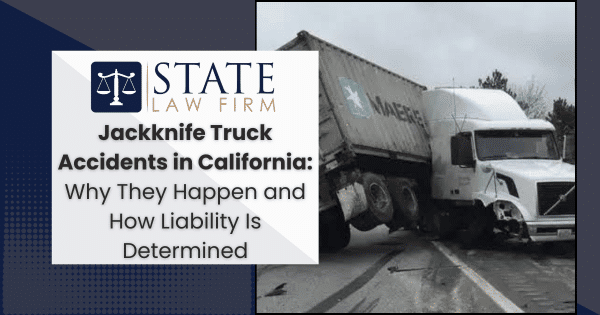
A tractor-trailer can lose alignment within seconds, leaving its trailer angled across several lanes of traffic. These jackknife truck accidents in California may involve multiple vehicles, serious injuries, and competing accounts of what caused the truck to lose control. Determining responsibility requires more than observing the truck’s final position. Investigators must examine the driver’s actions, vehicle condition, cargo, roadway, and electronic records.
Respuesta directa: A jackknife accident occurs when a commercial truck’s trailer swings away from its normal position behind the tractor, creating a sharp angle between the two units. Liability depends on why control was lost. The truck driver, motor carrier, cargo company, maintenance provider, manufacturer, another motorist, or more than one party may be responsible.
What Is a Jackknife Truck Accident?
A jackknife truck accident occurs when a tractor and attached trailer rotate toward each other instead of remaining aligned. The trailer moves sideways from its normal path, creating a shape similar to a partially folded pocketknife. The Federal Motor Carrier Safety Administration describes jackknifing as a loss-of-control condition in which a trailer yaws away from its ordinary straight-line path behind the power unit.
How the Tractor and Trailer Form a Sharp Angle
A truck may jackknife when the tractor loses traction, the trailer continues moving forward, or the tractor and trailer brake with different levels of force. Braking during a turn can increase the danger because the tractor changes direction while the trailer’s weight continues pushing forward.
A jackknife is different from a rollover, in which the truck or trailer tips onto its side. It is also different from an underride collision, where a smaller vehicle travels beneath part of a truck, or an ordinary skid in which the tractor and trailer remain generally aligned.
Why Jackknife Crashes Can Affect Several Lanes
As the trailer rotates, it may sweep through adjacent lanes, strike vehicles beside the truck, or form a sudden barrier across the roadway. Drivers approaching from behind may have little space to stop or avoid the obstruction.
These secondary impacts can create a jackknife truck pileup involving several drivers. Investigators must then determine which conduct caused the initial loss of control and whether later drivers had a reasonable opportunity to avoid additional collisions.
Why Do Jackknife Truck Accidents Happen?
The most common contributing factors include:
- Sudden or uneven braking
- Excessive speed for existing conditions
- Brake, tire, or mechanical problems
- Improperly loaded or shifting cargo
- Driver fatigue, distraction, or inadequate training
FMCSA crash research has connected commercial-vehicle loss of control with excessive speed for conditions, cargo shifts, vehicle-system failures, and poor road conditions.
1. Sudden, Improper, or Uneven Braking
A driver who brakes abruptly may cause wheels to lock or lose traction. The risk can increase when the driver is turning, traveling downhill, following too closely, or reacting late to stopped traffic.
California Vehicle Code section 21703 requires drivers to maintain a following distance that is reasonable and prudent based on vehicle speed, traffic, and roadway conditions. A commercial driver must account for the truck’s weight, braking capacity, cargo, and the additional distance needed to stop safely.
2. Driving Too Fast for Weather or Road Conditions
Rain, standing water, steep grades, sharp curves, construction zones, and congested freeway traffic can reduce traction or leave insufficient room for a controlled stop.
The posted speed limit does not necessarily establish a safe speed. Under California Vehicle Code section 22350, a driver must travel at a speed that is reasonable and prudent for the weather, visibility, traffic, roadway surface, and other existing conditions.
3. Brake, Tire, or Mechanical Failure
Worn brakes, mismatched braking force, damaged tires, steering problems, coupling defects, and poorly maintained suspension components may contribute to a jackknife.
Federal regulations require motor carriers to systematically inspect, repair, and maintain vehicles under their control. The carrier must also keep certain inspection and maintenance records. These records may show repeated brake problems, overdue repairs, failed inspections, or defects that existed before the collision.
4. Improperly Loaded or Shifting Cargo
An overloaded, unbalanced, or inadequately secured shipment can change how a trailer responds to braking and steering. Cargo that shifts sharply may destabilize the trailer or increase the force pushing against the tractor.
Federal cargo-securement rules generally require cargo to be firmly immobilized or secured using adequate vehicle structures, tiedowns, blocking, bracing, or similar systems. Depending on who controlled the loading process, investigators may examine the carrier, shipper, loader, freight broker, or logistics contractor.
5. Driver Fatigue, Distraction, or Inadequate Training
Fatigue can delay hazard recognition and decision-making. Distraction may prevent a driver from noticing slowing traffic, a curve, changing weather, or an unstable trailer. An inexperienced driver may also use an improper emergency-braking technique or make an abrupt steering correction.
Hours-of-service logs, electronic logging device data, dispatch communications, phone records, training files, and the driver’s schedule may help establish whether fatigue, distraction, or inadequate preparation contributed.
How Is Liability Determined After a California Jackknife Accident?
A jackknifed trailer does not automatically prove that the truck driver was negligent. Liability generally turns on four connected questions:
- Deber: Did the defendant have a legal obligation to use reasonable care?
- Incumplimiento: Did the defendant fail to act as a reasonably careful driver, carrier, loader, repair company, or manufacturer would under similar circumstances?
- Causalidad: Was that failure a substantial factor in causing the collision or injury?
- Daños y perjuicios: Did the claimant suffer legally recognized harm?
California’s current civil jury instructions address negligence, causation, comparative fault, employer responsibility, and damages.
Violations of Traffic or Commercial-Trucking Rules
Speeding, unsafe following distance, defective equipment, hours-of-service violations, or cargo-securement violations may support a negligence claim. However, a violation does not eliminate the need to prove causation.
For example, an overdue brake repair may be significant if brake performance contributed to the jackknife. It may be less relevant if evidence shows that another vehicle struck the trailer before the truck lost control.
Comparative Fault When Several People Contributed
California follows comparative-fault principles. Responsibility may be divided among the truck driver, motor carrier, other motorists, cargo contractors, maintenance companies, manufacturers, or additional parties.
An injured person’s damages may also be reduced according to the percentage of responsibility assigned to that person. Fault should be based on evidence, not simply on the fact that the commercial truck ended up jackknifed.
Who May Be Liable for a Jackknife Truck Crash?
Commercial transportation often involves several businesses. Each may control a different part of the driver, vehicle, cargo, or delivery process.
| Potentially responsible party | Conduct that may support liability |
| Commercial truck driver | Speeding, following too closely, abrupt braking, distraction, fatigue, impairment, or inadequate vehicle control |
| Motor carrier or trucking company | Unsafe dispatching, negligent hiring or training, poor supervision, inadequate maintenance, or responsibility for an employee acting within the scope of employment |
| Cargo loader, shipper, or logistics contractor | Improper weight distribution, insecure cargo, inaccurate weight documents, or unstable loading practices |
| Maintenance company | Negligent inspection, incomplete repairs, or failure to correct known brake, tire, steering, or coupling problems |
| Parts or vehicle manufacturer | Defective brakes, tires, coupling equipment, stability systems, or other components |
| Other driver | Unsafe lane change, sudden stop, speeding, distraction, or a collision that forced the truck out of control |
| Roadway or public entity | Dangerous construction conditions, debris, defective roadway features, or another condition for which the entity may be legally responsible |
A trucking company may be vicariously liable when its employee causes harm while acting within the scope of employment. Separate claims may also arise from the company’s own conduct, such as negligent hiring, supervision, training, dispatching, or maintenance.
A component failure may support a potential product-defect claim rather than, or in addition to, a negligent-maintenance claim. State Law Firm’s defective-products practice information explains the distinction between unsafe products and other forms of negligence.
Claims involving Caltrans, a city, county, or another public entity may be subject to special Government Claims Act procedures. Presenting a government claim is not the same as filing a lawsuit, and shorter procedural deadlines may apply.
What Evidence Can Prove How the Truck Jackknifed?
Prompt evidence preservation can be important because electronic information, camera footage, physical damage, and company records may change or disappear.
Electronic and In-Cab Data
- Engine control module or event-data information
- Electronic logging device records
- GPS, telematics, speed, and braking data
- Dashcam or inward-facing camera footage
- Dispatch messages and electronic route information
Carrier, Driver, and Cargo Records
- Driver qualification and training files
- Hours-of-service and dispatch records
- Inspection, repair, and maintenance history
- Bills of lading and cargo-weight records
- Loading diagrams and securement documentation
- Drug and alcohol testing records when legally relevant
Independent Crash Evidence
- Police and commercial-vehicle inspection reports
- Photographs, video, skid marks, debris, and vehicle damage
- Declaraciones de testigos
- Weather and roadway records
- Mechanical inspections
- Accident-reconstruction analysis
FMCSA’s SAFER Company Snapshot may provide publicly available carrier identification, inspection, crash, out-of-service, and safety-rating information. The information is useful background, but it does not establish liability by itself.
What Compensation May Be Available After a Jackknife Accident?
An injured person may pursue losses caused by another party’s negligence, but available damages depend on the evidence, injuries, responsible parties, insurance coverage, and applicable law.
Economic Losses
- Emergency and ongoing medical expenses
- Rehabilitation and reasonably necessary future care
- Lost wages and reduced earning capacity
- Daños al vehículo
- Necessary accident-related expenses
Noneconomic and Wrongful-Death Losses
Noneconomic damages may include physical pain, emotional distress, disability, inconvenience, and loss of enjoyment of life.
When a collision causes a death, eligible family members or the decedent’s estate may have claims involving different categories of loss. State Law Firm’s Los Angeles wrongful-death resource provides additional information. The recoverable losses depend on the claimant’s legal relationship to the decedent and the circumstances of the case.
What Should You Do After a Jackknife Truck Accident?
- Move to a safer location when it is possible to do so.
- Call emergency services and report the collision.
- Obtain appropriate medical care, including for symptoms that appear later.
- Photograph the tractor, trailer position, vehicles, roadway, cargo, debris, and visible injuries when safe.
- Collect witness, driver, carrier, and insurance information without arguing about fault.
- Preserve damaged property, medical records, receipts, photographs, videos, and insurance communications.
- Consider requesting prompt preservation of carrier records and electronic data before information is overwritten or lost.
If another vehicle’s unsafe movement contributed, State Law Firm’s guide to unsafe lane changes in California explains additional evidence and reporting considerations.
Frequently Asked Questions About California Jackknife Accidents
Does a Jackknifed Truck Automatically Mean the Driver Was at Fault?
No. Jackknifing shows that the tractor and trailer lost normal alignment, but it does not establish why that happened. The cause may involve driver error, mechanical failure, shifting cargo, weather, another motorist, or several contributing factors. Fault must be determined from the available evidence.
Can the Trucking Company Be Liable Even If the Driver Made the Mistake?
Yes, depending on the relationship and circumstances. A carrier may be responsible for an employee’s negligence committed within the scope of employment. The company may also face direct claims involving hiring, training, supervision, dispatching, inspections, or maintenance. Independent-contractor relationships may require a more detailed analysis.
What If Another Driver Forced the Truck to Swerve or Brake?
The other driver may bear part or all of the responsibility if unsafe conduct caused the truck to lose control. Evidence may also show that the truck driver was traveling too fast, following too closely, or otherwise unable to respond safely. California law allows fault to be divided among multiple responsible parties.
How Long Do I Have to File a California Truck Accident Lawsuit?
California sección 335.1 del Código de Procedimiento Civil generally provides two years for an action involving injury or death caused by another person’s wrongful act or neglect. The triggering event, exceptions, government-claim procedures, and other rules can change the applicable deadline. An exact deadline should be evaluated individually.
What Trucking Records Should Be Preserved?
Potentially important records include electronic logging data, engine and braking data, GPS records, dashcam footage, dispatch messages, driver qualification files, maintenance history, inspection reports, cargo documents, bills of lading, and securement records. The relevant records depend on the suspected cause and the parties involved.
Protect the Evidence and Understand Your Legal Options
California generally allows two years for many personal injury and wrongful-death actions based on wrongful conduct, but that rule does not apply identically to every claim. Government entities, delayed discovery, minors, out-of-state defendants, and other circumstances may affect the analysis.
Commercial-truck evidence can also be lost or overwritten before a lawsuit is filed. An early investigation may help identify the motor carrier, vehicle owner, cargo companies, maintenance providers, manufacturers, insurers, and other potential defendants.
State Law Firm assists people injured in California truck collisions from its main office in Sherman Oaks. The firm emphasizes direct attorney involvement and clear, accessible communication. Contact State Law Firm at (877) 659-9223 for a free consultation about the crash, potential defendants, evidence-preservation steps, and deadlines that may apply. Additional information is available through the firm’s California truck accident practice page.
Every case depends on its facts, evidence, injuries, insurance coverage, responsible parties, and applicable law.