Spanish
  English
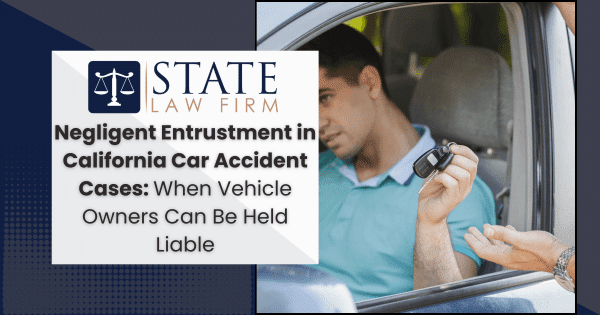
When an unsafe driver causes a collision while using someone else’s vehicle, responsibility may extend beyond the person behind the wheel. California law may allow an injured person to pursue a claim against an owner, employer, co-owner, or another person who controlled the vehicle and unreasonably permitted the driver to use it.
Negligent entrustment occurs when someone permits an incompetent or unfit person to drive a vehicle despite knowing, or having reason to know, that the person cannot drive safely. The owner may be liable if the driver’s particular unfitness contributes substantially to the accident and resulting harm.
Unlike liability based only on vehicle ownership, negligent entrustment focuses on the owner’s own conduct before the collision. This article explains the legal elements, warning signs, evidence, potential defendants, and practical steps involved in a California negligent entrustment claim.
What Is Negligent Entrustment Under California Law?
Negligent entrustment in California is a direct-negligence claim against a person who supplied, lent, assigned, or permitted the use of a vehicle. It is not based merely on the fact that the defendant owned the car.
Negligent Entrustment Is Based on the Owner’s Own Negligence
The central question is whether the owner or person controlling the vehicle acted reasonably when deciding to let the driver use it. California courts describe the theory as liability arising from the entruster’s independent negligence, not simply from the relationship between the owner and driver.
Ownership alone is not enough. There must generally be evidence that the owner permitted the use and knew, or reasonably should have known, that the driver was incompetent, inexperienced, reckless, impaired, or otherwise unfit.
The Driver Must Actually Cause the Accident Through Negligent Driving
An unsafe lending decision does not create liability by itself. The driver must operate the vehicle negligently, and the driver’s relevant incompetence or unfitness must be a substantial factor in causing the plaintiff’s harm.
For example, evidence that a driver had a history of intoxicated driving would be more relevant when the collision involved intoxication than when it resulted from an unrelated mechanical failure.
What Must an Injured Person Prove in a Negligent Entrustment Claim?
California Civil Jury Instruction CACI No. 724 identifies the core requirements of a negligent entrustment claim. An injured person generally must establish the following:
1. The Driver Was Negligent in Operating the Vehicle
The driver must have acted unreasonably under the circumstances. Examples may include speeding, unsafe lane changes, distracted driving, intoxication, or failing to yield. A citation can be relevant, but a traffic ticket is not always required to prove negligence.
2. The Defendant Owned or Controlled the Vehicle
The defendant may be a registered owner, co-owner, employer, company, or another person who possessed the vehicle with authority to permit its use.
3. The Owner Allowed the Driver to Use the Vehicle
Permission may be express, such as handing over the keys, or implied through repeated access, prior use, or standing permission. Theft and genuinely unauthorized use raise different questions.
4. The Driver Was Incompetent or Unfit to Drive Safely
The unfitness must relate to the safe operation of the vehicle. It might involve impairment, a relevant medical limitation, lack of experience, an invalid license, or a known history of reckless driving.
5. The Owner Knew or Should Have Known About the Risk
Actual knowledge means the owner was aware of the danger. Constructive knowledge means the circumstances were sufficient that a reasonable owner should have discovered or understood the risk.
6. The Driver’s Unfitness Was a Substantial Factor in Causing Harm
The known risk must connect to the way the accident occurred. California law does not impose negligent entrustment liability merely because an owner made a questionable decision and an unrelated accident later happened.
When Should a Vehicle Owner Know That a Driver Is Unsafe?
Warning Signs of an Unsafe Driver
Facts that may support the knowledge requirement include:
- No valid or appropriate license: California Vehicle Code section 14604 requires an owner to make a reasonable effort or inquiry to determine whether a prospective driver has a valid license authorizing that person to operate the vehicle.
- Prior crashes or serious violations: Known collisions, reckless driving incidents, suspensions, or repeated dangerous conduct may place an owner on notice.
- Visible intoxication or impairment: Slurred speech, difficulty walking, drug use, or other observable signs may show that permission was unreasonable when given.
- A known medical condition affecting vehicle control: Prior seizures, loss-of-consciousness episodes, or similar conditions may be relevant, but a diagnosis alone does not automatically prove liability.
- Insufficient experience: A minor, new driver, or person unfamiliar with a motorcycle, commercial truck, or specialized vehicle may be unfit for that particular vehicle.
The timing, seriousness, similarity, and owner’s awareness of these facts all matter. In McKenna v. Beesley, the court explained that failing to make the required license inquiry, followed by permitting an unlicensed person to drive, can support a finding of constructive knowledge. The court did not hold that the absence of an inquiry automatically establishes liability in every case.
Who Can Be Liable for Negligently Entrusting a Vehicle?
Potential defendants may include:
- Parents and family members: Liability depends on control, permission, and knowledge, not family status alone.
- Friends, roommates, and individual owners: Informal lending, repeated access to keys, or standing permission can still be relevant.
- Co-owners: A co-owner may potentially face liability if that person had control over the vehicle’s use and permitted an unsafe co-owner to drive.
- Employers and businesses: Company cars, delivery vehicles, work trucks, and fleets may create negligent entrustment issues when a business assigns a vehicle to an unfit employee.
- Rental and leasing companies: These cases involve additional California statutes and federal law and cannot be evaluated under ordinary owner-liability rules alone.
Employer cases may also involve respondeat superior, which can make an employer vicariously liable for an employee’s negligence committed within the scope of employment. Under Diaz v. Carcamo, an employer’s admission of vicarious liability may limit whether a separate negligent entrustment theory remains part of the case. The precise effect depends on the claims, admissions, and alleged independent conduct.
Rental-company claims require separate analysis. Federal law generally prevents liability based solely on rental-vehicle ownership when the rental company itself was not negligent or criminally at fault. A 2026 California appellate decision also addressed the duties of a remote car-sharing company that lacked prior knowledge of a renter’s intoxication.
Negligent Entrustment vs. California’s Permissive-Use Owner Liability
Negligent entrustment and permissive-use liability are separate legal theories.
| Issue | Permissive-Use Liability | Confianza negligente |
| Legal basis | California Vehicle Code section 17150 | Common-law direct negligence |
| Core proof | Ownership, permission, negligent operation, and resulting harm | Permission plus known or reasonably discoverable driver unfitness |
| Owner’s personal negligence required? | Not necessarily | Yes |
| Main focus | Whether the driver operated the vehicle with the owner’s permission | Whether the owner acted unreasonably by allowing that driver to use it |
Vehicle Code section 17150 provides a statutory path to owner liability when a person negligently operates an owner’s vehicle with express or implied permission. Negligent entrustment instead concerns the owner’s independent wrongful conduct.
The distinction can affect defenses, evidence, insurance questions, and statutory limitations. The theories that apply depend on ownership, permission, employment, insurance coverage, and the facts surrounding the lending decision.
What Evidence Can Prove Negligent Entrustment?
Evidence to Preserve After the Accident
Driver and vehicle records
- Driver’s license status
- Driving history and prior violations
- Previous collision reports
- Registration, title, and ownership documents
Communications showing knowledge
- Text messages, emails, and social media posts
- Warnings from relatives, friends, coworkers, or passengers
- Evidence that the owner previously took away the driver’s keys
- Statements about intoxication, reckless driving, or license problems
Employment and company records
- Driver applications and background checks
- Motor vehicle record reviews
- Training and disciplinary records
- Prior safety complaints or collision reports
- Vehicle-assignment and key-control records
Medical or impairment evidence
- Witness observations
- Police reports and body-camera recordings
- Toxicology results
- Admissible evidence of a known driving-related limitation
Prior incidents may sometimes be admitted for the limited purpose of showing the owner’s knowledge rather than proving that the driver acted negligently on the occasion in question. In Allen v. Toledo, prior collisions known to the owner supported the negligent entrustment analysis.
What Compensation May Be Available?
A negligent entrustment claim may become part of the broader car accident damages case. Depending on the evidence and governing law, claimed losses may include:
Economic Losses
Medical expenses, lost income, reduced earning capacity, property damage, rehabilitation, and reasonably necessary future care.
Noneconomic Harm
Physical pain, emotional distress, disability, inconvenience, and loss of enjoyment of life.
Wrongful Death Losses
When a collision is fatal, eligible family members may have separate claims under California law. A Los Angeles wrongful death lawyer can evaluate who may bring the claim and which losses may be recoverable.
Available damages depend on causation, proof, insurance coverage, the responsible parties, and the law applicable to the particular case.
What Should You Do If an Unsafe Driver Was Using Someone Else’s Vehicle?
After receiving appropriate medical attention and reporting the collision, consider these evidence-preservation steps:
- Photograph registration and insurance documents when safely available.
- Record statements about who owned the vehicle and why the driver had it.
- Preserve texts, emails, posts, or warnings concerning the driver.
- Obtain contact information for people familiar with the driver’s history.
- Request legal review before vehicle, company, or electronic records disappear.
For example, suppose an owner repeatedly warned a family member not to drive because the person had no valid license, but later returned the keys. Those communications may become important if the same licensing or competency issue contributes to a collision.
Some driving, employment, insurance, and electronic records may require subpoenas or formal discovery. A prompt investigation can help identify evidence not included in the initial police report.
Speak With a California Car Accident Lawyer About Every Potentially Liable Party
Negligent entrustment claims often depend on information that is not visible at the accident scene. An investigation may need to address vehicle ownership, express or implied permission, driving history, license status, impairment, employment relationships, and insurance coverage.
Bufete de abogados estatal Abogados de accidentes automovilísticos en Sherman Oaks represent injured people in Los Angeles County and throughout California. The firm emphasizes direct attorney involvement, clear communication, and accessible guidance throughout the claim process.
For a free consultation, contact State Law Firm at (877) 659-9223. Contingency-fee representation may be available where applicable.
Preguntas frecuentes
Can a car owner be liable if someone else was driving?
Yes. A California vehicle owner may face statutory permissive-use liability when another person drives with permission. The owner may also face negligent entrustment liability if the owner knew or should have known the driver was unfit and that unfitness substantially contributed to the collision.
Is lending a car to an unlicensed driver automatically negligent entrustment?
Not automatically. California law requires vehicle owners to make a reasonable effort or inquiry regarding a prospective driver’s license. A failure to inquire, combined with actual unlicensed driving, may support constructive knowledge, but the injured person must still prove the remaining elements, including causation.
Can a parent be liable for an adult child’s accident?
Potentially. The adult child’s age does not by itself determine liability. The inquiry focuses on whether the parent owned or controlled the vehicle, permitted its use, knew or should have known the driver was unsafe, and whether that known risk contributed to the accident.
Can an employer be sued for negligently entrusting a company vehicle?
An employer may potentially face such a claim when it assigns a vehicle to an employee it knew or should have known was unfit. However, an employer’s admission of vicarious liability may affect whether negligent entrustment remains a separate theory under California law.
Does the owner’s insurance always cover a borrowed-car accident?
No. Coverage depends on policy language, exclusions, the driver’s permission, the vehicle’s use, employment relationships, and other insurance. Legal liability and insurance coverage are related but separate questions.
A California negligent entrustment claim is not based on ownership alone. It requires proof that the person controlling the vehicle unreasonably allowed an unfit driver to use it and that the known risk contributed to the accident.
Readers who suspect an unsafe driver was using someone else’s car can also review State Law Firm’s guide to liability when someone borrows a vehicle or learn more about State Law Firm and its California practice.