Spanish
  English
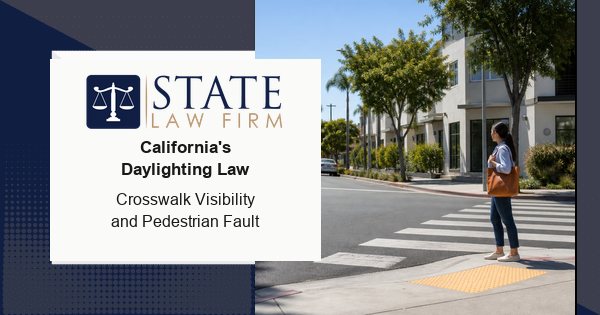
The California daylighting law generally prohibits stopping, standing, or parking a vehicle on the approach side of a marked or unmarked crosswalk within 20 feet, or within 15 feet when a curb extension is present. The rule is designed to improve the sightline between approaching drivers and people entering a crosswalk.
Respuesta directa: After a pedestrian accident, a daylighting violation may support an argument that an illegally positioned vehicle obstructed visibility and contributed to the collision. It does not automatically decide fault. A claim still requires evidence connecting the obstruction to what the driver and pedestrian could see, when they could see it, and whether reasonable conduct could have prevented the impact.
That distinction matters because several people or entities may be involved. The moving driver, pedestrian, owner or operator of an obstructing vehicle, and sometimes a public entity may each raise separate factual and legal questions.
What Is California’s Daylighting Law?
California Vehicle Code section 22500(n), enacted through Assembly Bill 413, creates a statewide crosswalk-clearance rule. Unless an exception applies, a person may not stop, park, or leave a vehicle standing:
- Within 20 feet of the vehicle-approach side of a marked crosswalk
- Within 20 feet of the vehicle-approach side of an unmarked crosswalk
- Within 15 feet of a crosswalk when a curb extension is present
The approach side is the side from which traffic reaches the crosswalk. Keeping that area clear can allow a driver to see a pedestrian before the pedestrian moves into the travel lane, while also allowing the pedestrian to see approaching traffic.
The law includes exceptions and local-authority provisions. A local authority may mark a different distance using paint or signs in specified circumstances. It may also authorize certain commercial loading areas or permit bicycle and motorized-scooter parking near a crosswalk subject to the statutory requirements. The exact location and local markings should therefore be documented rather than assumed.
Does the Curb Have to Be Painted Red?
No. The statewide restriction can apply even when the curb is not painted red and no sign identifies the clearance area. Before January 1, 2025, jurisdictions generally could issue only a warning for an unmarked violation. That warning-only phase has ended.
A lack of paint may still matter factually. A vehicle owner may argue that the crosswalk, approach side, curb extension, or applicable distance was unclear. Scene photographs and measurements can help establish where the vehicle was positioned relative to the legally relevant points.
Why Does Daylighting Improve Crosswalk Visibility?
A vehicle parked too close to a corner can create two connected blind areas. The approaching driver may not see a pedestrian waiting at or entering the curb, and the pedestrian may need to move farther into the roadway before seeing approaching traffic.
Visibility can become even more limited when the obstructing vehicle is:
- A pickup, van, SUV, delivery vehicle, or truck
- Parked beside a child or person using a wheelchair
- Positioned near a curved roadway or angled intersection
- Combined with darkness, glare, rain, landscaping, or street furniture
- Near a driver turning through the crosswalk
California’s traffic-control guidance recognizes parking restrictions as one method of improving crosswalk visibility. Other countermeasures may include curb extensions, lighting, warning signs, advance yield markings, high-visibility crosswalk markings, and pedestrian beacons. The presence or absence of one measure does not by itself determine whether a particular intersection was legally dangerous.
Does a Daylighting Violation Automatically Prove Fault?
No. A parking citation or apparent violation is evidence, not an automatic civil-liability decision. The injured person would still need to show how the violation relates to the collision and resulting injuries.
As summarized in California Civil Jury Instruction 418, available through the Judicial Council’s civil jury instructions, the negligence-per-se doctrine can create a presumption of negligence when the required elements are established, including a statutory violation, an injury of the type the law was designed to prevent, membership in the protected class, and a causal connection between the violation and the injury. The doctrine is not a separate claim, and causation remains essential.
Questions that may affect the analysis include:
- Was the vehicle actually inside the prohibited distance?
- Was it on the approach side for the relevant direction of travel?
- Did a statutory or locally authorized exception apply?
- Did the vehicle materially obstruct the driver’s or pedestrian’s view?
- Would the collision probably have occurred even with a clear sightline?
- Were speed, distraction, turning movement, lighting, or another condition more significant?
The analysis should separate the existence of a violation from proof that the violation contributed to the crash.
Who May Be Responsible for a Daylighting-Related Pedestrian Accident?
The moving driver
Vehicle Code section 21950 generally requires drivers to yield to pedestrians crossing within marked crosswalks and unmarked crosswalks at intersections. An approaching driver must also exercise due care, reduce speed, or take other action necessary to protect a pedestrian. A blocked view does not eliminate the driver’s responsibility to respond reasonably to the conditions.
Evidence of speeding, distraction, an unsafe turn, failure to brake, or failure to scan the crosswalk may support a claim against the moving driver.
The person responsible for the obstructing vehicle
The owner or operator of a vehicle stopped or parked inside the prohibited area may become relevant if the placement created the sight obstruction that contributed to the impact. Ownership alone does not automatically establish liability, and the evidence must identify who controlled or placed the vehicle and why its position mattered.
A commercial vehicle can present additional questions about the driver’s employment, a delivery company’s practices, loading authorization, and whether a statutory or local exception applied.
El peatón
Pedestrians must also use reasonable care. Section 21950 states that a pedestrian may not suddenly leave a curb or other place of safety and enter the path of a vehicle that is so close as to present an immediate hazard. This does not relieve a driver from using due care.
California uses comparative fault. If evidence shows that more than one person’s conduct contributed to the collision, responsibility may be divided. Shared fault does not automatically prevent an injured pedestrian from recovering, although an assigned percentage of fault may reduce the recovery.
A public entity
In a limited set of cases, the design or condition of an intersection may require investigation. Relevant issues might include sight distance, signal operation, signs, approved loading zones, crosswalk placement, lighting, landscaping, or a history of similar incidents. A collision at a public intersection does not by itself establish a dangerous condition or public-entity liability.
Government claims have special procedures and may require administrative action much earlier than an ordinary lawsuit. The responsible agency, ownership of the roadway, applicable design approvals, notice, causation, and available defenses must all be evaluated.
What Evidence Can Show That a Parked Vehicle Blocked the Crosswalk?
Evidence should reconstruct the sightline as it existed at the time of the collision. Useful material may include:
- Wide and close scene photographs: Capture the crosswalk, curb, approach lane, parked vehicle, intersection markings, signs, curb extensions, and the pedestrian’s route.
- Measurements: Record the distance from the obstructing vehicle to the crosswalk and identify the point from which the measurement was taken.
- Video: Doorbell, business, bus, traffic, dashcam, and residential footage may show placement, timing, speed, braking, and visibility.
- Witness statements: A neutral witness may describe where the vehicle was parked and whether the pedestrian appeared suddenly from behind it.
- Parking or traffic-enforcement records: A citation, photograph, dispatch record, or body-camera recording may document the vehicle’s location.
- Vehicle information: Height, length, window placement, tint, and exact position may affect the sightline.
- Lighting and weather evidence: Time-stamped photographs, weather records, shadows, glare, and street-light conditions can help recreate visibility.
- Electronic and physical crash evidence: Vehicle data, braking evidence, damage patterns, and final positions may help evaluate speed and reaction time.
Photographs taken after the vehicles have moved can still be useful, but they should not be presented as if they show the original positions. A scaled diagram or accident reconstruction may be appropriate when the sightline or available reaction time is disputed.
What Should an Injured Pedestrian Do After the Collision?
- Seek appropriate medical care. Pedestrian impacts can cause serious injuries even when symptoms are not immediately obvious.
- Report the collision. Ask that the obstructing vehicle’s position and identifying information be documented when possible.
- Photograph the full approach. Images taken only from the point of impact may miss the driver’s and pedestrian’s actual view.
- Identify cameras and witnesses. Video can be overwritten, and witness memories can become less precise.
- Preserve insurance and medical documents. Keep correspondence, bills, records, wage information, and photographs of injuries.
- Avoid accepting a fault percentage based only on an insurer’s initial opinion. Visibility and timing often require evidence that is not available during the first call.
For a broader explanation of driver and pedestrian duties, see State Law Firm’s guide to fault in California crosswalk accidents. Questions about crossings outside a crosswalk are addressed separately in the firm’s guide to California’s pedestrian crossing rules.
When May Legal Review Be Useful?
Legal review may be particularly useful when visibility is disputed, multiple parties may share fault, an obstructing commercial vehicle was involved, surveillance footage may disappear, or a public entity may be responsible for a roadway condition.
California Code of Civil Procedure section 335.1 generally provides two years for an action involving injury caused by another person’s wrongful act or neglect. Exceptions can change that period, and public-entity claims may require a much earlier government claim. The applicable deadline should be evaluated from the specific facts.
State Law Firm’s abogados de accidentes peatonales can review how the crosswalk was configured, what each person could see, and which evidence may still be available. A consultation does not determine the outcome, and every claim depends on its own facts.
Frequently Asked Questions About California’s Daylighting Law
Does the 20-foot rule apply to unmarked crosswalks?
Yes. Vehicle Code section 22500(n) generally applies on the approach side of both marked and unmarked crosswalks. Identifying an unmarked crosswalk may require examining the intersection and applicable legal definition.
Does the curb need to be red for the daylighting rule to apply?
No. The statewide restriction can apply without red paint or a sign. Local markings may clarify the restricted area or establish a different authorized distance in circumstances permitted by the statute.
Can the owner of an illegally parked vehicle be liable for a pedestrian crash?
Possibly, but not automatically. The evidence must connect the unlawful placement and resulting sight obstruction to the collision. It may also be necessary to identify who parked or controlled the vehicle.
Does a parking ticket prove the pedestrian accident claim?
No. A ticket may help document an alleged violation, but the civil claim still requires proof of negligence, causation, injury, and damages. The citation also does not resolve the conduct of the moving driver or pedestrian.
Can a pedestrian share fault even when a car was parked too close to the crosswalk?
Yes. California permits comparative fault. The conduct of the moving driver, pedestrian, and person responsible for the obstructing vehicle may all be considered when supported by the evidence.
What is the most important evidence in a daylighting accident?
Prompt photographs and video showing the original vehicle position and sightline are often especially useful. Measurements, witnesses, enforcement records, vehicle data, lighting conditions, and medical documentation may provide additional proof.