Spanish
 English
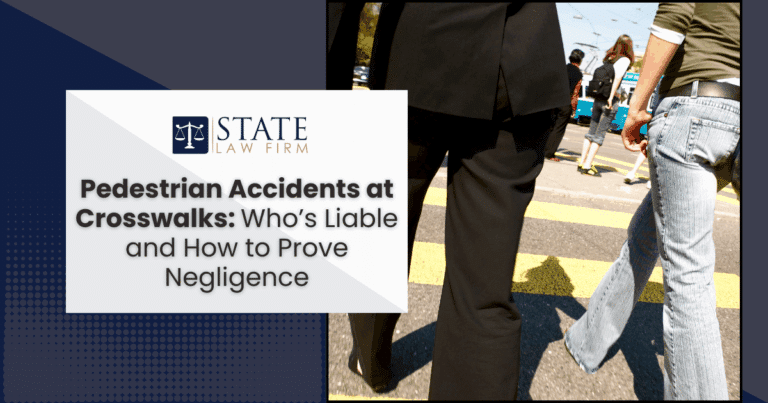
A driver who fails to yield to a pedestrian in a California crosswalk may be liable for the resulting injuries, but being in a crosswalk does not automatically decide every claim. Liability depends on the applicable crossing rules, signals, each person’s conduct, and whether that conduct caused harm. In some cases, responsibility may be shared or another party may also be involved.
If you were hit while crossing, prioritize medical care and preserve the details that explain what happened: your crossing path, the driver’s direction, the signal sequence, witnesses, and available video. Those facts are more useful than a general argument that pedestrians always have the right-of-way.
What California law requires at a crosswalk
Vehicle Code section 21950 generally requires drivers to yield to pedestrians crossing within a marked crosswalk or an unmarked crosswalk at an intersection. Drivers approaching pedestrians in those crossings must use due care and slow down or take other necessary protective action.
Pedestrians also have safety duties. They must not suddenly step or run from a safe place into the path of a vehicle so close that it presents an immediate hazard, or unnecessarily stop or delay traffic in a crosswalk. A pedestrian’s mistake does not cancel the driver’s own duty of care.
Marked and unmarked crosswalks
Paint is not the only way California recognizes a crosswalk. Vehicle Code section 275 includes marked crossings and certain roadway areas connecting or extending sidewalk boundaries at approximately right-angle intersections. The definition has exceptions, including crossings prohibited by posted signs.
If the location was unmarked, document the sidewalks, curb layout, intersection angles, and signs. Do not assume that every place where someone crosses is an unmarked crosswalk, or that missing stripes eliminate a valid claim.
Traffic signals can change the analysis
Bajo Vehicle Code section 21456, a WALK signal permits crossing, subject to yielding to vehicles already lawfully in the intersection when it first appears. A flashing hand with a countdown permits a pedestrian to start crossing if the crossing is completed before the steady hand appears when the countdown ends.
A steady hand, or a flashing hand without a countdown, means a pedestrian should not start crossing. Someone who began during WALK and is partway across should continue to a sidewalk or safety zone or otherwise leave the roadway as the statute directs. Record the actual display and timing rather than describing every flashing signal as the same.
Who may be responsible for a crosswalk collision?
A driver who failed to use reasonable care
Possible issues include a failure to yield, an unsafe turn, distraction, excessive speed for the conditions, or failure to respond to a pedestrian who was visible. The relevant question is what the driver should reasonably have done in the circumstances and how the failure contributed to the injury.
Another important rule applies when a vehicle has stopped to let a pedestrian cross. Vehicle Code section 21951 prohibits a driver approaching from behind from overtaking and passing that stopped vehicle at a marked crosswalk or an unmarked intersection crosswalk. In a multilane collision, identify which vehicles stopped and which continued.
Other people or businesses
Depending on the facts, an investigation may also consider an employer if the driver was working, a vehicle owner, or another person whose conduct contributed to the collision. Their responsibility is not automatic. Each potential claim needs a factual and legal basis, and insurance coverage is a separate question.
A public entity responsible for a dangerous condition
A crash on a public street does not by itself establish a claim against the city or county. Under La sección 835 del Código de Gobierno, a dangerous-condition claim involves specific requirements concerning the condition, causation, foreseeable injury risk, and either qualifying employee conduct that created the condition or sufficient prior notice to the entity.
Faded markings, blocked sightlines, or a malfunctioning signal may warrant investigation, but they are not automatic proof of government liability. Ownership, maintenance records, applicable immunities, and claim procedures matter. Identify the responsible agency rather than assuming the nearest city controls the road.
How do you prove negligence in a crosswalk accident?
A negligence claim requires more than showing that a collision happened. The evidence must establish the relevant duty, a failure to meet it, harm, and a causal connection between the failure and the harm. A traffic-law violation can be important evidence, but the circumstances and its connection to the injury still need to be examined.
Organize the evidence around the disputed facts:
| Question to resolve | Evidence that may help |
|---|---|
| Where was the pedestrian crossing? | Scene photographs, sidewalk boundaries, markings, signs, video, and witness descriptions of the crossing path. |
| What did the signals show? | Video showing the relevant approach, witness observations, and signal timing or maintenance records when available. |
| Could the driver see and respond? | Lighting, sightlines, obstructions, vehicle damage, movement before impact, and reconstruction when needed. |
| Did another vehicle stop for the pedestrian? | Dashcam footage, lane locations, witness contact information, and a diagram of vehicle movements. |
| What harm resulted? | Medical records, treatment recommendations, wage records, receipts, and documentation of daily limitations. |
Keep original files, not only edited clips or screenshots. Note who supplied each item and when it was obtained. If you make a diagram later, label it as your recollection rather than a measurement taken at the scene.
Video requests should identify the place and time
Nearby businesses, residences, buses, or vehicles may have useful recordings. Identify the exact intersection, approach, date, and a reasonable time window when asking an owner to preserve footage. Do not assume a visible traffic camera records or stores video, or that every system has the same retention period.
Our guide to requesting traffic-camera footage after an accident covers that separate process. A preservation request does not guarantee access. Some evidence requires formal legal procedures to obtain.
A police report is useful, but not the final decision
Obtain the report number and agency information. Review names, locations, witness information, and descriptions for factual mistakes. If your account was missing because you were taken for treatment, ask the agency how to provide a supplemental statement.
A citation, an officer’s conclusion, or the absence of a citation does not by itself resolve every civil-liability question. Preserve the underlying photographs, recordings, and witness evidence rather than relying only on the report’s summary.
What if the pedestrian is partly at fault?
California’s comparative-fault approach generally allows an injured person to seek compensation even when their own negligence contributed to the harm, with damages reduced by their percentage of responsibility. The Judicial Council’s comparative-fault instruction, CACI 405, requires proof of both negligence and its causal contribution, not just an accusation.
For example, an insurer may question when the pedestrian entered the road, whether a signal was obeyed, or whether a distraction affected the crossing. Those issues need evidence. They do not establish a fixed percentage of fault, and the driver’s conduct must still be evaluated.
Describe what you actually remember. Do not guess about speed, agree to an inaccurate account, or hide relevant facts. This article focuses on proof at the crossing; it does not treat the presence or absence of a pedestrian citation as a substitute for the civil-fault analysis.
Practical steps after being hit in a crosswalk
- Get to safety and obtain medical help. Call emergency services when needed. Do not remain in traffic or delay treatment to collect evidence.
- Identify the collision. When safe, collect the driver’s contact and insurance details, vehicle information, report number, and witness contact information.
- Document the setting. Record the crossing, signs, signals, visibility, and direction of travel. Ask someone else to help if your injuries prevent this.
- Preserve available records. Keep photographs, original video, correspondence, medical documents, bills, and work-loss information together.
- Clarify insurance requests. Find out which insurer is asking and what it needs. Your own policy may impose notice or cooperation duties that differ from a request by the driver’s insurer. See our guide to recorded statements to insurance adjusters.
- Check deadlines and any proposed release. Do not assume ongoing negotiations extend a legal deadline. Understand which claims a settlement would resolve before signing.
Compensation and deadlines are separate from proving fault
Depending on the evidence, a claim may include medical expenses, lost earnings, pain and suffering, and other legally recoverable losses. Future losses require support. There is no reliable settlement figure that applies merely because the impact occurred in a crosswalk. Fault, documented harm, available coverage, and other case-specific issues affect the outcome.
El California Courts’ personal-injury guide explains that the usual deadline to sue is two years from the injury, but exceptions and different rules can apply. For an injury claim against a government entity, an administrative claim generally must be presented within six months, followed by separate lawsuit requirements. Review the California Courts’ government-claim guidance and obtain advice about the actual dates.
Do not rely on a general deadline summary for a child’s claim, a government claim, or an unusual situation. Reporting the collision to police or opening an insurance claim is not the same as meeting every claim-presentation or court-filing requirement.
Frequently asked questions
Is the driver automatically at fault if I was in a crosswalk?
No. A driver’s duty to yield is important, but signals, the timing of entry, the driver’s opportunity to respond, and the cause of the injury still matter. Crosswalk location is evidence, not a guaranteed result.
Can I have a claim if there were no painted crosswalk lines?
Yes, potentially. California recognizes qualifying unmarked crosswalks at intersections. Photographs of the sidewalks, intersection layout, and posted restrictions can help establish whether that definition applies.
What if the driver says I suddenly stepped into traffic?
Compare that account with video, witness observations, visibility, and the positions and movements of everyone involved. The allegation alone does not establish pedestrian fault. A driver also retains a duty to use care.
Can I prove a crosswalk accident without video?
Potentially. Witness accounts, photographs, physical evidence, reports, and medical records may support a claim. Video can be helpful, but its absence does not automatically prevent proof of negligence or injury.
Does a faded crosswalk mean I can sue the city?
Not automatically. A public-entity claim requires more than faded paint or the fact that an accident occurred. The condition’s role in the injury, the responsible entity, statutory requirements, possible defenses, and short claim deadlines all need review.
When legal review may help
Consider legal advice when injuries are significant, the crossing or signal sequence is disputed, several parties may be responsible, or a dangerous road condition may be involved. Review can help identify the evidence and deadlines that apply without assuming every collision requires litigation.
For a collision in the Sherman Oaks area, State Law Firm’s Sherman Oaks pedestrian accident lawyers provide information about local pedestrian-injury claims. You can also request a consultation to discuss a pedestrian injury and bring any report, photographs, insurance correspondence, and treatment records you have.
General educational information, not individualized legal advice. Liability and deadlines depend on the facts and applicable law.