Spanish
  English
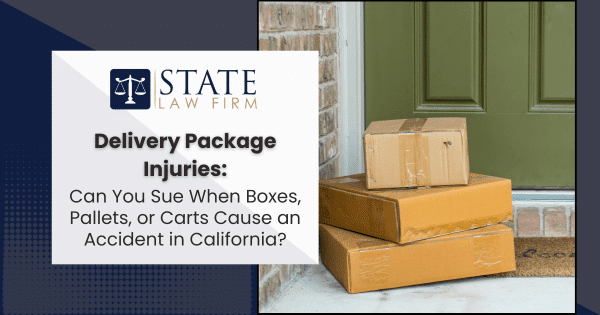
A delivery should be routine. A box should stay stacked, a cart should roll where it is guided, and a loading area should not become a hazard zone for shoppers, tenants, workers, or visitors. But when a package topples, a pallet shifts, or a loaded cart cuts across a walkway and causes a serious injury, the legal question becomes much more important than the package itself: who had the duty to keep that space, process, or equipment safe?
These cases can arise in apartment buildings, big-box stores, office complexes, warehouses, parking lots, and mixed-use properties. If your injury happened in or around a commercial property, a delivery zone, or even a vehicle-related loading area, it may be worth speaking with our El Monte car accident lawyers if the facts overlap with broader traffic or premises issues. And these incidents are not rare in the real world. The U.S. Bureau of Labor Statistics reported 835,040 cases involving transportation and material moving occupations over a two-year period, with 201,180 involving contact with an object or equipment.
Common Delivery-Related Injury Scenarios
Package injury claims do not all look the same. Some are dramatic and immediate. Others seem minor at first, only to become serious after the adrenaline wears off and the medical picture becomes clearer. What they often share is a simple fact pattern: someone allowed a delivery process, storage setup, or moving pathway to become unreasonably dangerous.
A few of the most common scenarios include:
- a box falling from a dolly, shelf, or stacked delivery pile
- a pallet left in a walkway or parking lot path
- a hand truck or cart rolling into someone
- a pallet jack, cart wheel, or brake malfunction
- loose shrink wrap, straps, or packaging materials creating a trip hazard
- delivery items blocking stairs, hallways, or entrance routes
- heavy merchandise being moved overhead without proper protection for people nearby
Some of these cases happen in public-facing stores. Others happen in apartment complexes where packages pile up near mailrooms or lobbies. Others happen in loading docks, employee corridors, or parking structures where residents, customers, vendors, and delivery workers are all moving through the same space.
The key is not whether the event looked ordinary. The key is whether the danger was preventable. California safety rules for things like working warehouses reflect that stacked merchandise, overhead storage, and active material movement can create serious risks when businesses fail to secure loads or separate people from danger zones.
If your injury happened during what seemed like a normal delivery moment, do not let that label shrink the seriousness of the claim. Normal business operations still have to be carried out safely. When they are not, the law may allow recovery.
Who Can Be Liable
One of the first mistakes people make after a package-related injury is assuming that only the person holding the box can be responsible. In reality, liability often depends on control, notice, supervision, and the exact cause of the hazard. That means several different parties may need to be evaluated, not just the nearest worker.
Depending on the facts, potentially liable parties may include:
- the property owner
- the store or business operating on the property
- the delivery company
- a third-party logistics or stocking contractor
- a landlord or property manager
- an employer supervising the loading area
- the manufacturer or distributor of defective equipment
For example, if a store allowed deliveries to pile up across a customer walkway for hours, the case may center on premises liability. If a delivery driver pushed a loaded cart carelessly through a crowded entryway, the case may look more like ordinary negligence. If a pallet jack, brake system, caster wheel, or handle failed during normal use, a product defect theory may also come into play.
This is why early investigation matters. A person may look like an “independent contractor” on paper while the property owner still controlled the space and the safety practices. A store may blame a delivery company, while surveillance footage shows its own staff ignored the obstruction all day. A landlord may say the risk was obvious, while the injured person had little practical choice but to pass through the blocked area to access a unit, elevator, or entry path.
That is also why readers should be cautious about accepting a quick explanation from management or an insurer. Fast answers are often incomplete answers.
If there is one practical takeaway here, it is this: get the names of everyone involved. Ask which company made the delivery, who controlled the area, who prepared the stack, and who owned the equipment. The sooner those dots are connected, the stronger the claim usually becomes.
Premises Liability vs. Negligence vs. Product Defect
These claims often sound similar in conversation, but they do not always rest on the same legal theory. Understanding the difference can help you see why some cases expand beyond a simple slip-and-fall framework.
Responsabilidad de las instalaciones usually focuses on the condition of the property. Was the walkway blocked? Was the package stack left where visitors had to squeeze past it? Was the loading area organized in a way that exposed people to falling items or rolling equipment? In California, a property owner, occupier, lessee, or controller generally has a duty to use reasonable care to keep property reasonably safe.
Negligencia focuses more directly on conduct. Did a worker push a loaded cart too fast? Did someone stack boxes carelessly? Did management ignore repeated complaints about deliveries obstructing a hallway? Did staff move merchandise through a public area without basic precautions? When the injury flows from a bad act or careless method, negligence may be the cleanest theory.
Product defect becomes important when the equipment itself failed. If a cart’s wheel locks unexpectedly, a pallet jack malfunctions, or a handle breaks during ordinary use, the claim may involve more than careless operation. It may involve a defective product placed into use in a way that injured someone during foreseeable use.
These theories can overlap. A single case may involve unsafe property conditions, careless human conduct, and defective equipment at the same time. California law does not force injured people into an artificially narrow box when the facts point in multiple directions.
This matters because defendants often try to simplify the story. They may argue the danger was open and obvious. They may say the injured person should have just walked around it. They may insist the worker made a split-second mistake no one could prevent. But real life is messier. People encounter delivery hazards in tight hallways, parking lots, apartment lobbies, and store aisles because they have to get where they are going. For a related example of how location-based California rules can shape everyday legal exposure, see Is It Illegal To Sleep In Your Car? Understanding California Laws.
When the facts are preserved early, the legal theory usually becomes much clearer.
Evidence Checklist, Damages, and Next Steps
In a delivery package injury case, evidence disappears fast. Boxes get moved. Pallets get thrown away. Staffing records change. Security video may not be saved unless someone asks for it quickly. That means the hours and days right after the incident can matter a great deal.
Try to preserve as much of the following as possible:
- photos of the scene from multiple angles
- the box, label, pallet, cart, or equipment involved
- names of employees, delivery personnel, and witnesses
- any incident report made on site
- surveillance camera locations
- medical records beginning with the first visit
- proof of missed work and lost income
- written communications with the property, store, or insurer
Do not just photograph the injury. Photograph the setting. Show the narrow walkway, the obstructed path, the leaning stack, the broken wheel, the torn shrink wrap, the warning signs that were missing, or the way the delivery area blended into customer or tenant space. In cases like this, context often proves the case.
Damages may include more than the first urgent-care bill. Depending on the injury, a claim can involve medical expenses, lost wages, future treatment, pain, physical limitations, and the day-to-day disruption that follows a serious fall or impact. What looks like a bruising incident on day one can become a shoulder injury, back injury, knee tear, concussion, or aggravation of a prior condition.
There is also a strategic reason to act early. The longer a case sits, the easier it becomes for each company involved to point at someone else. Early documentation helps lock in the facts before that blame-shifting hardens.
A tasteful but important reminder: if the delivery incident happened on commercial property, in a residential complex, or around a loading or parking area, legal advice is not overreacting. It is often the only way to identify every responsible party before evidence disappears. State Law Firm can help evaluate whether your case belongs under premises liability, negligence, product defect, or some combination of all three.
Llevar
Delivery package injuries may look ordinary, but the injuries and legal consequences can be anything but. When boxes, pallets, or carts cause harm in California, the real issue is usually who controlled the danger, who ignored it, and what evidence can still be preserved. If you were hurt, move quickly, document everything, and get the claim evaluated before the scene is cleaned up and the story gets rewritten.