Spanish
  English
State Law Firm | Sacramento, California
Sacramento Slip and Fall Lawyer
A property-injury claim starts with the condition, the location, and who was responsible for the area. State Law Firm helps people injured in Sacramento falls review evidence, reporting options, and next steps.
Free initial consultation
Slip, trip, and fall claim review
Property and evidence questions
Serving Sacramento from Sherman Oaks
Start with the fall date, exact location, property name, and any report number. Preserve original photographs and tell the team if a public facility or city sidewalk was involved. You can request a consultation before every record is available; a 311 service request does not replace a required government claim.
Start With the Exact Place and Condition
A fall at a Sacramento storefront, apartment stairway, parking garage, or sidewalk raises different questions about who controlled the area and what happened there. A street address is a starting point, but the particular entrance, stair, aisle, or section of pavement can matter just as much. State Law Firm helps injured people review these details and the records needed to assess a potential claim.
Begin with your medical needs. When it is safe, keep the fall date and time, the property name, any incident-report number, and contact information for people who saw the condition or its aftermath. You do not need a complete evidence file before requesting a consultation. Tell the team promptly if a public facility, city sidewalk, or work assignment was involved.
When a Property Condition May Support a Claim
A fall alone does not establish liability. California’s ordinary-care principle appears in Civil Code section 1714. A review considers the relevant duties, conduct, and connection between the condition and the injury, rather than assuming that every wet surface or uneven walkway creates a valid case.
For a private-property unsafe-condition claim, key questions include who owned, leased, occupied, or controlled the area; whether the condition presented an unreasonable risk; whether the responsible party knew or reasonably should have discovered it; and whether a failure to address it contributed to the harm. California’s civil jury instructions 1000 and 1003 describe these issues. Public-property claims follow a different statutory framework.
Ownership is not the only inquiry. A store operator, landlord, property manager, or maintenance contractor may have relevant responsibilities. Bring the property name and any lease, management, or insurer information you already have; the legal team can identify what additional records to request. Explore the firm’s premises-liability practice for broader context.
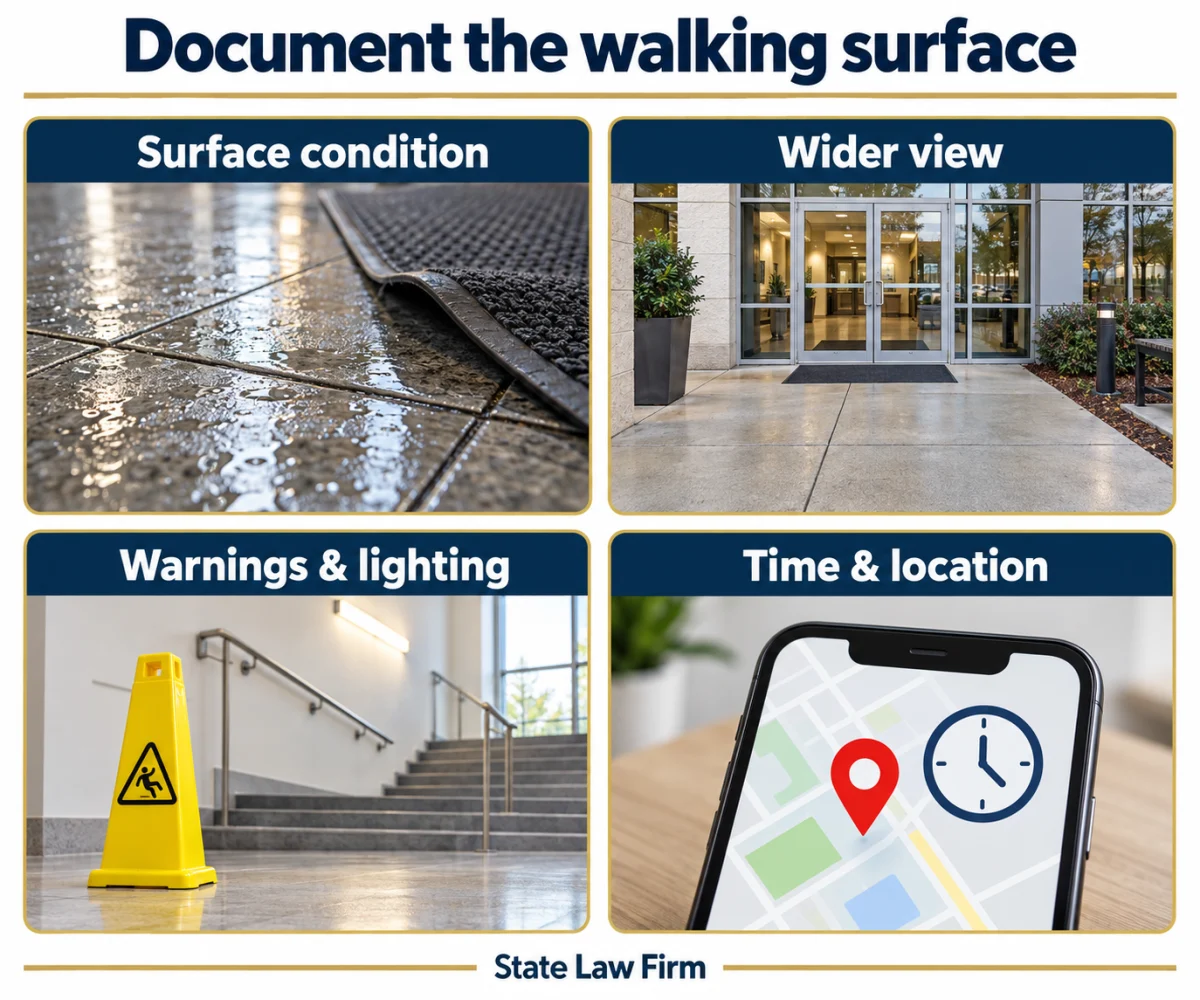
Document the Surface and the Surroundings
- Surface condition: Photograph the spill, mat edge, step, debris, or change in level as it appears. Do not move an object or recreate the fall to make a photograph.
- Wider view: Include the approach, doorway, aisle, railing, and nearby signs so a close-up can be placed in context.
- Warnings and lighting: Record the position of any cone or barrier and what could be seen from your direction of travel.
- Time and location: Preserve original photo files, the specific property address, the entrance or floor, and receipts or other records of your visit.
Keep original footage, messages, shoes, and other relevant items without altering or discarding them. If you know where a camera was located, tell the legal team; recordings may be overwritten. Ask about a prompt preservation request rather than assuming that a store, apartment manager, or public agency will keep everything indefinitely. Do not enter restricted areas or put yourself at risk to obtain evidence.
A missing photograph or witness does not answer whether a claim can be supported. Explain what is missing and why. Our evidence-preservation resource provides additional background on keeping original records.
What the Property Knew, and When
Inspection records, cleaning logs, maintenance requests, earlier complaints, and video may help reconstruct a condition’s history. CACI 1011 addresses whether it existed long enough to be found and addressed through reasonable care. There is no universal number of minutes that proves notice in every case.
Separate what you personally observed from what someone later told you. Write down an employee’s name and the substance of any conversation accurately, without filling gaps with assumptions. A report made after the fall does not, by itself, establish that the same condition was known beforehand. Read more about constructive notice, then discuss how the available records relate to your incident.
Sacramento Reports Serve Different Purposes
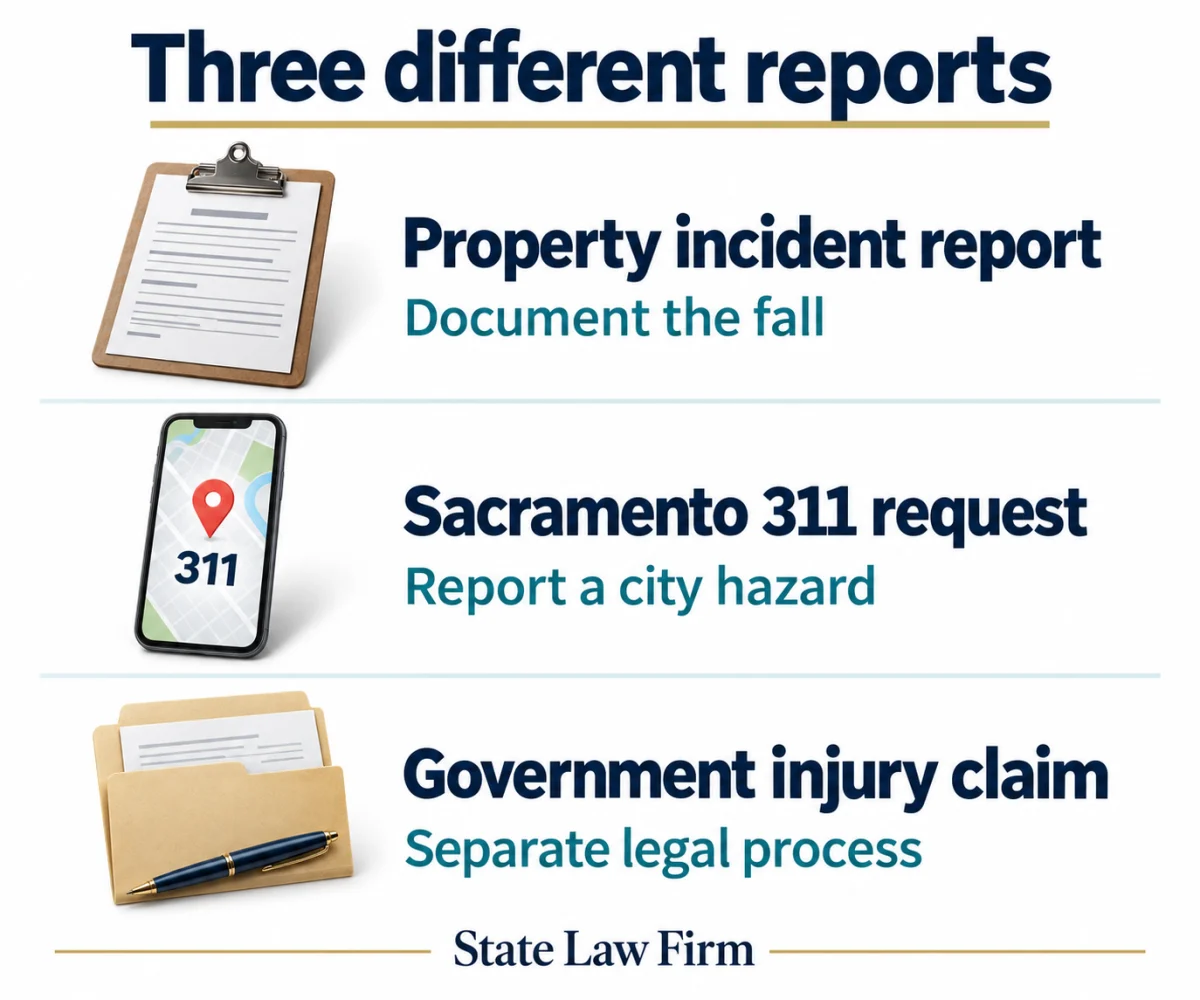
Keep reporting a condition separate from pursuing an injury claim. Which process applies depends on the property and parties involved; these are not three mandatory steps for every fall.
- Property incident report: Tell the appropriate manager what happened and ask for a copy or reference number. Keep your account accurate and save any correspondence.
- Sacramento 311 request: The City’s non-emergency service connects residents and visitors with City services and problem reporting. Save the service-request details if you use it for a city-related hazard.
- Government injury claim: A claim against a public entity has its own recipient, required information, and timing. A maintenance request is not a substitute.
Use the official Sacramento 311 page for service channels. For a claim against the City itself, consult the City’s general-liability claim resources. Its claim instructions direct paper submissions to the City Clerk and distinguish the City from the County, regional transit, and other separate entities. Confirm the current process and correct recipient with counsel.
A Sacramento mailing address does not identify the responsible government agency. Preserve the exact site location and any facility or project signage. Do not assume a public sidewalk, a private entrance, and a transit property share the same owner or claims route.
Public Property and Filing Deadlines
Government Code section 835 sets requirements for dangerous-condition claims involving public property, including causation, foreseeable risk, and specified creation-or-notice circumstances. An injury on public property is not automatic proof of government liability; statutory defenses and other requirements need review.
California’s general personal-injury limitation is two years under Code of Civil Procedure section 335.1. Public-entity injury claims generally require administrative presentation within six months of accrual under Government Code section 911.2, with separate lawsuit requirements afterward. Different claim types, dates, and exceptions can change the analysis. Do not wait for an insurer, repair response, or complete medical file before asking which deadlines apply.
Prepare for an Initial Case Review
Bring the incident details, available photographs, report numbers, insurer letters, and information about your treatment and missed work. Keep bills, receipts, and a factual record of how the injury affects everyday tasks. Ask how to share sensitive records securely; a first inquiry does not require uploading your entire medical history.
When retained, State Law Firm can investigate property control, request relevant evidence, review coverage, communicate with insurers, and assess negotiation or litigation. The team can explain what information is needed to evaluate claimed losses and any disputed responsibility. A settlement amount or resolution date cannot be promised. See the California premises-liability guide for additional background.
Meet the Attorneys

Eddie Tehrani
Eddie Tehrani founded State Law Firm after working in Los Angeles law offices handling personal injury and civil litigation. Review his background and discuss the firm’s approach to your property-injury questions.

Arnold Gross
Arnold Gross’s firm biography describes personal injury trial work, along with mediation and arbitration experience. Read his professional background on the firm’s attorney page.
Serving Sacramento From Our Sherman Oaks Office
State Law Firm’s main office is at 15490 Ventura Blvd #205, Sherman Oaks, CA 91403. Sacramento inquiries can begin by phone or online; ask about meeting arrangements before traveling. Review office locations o contact the team en (877) 659-9223.
If the incident involved a renovation, temporary walkway, or construction site, our Sacramento construction accident page offers related background. Tell the team if you were working at the time so the appropriate claim types and deadlines can be considered.
Preguntas frecuentes
Can I ask for help if I did not take photographs?
Yes. Describe the condition, location, timing, and who you spoke with. Available reports, witnesses, video, or maintenance records may help the review. Do not recreate the scene or change evidence to fill a gap.
Does a wet-floor sign decide whether I have a case?
No single sign answers every question. Explain where it was, what it warned about, and what you could see on your approach. The condition, warning, and surrounding circumstances need to be assessed together.
Does a Sacramento 311 request preserve my injury claim?
Do not rely on it to do so. A service request and a formal government claim serve different purposes. Save the request number and promptly ask which entity and legal process apply to your incident.
What if the insurer says I was partly responsible?
Preserve that correspondence and explain the facts. Proven comparative fault can reduce damages under California’s rules; an insurer’s allegation alone does not establish a percentage. Ask the attorney to review the available evidence.
Should I wait until my treatment is finished to call?
No. An initial review can begin while treatment continues. Evidence preservation and filing deadlines may need attention earlier. Explain your current care and update the team as more information becomes available.
Is the initial slip-and-fall consultation free?
Yes. The initial consultation is free. Ask the team to explain proposed attorney fees, case costs, and the terms of any engagement agreement before deciding whether to retain the firm.
Request a Sacramento Slip and Fall Consultation
Tell State Law Firm where and when the fall happened, the condition involved, and whether you reported it. Start with what you know and ask which records or deadlines need attention next.
Request a free consultation or call (877) 659-9223.
This page provides general information, not legal advice. Contacting the firm does not by itself establish an attorney-client relationship. A case-specific review is needed to assess eligibility, evidence, and deadlines.