Spanish
  English
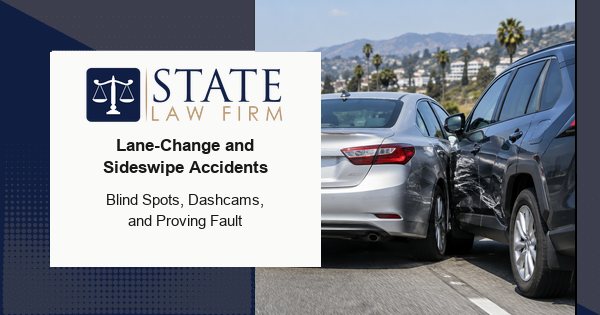
In a California lane-change or sideswipe crash, fault usually turns on which driver moved from a lane without reasonable safety, failed to signal when another road user could be affected, drifted across a lane line, or failed to account for a vehicle in a blind spot. The point of impact alone rarely answers the question. Dashcam video, vehicle damage, roadway markings, witness accounts, electronic vehicle data, and prompt photographs can help reconstruct how the vehicles came together.
A sideswipe may look minor, but a glancing impact at freeway speed can force a car into another lane, a barrier, or a rollover. An injury claim therefore requires two connected showings: evidence of who caused the collision and medical proof connecting the crash to the injuries and losses claimed.
What Is a Lane-Change or Sideswipe Accident?
A sideswipe occurs when the sides of two vehicles make contact while traveling beside one another or while one vehicle moves laterally. Common settings include freeway merges, congested multilane streets, lane reductions, construction zones, HOV entrances, highway exits, and simultaneous lane changes.
Not every sideswipe begins with a deliberate lane change. A distracted, fatigued, or impaired driver may drift across a painted line. A vehicle may also be pushed sideways by another impact. The factual sequence matters because the driver who crossed the line is not automatically the only person whose conduct must be evaluated.
What California Rules Apply to Lane Changes?
California Vehicle Code section 21658 generally requires a vehicle on a roadway with clearly marked lanes to remain as nearly as practical within one lane and not move from that lane until the movement can be made with reasonable safety.
Vehicle Code section 22107 separately provides that a driver may not turn from a direct course or move right or left until the movement can be made with reasonable safety. It also requires an appropriate signal when another vehicle may be affected.
El California Driver’s Handbook tells drivers to signal, check mirrors, check traffic behind and beside them, look over the appropriate shoulder, check blind spots, and confirm there is sufficient space before changing lanes. A traffic citation may be useful evidence, but it does not by itself determine every issue in a civil injury claim.
Who Is Usually at Fault for a Sideswipe?
The driver who makes an unsafe lateral movement is often primarily responsible. That may be a driver who merges into an occupied lane, changes lanes without a proper lookout, straddles a line, cuts across multiple lanes, or enters through a prohibited solid-line area.
Fault can be disputed or shared when:
- both drivers move toward the same lane at nearly the same time;
- one vehicle was speeding or accelerating to block a merge;
- a driver lingered in a large truck’s blind spot but the truck driver also failed to check;
- roadwork, faded markings, debris, or a disabled vehicle contributed to the movement;
- one driver made an evasive maneuver because of a third vehicle;
- a motorcyclist was lane splitting and the surrounding drivers failed to account for the rider; or
- one account conflicts with the damage pattern or video.
California’s comparative-fault system can allocate responsibility among multiple people. A claimant’s percentage of responsibility may reduce a recovery, but partial fault does not necessarily eliminate the claim. The allocation must be based on evidence rather than an assumption that the vehicle with more visible damage was blameless.
How Do Blind Spots Affect Fault?
Every vehicle has areas that mirrors do not fully show. The California DMV advises drivers to look over the shoulder and check blind spots before changing lanes or merging. Blind-spot monitoring can assist a driver, but it does not replace a visual check or the duty to move only when reasonably safe.
A driver generally cannot avoid responsibility simply by saying the other vehicle was in a blind spot. The useful questions are whether the driver checked, how long the vehicles traveled beside one another, whether a signal was used, whether warning systems activated, and whether the lane changer had enough space.
Commercial trucks have much larger no-zones. Truck mirrors, camera systems, driver logs, dispatch records, and the truck’s event data may be relevant when a tractor-trailer moves laterally. A trucking company may also be involved if maintenance, training, loading, or employment-related conduct contributed.
What Evidence Helps Prove Which Vehicle Left Its Lane?
Evidence is strongest when it captures the sequence rather than only the aftermath. Important sources may include:
- front, rear, and side-facing dashcam video;
- traffic, business, residential, transit, or construction cameras;
- scene photographs showing lane lines, debris, skid marks, gouges, signs, and final positions;
- witness names, contact information, and contemporaneous statements;
- 911 calls, dispatch records, collision reports, and body-camera footage when obtainable;
- paint transfer, scrape direction, crush patterns, broken mirrors, and wheel or tire marks;
- event data recorder information and vehicle telematics when available;
- phone records obtained through appropriate legal process when distraction is genuinely disputed; and
- qualified reconstruction or vehicle inspections in serious or contested cases.
Photos should cover all four sides of each vehicle, not just the largest dent. The height and direction of scraping may help compare competing accounts. Video should be preserved in its original form with the complete time sequence. A short social-media clip may omit the seconds that explain why a vehicle moved.
Camera footage may be overwritten quickly. SLF’s article on automated and red-light camera evidence explains why identifying the system owner and requesting the correct recording are important.
Does Vehicle Damage Always Show Who Changed Lanes?
No. Damage can support an account, but it should be interpreted carefully. A long scrape on one vehicle and concentrated damage near the other vehicle’s front corner may suggest relative movement, yet steering, braking, road curvature, secondary impacts, and differences in vehicle size can change the pattern.
Repair estimates are created to price repairs, not necessarily to reconstruct a collision. Preserve photographs taken before repairs and, when liability or injuries justify it, consider whether the vehicle should be inspected before parts are replaced or discarded.
What Should You Do After a Lane-Change Collision?
- Move to safety when possible. Call 911 when someone may be injured or the location remains dangerous.
- Report the collision accurately. Describe the lane, direction of travel, signals, vehicle positions, and what you observed without guessing.
- Photograph the full scene. Include roadway markings, merge signs, construction features, debris, each vehicle, and visible injuries.
- Identify witnesses and cameras. Ask nearby drivers whether they have dashcam video and note nearby businesses or homes.
- Seek appropriate medical care. Some symptoms may not be obvious at the roadside. Give clinicians an accurate crash and symptom history.
- Notify insurers promptly. Follow policy duties, but avoid speculating about speed, distance, or fault.
- Preserve records. Keep the original video, photographs, repair documents, medical bills, work records, and insurer communications.
How Are Injuries and Damages Proven?
A claimant must connect the collision to the injuries and requested losses. Medical records may document the onset of symptoms, examination findings, diagnoses, treatment, restrictions, and expected care. Diagnostic imaging should be considered with the clinical record rather than treated as automatic proof of severity. See SLF’s guide to MRI evidence after a California car accident.
Depending on the facts, recoverable losses may include reasonable medical expenses, lost income, reduced earning capacity, pain, physical limitations, property damage, and other legally recognized harm. The available insurance, injury evidence, prior medical history, comparative fault, and policy limits can materially affect the claim. There is no reliable “average” sideswipe settlement.
When Legal Review May Be Useful
Legal review may be useful when both drivers blame one another, video is at risk of deletion, a commercial truck or rideshare vehicle is involved, injuries are significant, several vehicles contributed, or an insurer minimizes the collision because the damage appears limited. Counsel can help preserve records, analyze applicable coverage, coordinate inspections, and present the liability and medical evidence together.
State Law Firm represents people injured in California vehicle collisions. To discuss a contested lane-change or sideswipe claim, call (877) 659-9223 or use the firm’s contact form for a consultation.
Preguntas frecuentes
Is the driver changing lanes always at fault?
No. The lane-changing driver is often a central focus, but another driver’s speed, simultaneous movement, distraction, or other conduct may also contribute. Evidence determines the allocation.
Can dashcam video prove a sideswipe claim?
It can be powerful evidence if it shows the lane markings, vehicle positions, signals, and complete sequence. Preserve the original file and surrounding footage.
Does failing to signal automatically make a driver liable?
Not automatically. Failure to signal can support negligence when another vehicle may have been affected, but causation and the conduct of all involved drivers still matter.
What if both drivers changed into the same lane?
Responsibility may be shared. Video, witnesses, vehicle damage, lane positions, speed, and which driver began moving first can help reconstruct the event.
Can a sideswipe cause serious injuries without major vehicle damage?
It can, especially when the first contact leads to a barrier strike, spin, rollover, or secondary collision. Injury proof must come from the medical evidence and full crash dynamics, not a repair photograph alone.
Should I give the insurer my dashcam file?
Preserve the original and review what it shows before providing a copy. Policy cooperation duties may apply, but a complete, accurate file is preferable to an edited clip.
This article provides general information and is not legal advice. Reading it or contacting State Law Firm does not create an attorney-client relationship. Rights, coverage, and deadlines depend on the facts.