Spanish
  English
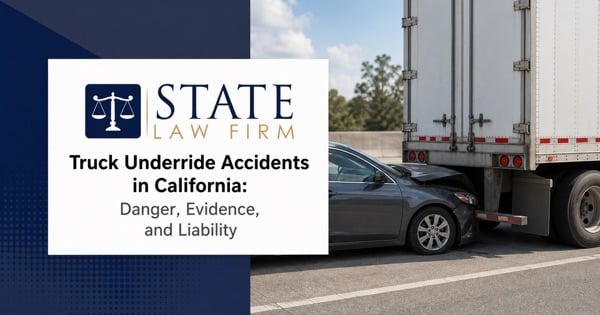
An underride truck accident happens when a smaller vehicle travels partly beneath a truck or trailer during a collision. Because the truck’s body can enter the passenger compartment above the car’s main crash structures, occupants may suffer catastrophic or fatal injuries. In California, liability may extend beyond the truck driver to a motor carrier, trailer owner, maintenance company, manufacturer, or another party whose conduct contributed to the crash.
Determining responsibility requires more than proving that underride occurred. Investigators may need to establish how the collision developed, whether required safety equipment was present and maintained, and whether negligent driving, poor visibility, defective components, or multiple failures combined to cause the harm.
What Is an Underride Truck Accident?
Most passenger vehicles are designed so their bumpers, frame, crumple zones, seat belts, and airbags work together during a collision with another similarly sized vehicle. A commercial truck or trailer sits much higher. In an underride collision, the lower portion of the car can pass beneath that elevated structure instead of engaging it squarely.
The result may be passenger-compartment intrusion at windshield or roof height. This is different from an ordinary rear-end collision in which the front of the passenger vehicle absorbs much of the initial impact.
Underride generally occurs in three configurations:
- Rear underride: A passenger vehicle strikes the back of a truck or trailer and moves beneath it.
- Side underride: A vehicle travels beneath the side of a trailer, often when a truck is turning, crossing traffic, backing, or blocking travel lanes.
- Front override: The front of a large truck rides over part of a smaller vehicle. Although often called an override rather than an underride, it creates a similar height-mismatch danger.
Why Are Underride Accidents So Dangerous?
Underride crashes are dangerous because the point of contact may be above the strongest crash-management structures in a passenger vehicle. If the hood moves underneath a trailer, the trailer may intrude into the windshield, roof pillars, or seating area before the vehicle can absorb and redirect the collision forces as intended.
This mechanism can produce severe head, brain, neck, spinal, chest, and crushing injuries. Occupants may also be trapped inside the vehicle, complicating emergency response. The medical consequences depend on the crash configuration, speed, restraint use, degree of intrusion, and other facts, so no particular injury should be assumed from the label “underride” alone.
The danger is not limited to high-speed freeway crashes. A trailer positioned across a dark roadway may be difficult to perceive in time, and a side impact at a lower speed can still place the passenger compartment against an unforgiving structure. The Administración Nacional de Seguridad del Tráfico en las Carreteras has also explained that underride events have historically been underreported in crash databases.
Rear, Side, and Front Underride Crashes Raise Different Questions
| Crash type | Common investigation questions | Important evidence |
|---|---|---|
| Rear underride | Was the trailer visible? Did the rear impact guard meet applicable requirements and remain properly maintained? | Guard measurements, welds, corrosion, reflective material, lighting, trailer inspections, impact damage |
| Side underride | Why was the trailer crossing or occupying the lane? Could drivers see it in time? Was a side guard present? | Roadway lighting, conspicuity tape, turn path, dash cameras, witness accounts, trailer geometry |
| Front override | Did the truck driver brake, follow too closely, lose control, or fail to respond to traffic? | Truck data, braking evidence, following distance, driver logs, forward-facing video |
These distinctions matter because the applicable regulations and liability theories may differ. A rear-guard requirement should not be casually applied to a side-impact configuration, and the absence of a side guard does not by itself establish that a federal standard was violated.
What Do Federal Underride-Guard Rules Require?
Federal Motor Vehicle Safety Standards 223 and 224 establish performance and installation requirements for rear impact guards on covered trailers and semitrailers. The rules address matters such as guard strength, energy absorption, dimensions, and placement. Federal Motor Carrier Safety Regulation 49 C.F.R. section 393.86 also governs rear impact guards and rear-end protection for commercial vehicles in operation.
The requirements do not apply identically to every truck, trailer, or model year. Vehicle type, weight rating, configuration, manufacturing date, and regulatory exceptions must be checked before alleging noncompliance.
Rear and side guards also have different regulatory histories. NHTSA strengthened federal rear-impact protection standards in 2022, but federal agencies have continued researching and evaluating side-underride protection. An article or claim should not imply that every trailer is presently subject to a universal federal side-guard mandate.
Compliance with a minimum federal standard does not necessarily resolve every civil-liability question. Investigators may still examine negligent maintenance, missing repairs, an unsafe trailer position, inadequate visibility, or a potential product defect. Conversely, damage to a guard after a severe collision does not automatically prove that the guard was defective before impact.
Who May Be Liable for a California Underride Accident?
Liability depends on the conduct that caused the collision and the relationship between the people and companies involved. One crash may support claims against several parties, while another may rest primarily on a single driver’s negligence.
The truck driver
A driver may be responsible for unsafe lane changes, following too closely, excessive speed, impaired or distracted driving, improper backing, an unsafe turn, or leaving a trailer positioned across active traffic. Failure to deploy warning devices after a breakdown may also become relevant in the appropriate circumstances.
The motor carrier or employer
A carrier may be responsible for an employee’s conduct within the scope of employment. Separate questions may involve hiring, training, supervision, scheduling, inspection, maintenance, or policies that encouraged unsafe operation. The exact employment and contracting relationships must be verified rather than inferred from a logo on the truck.
The truck, trailer, or equipment owner
The tractor and trailer may have different owners. An owner that retained inspection or maintenance responsibilities may be implicated if defective lights, missing conspicuity material, corrosion, guard damage, or another unsafe condition contributed to the collision.
A maintenance or repair provider
A third-party shop may bear responsibility if it negligently inspected, repaired, installed, or altered a guard or another safety component. Repair orders, invoices, technician notes, photographs, and discarded parts may be critical.
A manufacturer or seller
A product-liability investigation may be appropriate when the trailer or guard allegedly contained a manufacturing, design, or warning defect. This is a technical inquiry that ordinarily requires preservation of the component and qualified engineering analysis. A guard’s post-crash appearance alone does not establish a defect.
Other potentially responsible parties
Depending on the facts, responsibility may also involve a loading or logistics company, another motorist, a contractor controlling the work zone, or a public entity responsible for a dangerous roadway condition. Claims involving a California government entity can carry special notice requirements and shorter initial deadlines.
Does a Missing or Failed Underride Guard Automatically Prove Liability?
No. A claimant generally must connect a legally actionable failure to the collision and resulting harm. That may require proof that a rule applied, that the responsible party violated it, and that the violation was a substantial factor in causing injuries that proper protection would have prevented or reduced.
The defense may argue that the guard complied with applicable standards, that an exception applied, that the impact exceeded the equipment’s design conditions, or that another act caused the collision. California’s comparative-fault system can allocate responsibility among multiple people or entities, including an injured driver when supported by the evidence. Comparative fault does not necessarily eliminate a claim, but it may reduce the recoverable damages.
That is why the investigation should separate four questions:
- What caused the initial collision?
- Did the vehicle underride the truck or trailer?
- Did a guard, visibility device, or other component fail to perform as legally required or reasonably expected?
- How did underride or component performance affect the nature and extent of the injuries?
What Evidence Can Establish How the Underride Happened?
Underride evidence can disappear quickly when vehicles are repaired, salvaged, returned to service, or inspected without notice to interested parties. Useful evidence may include:
- The tractor, trailer, passenger vehicle, guard, mounting hardware, welds, and fractured components
- Scene photographs, roadway measurements, debris locations, skid marks, gouges, and final vehicle positions
- Trailer lighting, reflective tape, warning triangles, and other visibility equipment
- Police photographs, body-camera footage, dispatch recordings, and supplemental reports
- Dash-camera, surveillance, traffic-camera, and witness video
- Electronic logging device, engine-control, telematics, GPS, braking, and event data
- Driver qualification, hours-of-service, training, dispatch, and communication records
- Trailer inspection, maintenance, ownership, lease, repair, and recall records
- Guard certification labels, specifications, installation instructions, and design documents
- Witness statements and testimony from first responders
- Medical records connecting the crash mechanism to diagnosed injuries
An underride reconstruction may require specialists in commercial vehicles, crash dynamics, metallurgy, guard performance, visibility, or biomechanics. The appropriate disciplines depend on the disputed issues. Not every case requires every type of expert.
A preservation request can identify relevant vehicles, components, documents, and electronic records, but it should be tailored to the case. Evidence should not be altered through destructive testing before the relevant parties have an appropriate opportunity to inspect it.
What Compensation May Be Available?
A person injured by another party’s negligence may be able to seek compensation for reasonably necessary medical care, lost income, reduced earning capacity, property damage, pain, emotional distress, disability, disfigurement, and other legally recoverable losses. The available categories and amounts depend on the evidence and the individual consequences of the injury.
When an underride crash is fatal, eligible survivors or the decedent’s personal representative may have wrongful-death or survival claims. These claims address different losses and require careful confirmation of who may bring them.
There is no reliable “average underride settlement.” Case value can be affected by injury severity, causation, comparative fault, available insurance, responsible parties, future-care evidence, earnings history, and the strength of the liability proof.
When Is Early Legal Review Particularly Important?
Early review may be useful when an underride collision caused a death or catastrophic injury, the trailer may soon return to service, a damaged guard could be discarded, several businesses controlled the truck or trailer, or an insurer disputes how the crash occurred. Prompt investigation may also matter when video, electronic data, maintenance records, and physical components are at risk of being lost.
California filing deadlines are subject to exceptions, and claims involving public entities may require an earlier administrative claim. The existence of a criminal or regulatory investigation generally should not be assumed to preserve a civil claim.
Bufete de abogados estatal California truck accident practice can evaluate the specific collision, identify the evidence that should be preserved, and determine which parties and insurance policies warrant investigation. Legal review does not guarantee a particular result, but it can help prevent important physical and electronic evidence from disappearing before responsibility is understood.
Frequently Asked Questions About Underride Truck Accidents
What is the difference between an underride crash and an ordinary truck accident?
An underride crash specifically involves a smaller vehicle moving partly beneath a truck or trailer. This can allow the larger vehicle to intrude into the passenger compartment above the car’s primary crash structures.
Are side underride guards required on every trailer?
No. Federal rear-impact-guard standards should not be confused with the developing regulatory treatment of side-underride guards. The requirements applicable to a particular trailer must be verified by vehicle type, configuration, weight, and manufacturing date.
Can a trucking company be liable if the driver caused the crash?
Potentially. A carrier may be responsible for an employee’s work-related negligence, and separate liability may arise from the carrier’s own hiring, training, supervision, inspection, maintenance, or scheduling decisions.
Can the guard manufacturer be responsible?
Possibly, if admissible evidence supports a manufacturing, design, or warning defect and connects that defect to the injuries. Engineering analysis and preservation of the guard are often important to that determination.
What if the injured driver was partly at fault?
California comparative-fault principles may reduce recovery according to the injured person’s share of responsibility. Partial fault does not automatically prevent a claim against other responsible parties.
Should the damaged trailer be inspected?
Inspection may be especially important when guard condition, trailer visibility, maintenance, or product performance is disputed. Relevant parties should ordinarily receive appropriate notice before destructive testing or alteration of critical evidence.