Spanish
  English
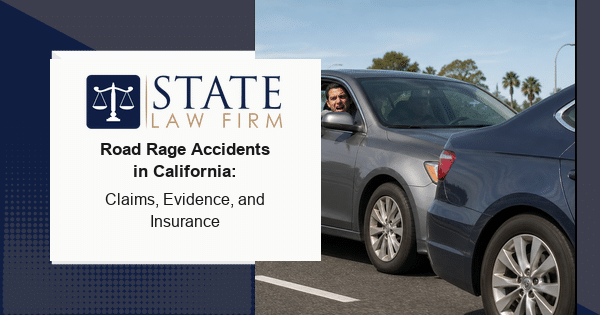
A person injured in a California road-rage accident may have a civil personal injury claim when another driver’s aggressive, reckless, or intentional conduct causes a collision and resulting harm. The legal theory depends on what the driver actually did. Unsafe weaving or tailgating may support a negligence claim, while deliberately ramming a vehicle or forcing it off the road may involve intentional misconduct.
That distinction matters because it changes what must be proven and how insurance may respond. Useful evidence can include dashcam footage, witness statements, 911 recordings, police observations, vehicle damage, electronic vehicle data, threats, and admissions. A criminal conviction is not always required to pursue a separate civil claim.
When Does Road Rage Become a California Personal Injury Claim?
“Road rage” describes conduct, but it is not one universal California civil cause of action. A claim usually begins with the specific behavior that caused the injury. The injured person generally must establish who was responsible, what that person did, how the conduct caused the incident, and what harm resulted.
For example, a driver may become frustrated and follow another vehicle too closely. If the tailgating causes a rear-end collision, the claim may be based primarily on negligence or violation of a traffic-safety law. If the driver instead turns the vehicle toward another car and intentionally makes contact, intentional-tort issues may arise.
Angry gestures or shouting, without a collision, physical contact, a legally recognized threat, or compensable harm, do not automatically create a personal injury claim. The facts must support the elements of a recognized claim.
Aggressive Driving, Reckless Driving, and Intentional Harm Are Not the Same
The phrase “road rage accident” can cover several legally different situations:
| Conduct | Possible civil characterization | Central proof issue |
|---|---|---|
| Speeding, unsafe weaving, or following too closely | Negligence or negligence per se, depending on the facts | Whether the unsafe driving caused the collision |
| Brake-checking or trying to block another vehicle | Negligence, recklessness, or intentional misconduct | Why the maneuver occurred and how it affected the crash |
| Deliberately sideswiping, ramming, or forcing a vehicle from the road | Potential intentional tort as well as other applicable theories | Identity, intent, causation, and resulting harm |
| Threatening or attacking someone after the vehicles stop | Potential assault or battery claim separate from collision negligence | The threat or contact, resulting injury, and responsible person |
Aggressive but negligent driving
A driver does not need to intend an injury to be liable for negligent driving. Speeding, unsafe lane changes, tailgating, or failing to maintain control may support liability when the driver fails to use reasonable care and causes a crash.
Reckless driving
California Vehicle Code section 23103 defines reckless driving as driving with willful or wanton disregard for the safety of people or property. Whether particular conduct satisfies that criminal standard depends on the evidence. An injured person’s civil claim still requires proof of causation and damages.
Intentional collision or assault
Deliberately using a vehicle to strike, threaten, or force another person from the road may support intentional-tort allegations and criminal investigation. The proper claims should be based on evidence rather than the label “road rage” alone.
What Road-Rage Conduct Can Cause an Injury Claim?
Road-rage injury claims may arise from conduct such as:
- Following another vehicle at an unsafe distance
- Repeatedly cutting off or blocking a driver
- Intentionally braking to frighten or punish a following driver
- Chasing a vehicle through traffic
- Forcing a vehicle onto a shoulder, median, barrier, or another lane
- Deliberately sideswiping or ramming a vehicle
- Striking a pedestrian, cyclist, or vehicle occupant during a confrontation
- Causing an uninvolved driver to crash while trying to avoid the aggressor
Each scenario requires its own analysis. State Law Firm’s guide to whether brake-checking is illegal in California addresses the special fault questions that arise when a lead driver deliberately slows in front of a tailgater. If an aggressive driver causes a collision without making contact, review what can happen when another vehicle forces you to hit a car.
What Evidence Can Prove a Crash Was Caused by Road Rage?
The strongest evidence usually shows the full sequence rather than only the moment of impact. It should help establish the responsible vehicle, the pattern of driving, any threats or deliberate maneuvers, the collision mechanics, and the resulting injuries.
- Dashcam and surveillance footage: Video may show following distance, repeated lane movements, gestures, braking, attempts to escape, or deliberate contact. Save the original file and avoid editing it.
- Independent witnesses: Other drivers, passengers, pedestrians, and nearby employees may have observed conduct that occurred before the crash.
- 911 recordings and dispatch records: A contemporaneous report may document the vehicle description, location, direction of travel, threats, and continuing danger.
- Police evidence: Reports may preserve driver statements, witness information, citations, demeanor, photographs, and observations. A report can be important without conclusively deciding civil liability.
- Vehicle and scene evidence: Damage patterns, tire marks, debris, roadway geometry, and final positions may help determine whether contact was accidental or deliberate.
- Electronic vehicle information: Depending on the vehicle, event data or telematics may show speed, braking, throttle, steering, or other events. Learn more about black-box data after a collision.
- Threats and admissions: Lawfully obtained messages, recordings, body-camera footage, or statements may help establish state of mind and intent.
Evidence of a person’s prior behavior is not automatically discoverable or admissible. Relevance, privacy, authentication, and California evidence rules must be considered before using prior incidents to prove conduct or intent.
What Should You Do During and After a Road-Rage Incident?
Your immediate priority is safety, not gathering perfect evidence.
- Do not engage or retaliate. Avoid gestures, shouting, brake-checking, or following the other driver.
- Call 911 when there is an immediate danger. Provide the vehicle description, license plate if known, location, direction of travel, and observed conduct.
- Do not drive home if you are being followed. When feasible, follow emergency-dispatch instructions and proceed toward a police station or another populated, safe location.
- Remain in a protected location when appropriate. Do not exit solely to confront the other driver.
- Obtain appropriate medical care. Describe symptoms accurately and follow medical advice.
- Preserve dashcam footage and photographs. Back up original files without changing timestamps or content.
- Identify witnesses and cameras. Record contact information and nearby sources of video. State Law Firm explains practical steps for preserving traffic-camera footage.
- Notify the appropriate insurer. Report facts accurately without guessing about speed, intent, fault, or injuries.
Avoid posting accusations, vehicle descriptions, or edited video publicly. Social-media activity can create safety, identification, privacy, and litigation problems.
Does Insurance Cover a Road-Rage Accident?
Insurance coverage can be one of the hardest parts of a road-rage case. Coverage may depend on the driver’s conduct, the policy language, the alleged claims, the relationship between the vehicle and the injury, and how California law applies.
California Insurance Code section 533 provides that an insurer is not liable for a loss caused by the insured’s willful act, while also stating that the insurer is not exonerated by the insured’s negligence. This creates an important distinction:
- A crash caused by negligent speeding, tailgating, or weaving may fall within ordinary automobile liability coverage, subject to the policy and facts.
- A deliberate attempt to cause injury may produce an intentional-act coverage dispute.
- Conduct described as “road rage” may still involve disputed intent. The label used in a police report or claim is not necessarily the final coverage determination.
An injured person’s own uninsured- or underinsured-motorist coverage, medical-payments coverage, health insurance, or other sources may need to be evaluated. None can be assumed to apply without reviewing the policy and circumstances. If an insurer rejects responsibility, State Law Firm’s guide to challenging an insurance liability denial explains why the insurer’s position is not the same as a court judgment.
Can Criminal Charges, Restitution, and a Civil Claim Proceed Together?
A criminal prosecution and a civil injury claim have different purposes. Prosecutors decide whether to file criminal charges, and a criminal court may impose punishment and restitution. The injured person may separately pursue civil remedies for legally recoverable losses.
A civil claim does not always require a criminal conviction. A decision not to arrest or prosecute does not necessarily determine civil liability. At the same time, evidence from a criminal investigation may raise access, timing, admissibility, and self-incrimination issues that require careful handling.
Eligible crime victims may also qualify for limited assistance from the California Victim Compensation Board. CalVCB may reimburse certain uncovered expenses for qualifying victims, but it does not pay ordinary property losses or pain and suffering. Restitution, insurance, civil recovery, and CalVCB benefits can also create notice or reimbursement obligations.
Can Punitive Damages Be Awarded After a Road-Rage Collision?
Punitive damages are possible in some cases, but road rage does not make them automatic. Under Sección 3294 del Código Civil de California, punitive damages generally require clear and convincing evidence of oppression, fraud, or malice.
The statute defines malice to include conduct intended to cause injury or despicable conduct carried on with willful and conscious disregard for others’ rights or safety. Whether the evidence satisfies that standard is a case-specific question. Additional requirements apply when punitive damages are sought from an employer based on an employee’s conduct.
Punitive damages are intended to punish and deter. They are distinct from compensatory damages for medical expenses, lost income, property loss, pain, and other legally recoverable harm. An award should never be promised, and insurance or collectability questions may affect the practical recovery.
When Legal Review May Be Useful After a Road-Rage Injury
Prompt legal review may be useful when the incident involves serious injury, deliberate vehicle contact, threats, a weapon, a hit-and-run driver, disputed identity, multiple vehicles, disappearing video, a criminal investigation, or an insurance denial based on intentional conduct.
A lawyer can help separate the potential legal theories, preserve time-sensitive evidence, identify applicable insurance, coordinate with a criminal investigation when appropriate, and document the connection between the incident and the resulting harm. State Law Firm’s Abogados de accidentes automovilísticos en California can evaluate the facts and available recovery sources without assuming that every aggressive-driving incident follows the same legal path.
Preguntas frecuentes
Can I sue if the road-rage driver was not arrested?
Potentially. A civil claim does not always depend on an arrest or criminal conviction. The available evidence must independently support the civil claim’s required elements.
What if a road-rage driver forced me to hit another vehicle?
The aggressive driver may bear responsibility even without direct vehicle contact, but the claim will depend on identifying that driver and proving how the conduct caused the collision. Other drivers’ actions and comparative fault may also be evaluated.
Does dashcam footage prove that the driver acted intentionally?
Dashcam footage can be strong evidence of a repeated pattern, threats, or deliberate movement. Intent is usually determined from the complete context, not from one isolated maneuver.
Can an insurance company deny a road-rage claim as an intentional act?
An insurer may raise an intentional-act or willful-act issue, but the result depends on the conduct, allegations, policy language, and applicable California law. A denial should be reviewed rather than assumed correct.
Can a road-rage victim recover punitive damages?
Possibly, when clear and convincing evidence satisfies California’s statutory requirements for oppression, fraud, or malice. Punitive damages are not available merely because a driver was angry or received a citation.
What if the aggressive driver leaves the scene?
Call 911, preserve identifying details and video, obtain witness information, and notify the appropriate insurer. Hit-and-run procedures and potentially applicable first-party coverage should be evaluated promptly.
This article provides general information about California law and is not individualized legal advice. Claims, insurance coverage, procedures, and deadlines depend on the specific facts.