Spanish
  English
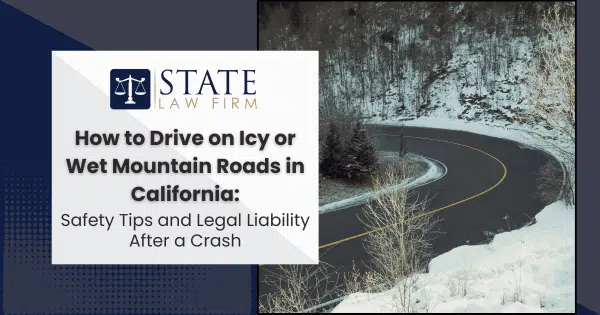
A California mountain drive can feel routine until the pavement turns slick and the margin for error disappears.
In wet or wintry conditions, traction drops quickly, visibility collapses without warning, and even a small mistake can become a multi-car collision.
Federal safety data shows most weather-related crashes happen on wet pavement and during rainfall, which is why “just slow down” is not advice. It is a strategy.
If a crash occurs, our Fullerton car accident lawyers can help you understand what happened, which evidence matters, and how fault is typically evaluated whenroad conditions are part of the story.
Understanding the Dangers: Why Mountain Roads in California are Hazardous When Wet or Icy
Mountain roads amplify ordinary hazards. Grades increase stopping distance. Curves reduce sightlines. Shade lingers in canyons and under tree cover, keeping pavement colder long after the sun hits the rest of the highway. The result is a road that can switch from merely wet to actively dangerous in a single turn.
Wet pavement changes braking more than most drivers expect. You may feel fine at 45 mph on a straightaway, then realize the tires are skating as you enter a curve or crest a ridge. Water also pools in ruts, creating pockets of standing water that can trigger hydroplaning, especially when the tire tread is worn.
Ice is not always visible, and it is rarely polite. Black ice blends into asphalt and often forms first on bridges, overpasses, and shaded corners. When you add elevation and wind, temperatures fluctuate fast. What was rain at the foothills can become sleet at the pass, then refreeze on the descent.
The weather does not just affect you. It affects everyone around you. Trucks need more time to stop. Visitors may not know chain rules. A nervous driver can brake hard mid-turn, and your “safe” following distance suddenly becomes unsafe.
Essential Safety Tips for Driving on Icy or Wet Mountain Roads
The goal is not bravery. It is control. The safest drivers in the mountains do fewer things, more gently, and earlier than everyone else.
1) Drive like you are carrying an open cup of coffee
Smooth inputs keep traction available. That means gradual steering, gentle acceleration, and early, light braking. On slick surfaces, abrupt moves steal grip from the tires, and the car will “choose” between turning and stopping. It cannot do both well at the same time.
Practical moves that work:
- Slow down before the curve, not in the curve.
- Avoid sudden lane changes, even if the road looks open.
- Coast earlier when traffic compresses, instead of braking late.
2) Increase the following distance beyond what feels reasonable
On wet pavement, stopping distance can increase dramatically. In the mountains, it is worse because downhill grades turn your car into a sled with opinions. Create space, then protect it. If someone cuts in, rebuild the gap without anger and without panic.
A good rule of thumb: if you can’t see a safe “out” ahead, you are too close.
3) Be intentional about speed on descents
Downhill driving is where many mountain crashes begin. If you ride the brakes, they heat up and lose effectiveness. If you brake hard, you can lock traction and slide.
Instead:
- Use a lower gear on steep grades so the engine helps control speed.
- Brake in short, controlled intervals if needed, not continuously.
- If you feel the wheels lose grip, ease off, regain traction, then reapply gently.
4) Treat standing water like a hidden pothole
Hydroplaning can happen faster than drivers expect, especially with worn tires. If you hit standing water:
- Keep the steering wheel steady.
- Ease off the accelerator.
- Do not slam the brakes.
- Let the tires regain contact before you make any big move.
5) Use the right visibility habits, not just the right lights
Turn headlights on early, even in daytime storms. In heavy precipitation, avoid high beams because glare can reduce what you see. And remember that visibility is not only what you can see. It is whether other drivers can see you.
Tasteful reality check: if you are white-knuckling the wheel and you cannot maintain a steady speed, the safest choice may be to exit, pause, and let the weather pass. Getting there later is always better than not getting there at all.
If another driver makes a risky move in these conditions and you get hit, document what you can and consider speaking with our Fullerton car accident lawyers about next steps.
Preparing Your Vehicle for Mountain Driving in Challenging Conditions
In the mountains, preparation is not optional. You do not want your first chain install to happen on the shoulder in sleet with semis rushing past.
A practical winter and wet weather checklist
Tires and traction
- Check tread depth and overall tire condition.
- Confirm your tires match the conditions you plan to drive in.
- Carry properly sized chains or approved traction devices, plus gloves and a headlamp.
California chain controls can require traction devices even when the pavement looks “mostly fine.” Caltrans explains the current chain requirements and what different restriction levels mean here: Caltrans Chain Controls.
Visibility and basics
- Replace worn wiper blades.
- Top off washer fluid suitable for cold conditions.
- Make sure headlights, brake lights, and hazard lights work.
- Confirm your defroster is effective before you climb.
Emergency supplies
- Water and shelf stable snacks.
- Warm layers and a blanket.
- Phone charger and a backup battery.
- First aid kit.
- A small shovel if snow is forecast.
Plan the trip like a lawyer plans a hearing
Know the route, the elevations, and the likely trouble spots. Check conditions before you leave and again before you climb. If there is active chain control, assume speeds will be slower and delays will be longer. That is not a nuisance. That is the point.
Navigating Common Challenges: Black Ice and Sudden Weather Changes
Black ice and sudden weather shifts are the two problems that surprise the most careful drivers, because they arrive without a courteous introduction.
How to spot black ice before you meet it
Black ice is most common:
- Early morning and after sunset.
- On bridges and overpasses.
- In shaded curves and canyon stretches.
- Near snow banks where meltwater refreezes.
Clues include a glossy sheen on the road, vehicles ahead fishtailing, or a sudden silence in the steering wheel, where feedback disappears.
What to do if you hit black ice
If you feel the car start to slide:
- Stay calm and keep your eyes on where you want the car to go.
- Ease off the accelerator.
- Avoid abrupt braking.
- Steer gently to correct, not sharply to “fight” the car.
If the slide continues, your best move may be to reduce inputs and let the vehicle slow naturally until traction returns.
Sudden weather changes: make conservative decisions earlier
In the mountains, the weather can change in minutes. A clear ridge can become a whiteout. A light rain can turn to freezing precipitation at elevation. When conditions deteriorate:
- Reduce speed immediately.
- Increase following distance further.
- Avoid passing and avoid being passed by staying predictable.
- If you need chains, install them at the designated area, not “later when it gets worse.”
If you are traveling and conditions become unsafe, it is reasonable to stop and wait. The road will still be there when the storm is done.
The Law: Your Legal Responsibilities When Driving on Dangerous Roads in California
Bad weather does not erase legal responsibility. In many crashes, the question is not “Was it raining?” The question is “Did the driver adjust?”
The basic idea: you must drive reasonably for the conditions
California’s rules emphasize that speed limits are not targets. A driver can be going under the posted limit and still be driving too fast for conditions if the road is slick, visibility is poor, or traffic is compressed.
In practical terms, this can matter in a fault analysis. If you were rear ended on a wet descent, the driver behind you may still be responsible for following too closely or failing to brake safely. If you slid into another lane, the question may be whether you were traveling at a safe speed for that curve and surface, and whether your vehicle was properly equipped.
Chains and traction rules can affect fault arguments
When chain control is active, ignoring it is not just risky. It can also complicate liability. If a driver bypasses chain requirements, loses control, and causes a collision, that decision can become a central fact in determining negligence.
California fault is often shared, not all or nothing
Many storm crashes involve mixed responsibility. California generally allows fault to be divided between drivers based on what each did or failed to do. That means evidence matters. Skid marks, vehicle positions, damage patterns, dash cam footage, and the timing of a braking event can change the story.
If you were injured and the insurer is trying to pin the crash on “the weather,” it may help to speak with a team that knows how these cases are evaluated. Our Fullerton car accident lawyers can walk through liability, insurance coverage issues, and what proof typically moves the needle.
What To Do After a Crash: Insurance Claims and Determining Fault
When the road is wet or icy, people often say things at the scene that they later regret. You do not have to litigate the case on the shoulder. Focus on safety and documentation.
Step 1: Protect people first
- Move to a safe location if you can do so without making the scene more dangerous.
- Call 911 if anyone is hurt or if traffic is blocked.
- Accept medical evaluation if there is any doubt. Cold and adrenaline hide injuries.
Step 2: Document conditions as they actually were
Weather crashes are evidence-heavy. If it is safe:
- Photograph the roadway, including standing water, ice patches, slush, or debris.
- Capture any chain control signs, advisory speed signs, and “slippery when wet” warnings.
- Take wide shots showing curves, grades, and sight distance.
- Get names and contact info for witnesses.
Do not assume the official report will capture everything that mattered. It may not.
Step 3: Exchange information and report the collision
Exchange driver and insurance information. If law enforcement responds, ask how to obtain the report. If they do not respond, you may still have reporting obligations depending on the circumstances. Notify your insurer promptly, but be careful with recorded statements when you are still shaken or injured.
Step 4: Know the deadlines before time runs out on the case
Civil deadlines can be shorter than people expect. California courts provide an overview of common statutes of limitations, including the typical deadlines for personal injury and property damage claims: California Courts: Deadlines to Sue Someone.
If a public entity may be involved, such as a claim related to roadway conditions, different rules can apply, and deadlines may be much shorter. That is one reason it can be smart to get legal guidance early, even if you are not sure who is at fault yet.
Step 5: A simple rule for fault disputes
If you want to protect your claim, do two things consistently:
- Get medical care and follow through.
- Preserve evidence, especially proof of road conditions and vehicle equipment.
Insurance companies do not decide cases based on vibes. They decide based on records.
Safe Practices Save Lives, Be Prepared Before You Hit the Road, and Know Your Rights if an Accident Happens
Mountain driving in California demands humility. Slow down earlier than you think you need to. Create space that feels excessive. Equip your vehicle as if you plan to be surprised.
Short takeaway:
- Control is the goal, and control comes from smooth inputs, lower speeds, and more following distance.
- Chains and traction rules matter. Carry the right equipment and use it when required.
- Black ice and sudden weather changes are predictable in the places they like to hide.
- After a crash, document conditions immediately and avoid assuming the weather alone decides fault.
- If you were hurt and liability is being contested, our Fullerton car accident lawyers can help you sort out the facts, the law, and the next best step.