Spanish
  English
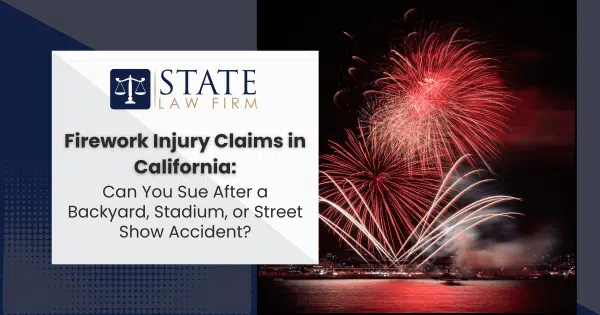
A fireworks accident can turn a celebration into a trauma scene in seconds. In California, a valid injury claim may reach beyond the person who lit the fuse and extend to a homeowner, event organizer, pyrotechnics company, product seller, or another party whose carelessness helped create the danger.
If you are trying to understand how California negligence cases are built after a serious injury, our El Monte injury attorneys can help evaluate what happened. In 2024 alone, the U.S. Consumer Product Safety Commission estimated 14,700 fireworks-related injuries nationwide, a reminder that these incidents are not rare, minor, or automatically written off as “holiday accidents.”
Firework Injuries: When You Can Bring a California Claim
Not every fireworks injury leads to a lawsuit, but many do. The key question is usually whether someone failed to act with reasonable care under the circumstances. That might mean setting off fireworks in an unsafe area, allowing minors to use them without supervision, ignoring crowd-control needs, using fireworks where they were not allowed, or selling a product that misfired or exploded unexpectedly.
California fireworks cases often turn on details that people overlook in the moment. Who bought the firework? Who lit it? Who owned or controlled the property? Was the event private or public? Were local rules being ignored? Did the device work as intended, or did it malfunction? Those questions shape the case.
El Office of the State Fire Marshal’s fireworks guidance matters here for a reason. California regulates fireworks heavily, and that regulatory structure often helps identify when someone stepped outside the rules in a way that supports liability.
As a practical matter, you may have a viable claim if your injury happened because:
- someone used fireworks recklessly
- a host allowed an unsafe setup on private property
- an event failed to maintain safe distances or proper crowd control
- illegal fireworks were used
- a firework was defective, mislabeled, or lacked adequate warnings
A strong claim is usually built early. Medical records, photos, debris, witness names, and location details can matter more than people realize in the first 24 to 72 hours.
Backyard Fireworks: Who Is Responsible When a “Friend’s” Firework Causes Harm
Backyard fireworks cases are often more complicated than they look. The obvious instinct is to blame the person who lit the fuse. Sometimes that is correct. But sometimes the liability picture is broader.
A friend who lights a firework toward a group, launches it too close to people, tries to relight a dud, or uses fireworks while impaired may be directly responsible. A homeowner or party host may also face exposure if they allowed dangerous activity on the property, knew the setup was unsafe, failed to supervise children, or ignored obvious risks like dry grass, tight spacing, blocked exits, or guests packed into a launch area.
These cases become especially serious when children are involved. Adults often assume they can avoid responsibility by saying the kids were “just playing” or that the firework itself caused the injury. That is usually not the end of the story. Supervision, access, storage, and permission all matter. In many situations, the adults who created the environment can be just as important as the person who physically ignited the device.
That is why early evidence matters. If you were hurt at a private gathering, try to identify:
- who purchased the fireworks
- who hosted the event
- who lit the device
- whether minors were involved
- whether anyone had been drinking
- where the fireworks were launched from
- whether video exists from phones, doorbells, or backyard cameras
A backyard injury claim is often won or lost on specifics, not assumptions. The faster those specifics are locked down, the stronger the case tends to be.
Stadium and Public Shows: When Event Organizers May Be Liable
Professional fireworks displays feel safer because they are organized, advertised, and often presented to large crowds. But when something goes wrong, the injuries can be severe, and the responsibility can extend across multiple parties.
Depending on the facts, that may include the event organizer, venue operator, pyrotechnics company, subcontractors, security personnel, or another entity involved in setup and execution. Public-show claims often focus less on one reckless act and more on system failure: poor launch-zone planning, inadequate barriers, crowd placement, unsafe fallout areas, weak emergency response, or a failure to account for weather, visibility, or exit flow.
That matters in California because public displays are not supposed to be casual affairs. They are regulated events. When a permitted show is handled carelessly, the existence of formal planning can actually help show where the breakdown occurred.
If you were injured at a stadium, fairground, concert venue, or civic fireworks show, preserve more than just medical proof. Save the ticket, event confirmation, parking receipt, venue map, wristband, and screenshots of the event page. Those details can help identify the correct defendants and reconstruct how the show was staged.
A few practical steps after a public-show injury:
- photograph the scene, barriers, launch area, and your position in the crowd
- note the exact time of the incident
- keep all admission and parking records
- request names of security or event staff you spoke with
- avoid posting detailed theories online before the facts are preserved
If a show was sold to the public as safe, controlled, and professionally managed, that representation matters when the event was not actually run that way.
Illegal Fireworks and Negligence Per Se Concepts
Illegal fireworks can change the legal analysis quickly. California does not treat all fireworks the same, and local rules matter. In some communities, even fireworks people assume are ordinary may still be prohibited. That is one reason fireworks cases can become powerful negligence cases when the conduct also violates a safety law.
Bajo California Evidence Code Section 669, a violation of a statute, ordinance, or regulation can support a presumption of negligence if the violation caused the kind of injury the law was designed to prevent and harmed a person the law was meant to protect. In plain English, if someone breaks a fireworks safety rule and that exact kind of danger hurts someone, the violation may significantly strengthen the injured person’s claim.
This is often where illegal fireworks cases separate themselves from “ordinary accident” cases. If someone used fireworks that were unlawful in that community, lacked the required approval markings, or staged a display without the required legal permissions, that may do more than make the conduct look irresponsible. It may help establish negligence in a more concrete way.
California injury law often turns on local and statutory detail. That same theme shows up in other everyday legal questions, including our article on whether it is illegal to sleep in your car in California. With fireworks, local ordinances can be just as important as statewide rules.
From a practical standpoint, if you suspect illegal fireworks were involved, try to document:
- packaging and labels
- whether the device exploded, flew, or moved unpredictably
- the city and exact address where it happened
- any police, fire, or code-enforcement response
- whether neighbors had complained or warned against the activity
Product Liability: Defective Fireworks, Misfires, and Explosions
Sometimes the problem is not only who used the firework. Sometimes the product itself failed.
A defective fireworks claim may arise when a firework explodes prematurely, misfires sideways, tips over because of bad construction, burns far more aggressively than expected, or lacks adequate instructions and warnings. In those cases, the responsible parties may include a manufacturer, distributor, retailer, or another company in the chain of sale.
This is a different kind of case from a simple negligence claim against a careless user. The focus shifts to the product: how it was made, how it was packaged, whether it was defectively designed, whether it matched its labeling, and whether the warnings were adequate for foreseeable use. A firework that was marketed as a consumer item but behaved like an unstable explosive may open the door to a powerful products claim.
The problem is that the best evidence in these cases disappears fast. Debris gets swept up. Packaging gets thrown away. People soak the remains in water and toss them out. That can destroy the very proof needed to show what went wrong.
If a misfire or premature explosion injured you, do not rush to discard everything. Preserve what you safely can, and photograph the rest before anything is moved. The CPSC’s fireworks safety page is a reminder that misfire and malfunction incidents are not theoretical. They are part of the national injury picture every year.
Common Firework Injuries and Damages
Fireworks injuries are often visually dramatic, but the full damage picture usually runs deeper than the initial ER visit. Burns may require ongoing wound care, grafting, scar management, or infection monitoring. Hand injuries may involve fractures, tendon damage, nerve loss, reduced grip strength, or permanent loss of dexterity. Eye injuries can leave a person with lasting blurred vision, light sensitivity, or partial vision loss. Blast exposure can also produce hearing damage, tinnitus, and head or facial trauma.
In a legal claim, damages may include more than the first round of medical bills. A serious fireworks case may involve:
- emergency treatment and hospitalization
- surgery and follow-up care
- burn treatment and scar revision
- vision or hearing treatment
- pérdida de ingresos
- future medical care
- dolor y sufrimiento
- angustia emocional
- permanent impairment or disfigurement
These cases also tend to affect daily life in personal ways. A hand injury can disrupt work, driving, childcare, cooking, exercise, and sleep. Facial burns or eye trauma can alter confidence and social functioning. A fireworks injury is not minor just because it happened during a celebration.
Evidence Checklist: What to Preserve Before It Disappears
In fireworks cases, disappearing evidence is a real problem. The faster you preserve the basics, the better.
Try to keep or document:
- the firework debris and packaging
- photos of the scene before cleanup
- burn marks, launch location, and damage pattern
- phone videos and social media clips
- names and numbers of witnesses
- 911, fire department, or police response information
- ER records, urgent care records, and prescriptions
- receipts for medications, bandages, eye care, or follow-up treatment
- the clothing or personal items damaged in the explosion
- tickets, wristbands, and venue information for public events
Also take photos of your injuries over time. A fireworks burn or hand injury often looks very different on day one, day five, and week three. That progression can matter.
When to Call a Lawyer
You should consider calling a lawyer sooner rather than later if the injury involved burns, eye trauma, a hand injury, hearing damage, a child, a public event, illegal fireworks, or a suspected product defect. Those are the kinds of cases where evidence disappears quickly and multiple defendants may point fingers at each other.
A lawyer can help identify the right theory of liability, preserve evidence, locate insurance coverage, and determine whether the case is really about a careless individual, a negligent host, a badly run event, a defective product, or some combination of all four.
If you want help sorting that out, State Law Firm’s El Monte injury team can review the facts and help you understand your next move.
Takeaway
A fireworks injury case in California is rarely just about a fuse and a flash. It is about who created the risk, who ignored the rules, what evidence still exists, and whether your injury could have been prevented. When the facts are preserved early, a case that looks chaotic at first often becomes much clearer.