Spanish
  English
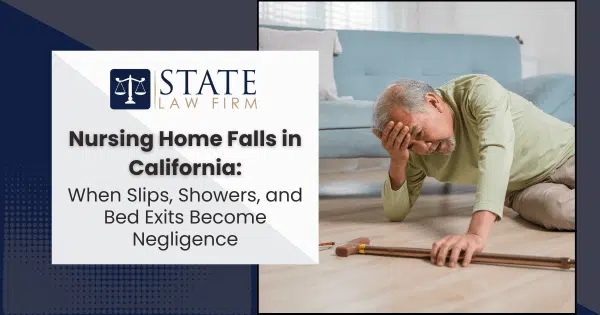
A fall inside a California nursing home can change a family’s life in a single afternoon. What looks, at first, like an isolated mishap often turns out to be something more troubling: a missed care plan, an ignored call light, an unsafe transfer, a medication issue, or a resident left alone when assistance was clearly needed.
If your family is already trying to understand whether a preventable fall may support a claim, speaking with an El Monte personal injury team early can help preserve the records that matter most.
Falls are the leading cause of injury for older adults, and federal patient-safety authorities have noted that roughly 1.3 million residents in nursing facilities fall each year. In that setting, the real legal question is rarely whether a fall happened.
The question is whether the facility did what it was supposed to do before the fall, during the fall-risk period, and after the resident was injured.
Can You Sue a Nursing Home for a Fall in California?
Yes, in the right case, you can sue a nursing home for a fall in California. But not every fall automatically means the facility is legally responsible.
Nursing home residents are often medically fragile. Some have balance problems, dementia, weakness, dizziness, neuropathy, stroke history, medication side effects, or a documented need for one-person or two-person assist during transfers. Because of that, the law does not treat every fall as proof of negligence. A facility is not a guarantor of perfect safety. What it must do is provide reasonable care, proper supervision, and services consistent with the resident’s condition.
That distinction matters.
A valid case usually develops when the evidence shows the fall was avoidable. In other words, the resident had known risks, the facility knew or should have known about them, and staff failed to respond in a reasonable way. That might mean the resident should not have been left alone in the shower, should have had help getting off the toilet, should have had a safer bed-exit protocol, or should have been monitored after a medication change that increased dizziness or confusion.
Families often sense this long before they see the chart. They hear phrases like “these things happen,” “we found him on the floor,” or “she must have tried to get up on her own.” Sometimes that explanation is true. Sometimes it is a way of flattening a preventable event into something that sounds inevitable.
If your instinct is that the story does not add up, trust that instinct and start asking for documentation quickly. In many cases, the paper trail tells a more honest story than the first phone call does.
When a Fall Becomes Negligence, Not Just an Accident
A fall becomes negligence when the facility fails to take reasonable precautions for a known or knowable risk. In a nursing home case, it usually starts with the resident’s assessment and care plan.
Facilities are supposed to identify fall risks, create a plan around them, and actually follow that plan on the floor. That means staff should know whether a resident needs standby assistance, a gait belt, scheduled toileting, closer supervision, hydration support, bed-height adjustments, proper footwear, mobility devices within reach, or monitoring after a medication adjustment.
Negligence tends to show up in patterns like these:
- A resident with documented fall risk is left unattended during a transfer
- Staff know a resident gets up impulsively, but call lights go unanswered
- The resident’s care plan requires assistance, but staffing is too thin to provide it
- The floor, bathroom, or room layout creates a predictable hazard
- The facility fails to reassess after a prior near-fall or recent fall
- A resident becomes dizzy after medication changes, dehydration, or illness, and no one increases monitoring
This is why these cases are about much more than the moment of impact. A broken hip or head injury may occur in seconds, but the negligence often builds over days or weeks. Warning signs are missed. Complaints are brushed aside. Staffing becomes stretched. Documentation grows thinner right where it should be most specific.
That is also why families should think broadly. A lawsuit may be based not only on the fall itself, but on the neglect that made the fall likely. If a facility repeatedly failed to protect a resident from known safety hazards, failed to provide needed care, or failed to respond appropriately to medical decline, the legal exposure can go well beyond a simple accident claim.
A prompt legal review can be especially valuable here because records do not stay fresh forever. Staffing data, internal notes, video, and witness memories all become harder to pin down with time.
Common Fall Scenarios: Shower Slips, Toilet Transfers, and Bed Exits
Some nursing home falls follow familiar patterns. The setting changes, but the core problem is the same: a resident needs help, the help is delayed or missing, and the facility later describes the event as unavoidable.
Shower and bathroom falls. These are among the most troubling because bathrooms are obvious hazard zones. Wet surfaces, privacy concerns, urgency, and reduced mobility create a dangerous mix. If a resident required shower assistance, transfer help, or supervision while toileting, a fall in that setting can raise serious questions about whether staff followed the care plan.
Toilet transfer falls. Many residents need help sitting down, standing up, pivoting, or using assistive equipment. A fall during a toilet transfer often points to poor staffing, rushed care, or failure to use the right transfer technique. It may also reflect the facility’s failure to anticipate urgency, especially for residents with incontinence, mobility limits, or confusion.
Bed-exit falls. These cases often involve residents who attempt to stand on their own, usually at night or early morning. If the chart shows impulsivity, confusion, prior falls, or a need for assistance with ambulation, the investigation should focus on whether the facility adjusted supervision appropriately. Was the resident placed where staff could observe them? Were call lights answered? Was the bed configured safely? Had the care plan been revised after earlier incidents?
Hallway or room falls after medication issues. A resident who becomes newly sedated, weak, dehydrated, or disoriented may need more frequent checks and more hands-on assistance. When that does not happen, a “simple fall” can actually be the visible result of a medical-monitoring failure.
These details matter because a nursing home fall case is built on context. The same fall can look very different depending on whether the resident was truly independent, partially assisted, or fully dependent. If your family has only been given a short verbal summary, that is usually not enough.
Fall Prevention Duties: Care Plans, Staffing, Supervision, and Medical Monitoring
California nursing home cases often turn on whether the facility had systems in place and whether those systems were followed in real life.
At a practical level, fall prevention duties often include:
- timely assessment of fall risk
- a clear, individualized care plan
- enough trained staff to carry out that plan
- safe transfer practices
- monitoring after prior falls or near-falls
- attention to medication side effects, dehydration, infection, or sudden weakness
- supervision consistent with the resident’s cognitive and physical condition
Families should also remember that understaffing is rarely announced, but it often leaves fingerprints. Repeated unanswered call lights, delayed toileting help, rushed transfers, incomplete charting, and residents trying to do things alone are common signs. So is the quiet mismatch between what the care plan says and what the floor could realistically deliver.
There are also moments when a fall points to neglect beyond mobility alone. If a resident was dehydrated, over-sedated, newly confused, or medically declining, the case may involve failures in monitoring and treatment, not just supervision. That distinction can be important when evaluating whether the claim is ordinary negligence, professional negligence, or elder neglect.
For families doing their own early homework, official resources can help. California’s Nursing Home Residents’ Rights materials are worth reviewing, and Medicare’s Care Compare can provide useful background on a facility’s inspections, staffing, and quality information. Those tools are not the final word, but they can help you ask sharper questions.
When Families Can Sue for Neglect, What Evidence to Request, and What Damages May Be Available
In many cases, the strongest claim is not merely “my loved one fell.” It is “the facility failed to protect my loved one from a known safety risk and failed to provide the care their condition required.”
That is the heart of neglect cases.
Evidence checklist families should request
Ask for the following as soon as possible:
- the incident report
- the resident’s chart and progress notes
- the fall-risk assessment
- the care plan and any revisions
- medication administration records
- physician orders
- nursing notes from the days before and after the fall
- staffing schedules and assignment sheets
- call-light logs, if available
- internal investigation materials
- photographs of the room, bathroom, bed area, and assistive devices
- any preserved video
- hospital records if the resident was transferred out
If the resident or their representative requests records, nursing home rights materials also describe access rights that can be very important in the first days after an incident. And because public ratings do not always tell the whole story, families should be cautious about assuming a low reported fall rate means the facility is safe. If needed, a lawyer can move quickly to preserve evidence before it disappears.
Damages in a nursing home fall case
Damages depend on the facts, but they may include compensation for:
- emergency treatment and hospitalization
- surgery, rehabilitation, and follow-up care
- dolor y sufrimiento
- loss of mobility and independence
- worsening cognitive decline after the injury
- complications from immobility
- wrongful death damages in fatal cases
In the right elder neglect case, California law may also allow enhanced remedies beyond a standard negligence claim. That is one reason families should not assume a fall case is “too small” just because the incident itself seemed brief. The legal value often lies in the harm that follows and the pattern that preceded it.
Deadlines and next steps
Do not sit on the timeline. In California, deadlines can vary depending on how the claim is framed. A case may involve ordinary negligence, professional negligence, wrongful death, or elder abuse and neglect theories, and each can raise different timing questions. The safest move is to have the facts reviewed early, before a deadline issue becomes the reason a valid case is lost.
You can also file a complaint with the California Department of Public Health if you believe the facility endangered a resident. That administrative step does not replace a civil claim, but it can matter.
If the fall forced your family into a rushed relocation and short-term housing scramble, practical questions can pile up fast. For one common emergency issue, State Law Firm also has a guide on whether it is illegal to sleep in your car in California, which some families look up while navigating sudden displacement after a care crisis.
Takeaway
A nursing home fall is not always negligence, but it is never something families should dismiss without looking deeper. When a resident had known risks, needed help, and was still allowed to fall in a shower, during a toilet transfer, or while getting out of bed alone, the law may treat that event as preventable neglect, not bad luck. The sooner the records are preserved and the story is tested against the chart, the clearer the case usually becomes.