Spanish
  English
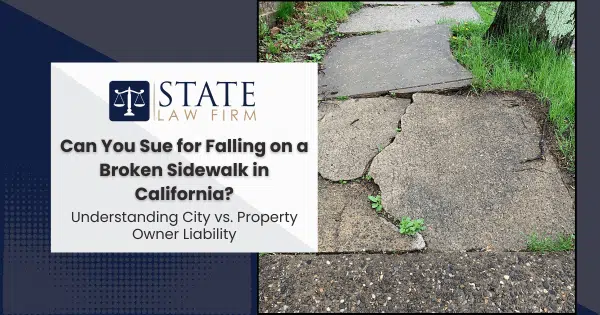
A broken sidewalk can turn a normal walk into an ambulance ride in a heartbeat. The hard part is not only healing but also figuring out who is legally responsible when a defect sits in front of someone’s home or business, yet still belongs to the public right-of-way.
In California, falls are not “minor” in the aggregate. Among Californians age 65 and older, falls caused 317,582 emergency department visits in 2023, a reminder that a single misstep can have very real consequences.
If you need clear next steps, start with our Workplace injury lawyers—they explain timelines, evidence, and common pitfalls.
This guide explains how sidewalk injury claims work in California, when a city can be at fault, when a property owner may be on the hook, and what you should do right away to protect your case.
Who is responsible for sidewalk maintenance in California?
Most people assume a sidewalk “belongs” to the homeowner or storefront it borders. In reality, sidewalks are usually public property controlled by a city or county, even when they run along private land. That public ownership matters because public entities are not automatically liable the way private parties can be.
At the same time, California law often places a maintenance obligation on the adjacent property owner. Many cities also have local ordinances that require owners to keep sidewalks in repair, reimburse the city for repairs, or maintain trees and landscaping that can disrupt pavement.
Here is the practical takeaway: maintenance responsibility and legal liability are related, but not identical. A property owner might have a duty to maintain, yet not be legally responsible for a pedestrian’s injuries unless additional facts are present. That is why the same fall can lead to very different outcomes depending on how the defect formed and who knew about it.
Start by identifying the “who” before you chase the “how much.”
- Look at the location: is it in front of a single-family home, a business, a multi-tenant property, or an HOA-managed development?
- Determine which public entity controls that sidewalk: city, county, or a state agency (for some highway-adjacent areas).
- Check whether a tree well, sprinkler runoff, construction work, or a driveway cut contributed to the defect. Those details often decide whether a private party can be brought into the case.
A good claim begins like a good investigation: with the map, the owner, and the timeline.
City liability: When is the municipality at fault?
Suing a city or other public entity is possible, but it is not the same as suing a private property owner. In California, a public entity is typically liable for sidewalk injuries only when the sidewalk qualifies as a dangerous condition of public property and the entity had the required level of notice or involvement.
In plain English, you generally need to prove four ideas:
- The sidewalk had a condition that posed a substantial risk when used with reasonable care.
- The condition was a substantial factor in causing your fall and injuries.
- The risk was reasonably foreseeable.
- The public entity either created the condition through its employees’ negligence, or had actual or constructive notice of it long enough to fix it or warn people.
That last point is where many cases are won or lost. A city may argue, “We did not know,” or “We could not reasonably have known,” especially if the defect developed recently.
What counts as “notice” in a sidewalk case?
Notice can be:
- Actual notice, such as prior complaints, maintenance requests, work orders, inspection reports, or prior incidents at the same spot.
- Constructive notice, meaning the defect existed long enough and was obvious enough that a reasonable inspection program should have caught it.
Build your notice file early.
- Submit a public records request for 311 complaints, sidewalk repair tickets, inspection logs, and prior claims for that block or intersection.
- Document how long the defect appears to have existed. Look for older photos (your own, neighbors’, business listings, mapping images) that show the same break or uplift.
- Identify nearby aggravating conditions, like poor lighting, uneven transitions at curb ramps, or a high-foot-traffic area. Context can turn “small defect” into “foreseeably dangerous.”
When cities defend hard, they often use predictable tools
Cities and counties commonly raise defenses such as:
- Trivial defect arguments (the defect was too minor to be legally “dangerous”).
- Lack of notice (no time to repair or warn).
- Design immunity (the condition resulted from an approved plan or design).
- Comparative fault (you were not watching, wore unsafe shoes, were distracted, or chose an unsafe path).
These defenses are not automatic wins for the city. They are starting points. The job is to answer them with facts: measurements, photos, medical records, witness statements, and a clear story of what happened and why the hazard would have caught a reasonable person.
If a city is involved, the clock moves fast, and the paperwork is unforgiving. A lawyer can help identify the correct public entity, preserve evidence, and pursue the claim before deadlines close the door.
Property owner accountability: When a private party can be responsible
Even when the sidewalk is public, a private property owner can sometimes be a proper defendant. The key question is not simply “Whose sidewalk is it?” but “Did the adjacent owner do something, or fail to do something, that created or worsened the danger?”
In California, courts often look for facts showing the owner:
- Created the hazard (for example, making unpermitted modifications, damaging the walkway during remodeling, directing drainage onto the sidewalk, or negligently maintaining a tree that uplifted concrete).
- Made a special use of the sidewalk that increased risk (for example, a business that regularly uses the sidewalk area in a way that creates wear, slick residue, or obstacles).
- Controlled the area in a meaningful way, such as through an HOA or a private entity responsible for the walkway in a development that looks like a public sidewalk but is actually privately maintained.
This is why “just fix it” laws do not always translate into “just pay” liability. A rule requiring an owner to maintain a sidewalk does not necessarily mean the owner is liable to every pedestrian who is injured there. Liability often turns on the owner’s conduct and the cause of the defect.
Look for private-cause fingerprints.
- Tree roots: Is there a tree on private property or in a maintained strip that the owner controls? Are there irrigation patterns that suggest overwatering or root growth issues?
- Runoff: Is there staining, algae, moss, or a consistently wet area from sprinklers or downspouts?
- Construction: Was there recent work, debris, patched concrete, or temporary plates?
- Business practices: Are there mats, displays, grease, cleaning runoff, or repeated cart traffic that affects the walking surface?
When private factors appear, you may have more than one responsible party. That can matter because public entities have special claim procedures and defenses, while private defendants are handled through ordinary personal injury litigation.
If you are not sure whether your case involves a city, a homeowner, a business, or all of the above, a quick liability analysis can prevent months of misdirected effort.
The claims process: Steps to take after a sidewalk fall
Sidewalk injury claims succeed when the evidence is gathered while the scene is still honest. Concrete gets patched. Photos disappear. Witnesses forget. Cities repair hazards after complaints. Your job is to preserve the truth before it changes.
Step 1: Get medical care and create a clear record
Your health comes first. Also, early medical documentation connects the fall to the injuries. Tell providers exactly how you fell and what hit the ground (knee, shoulder, head, wrist). If you hit your head, treat that as urgent.
Step 2: Document the defect like you are building a case, because you are
- Take wide-angle photos that show the defect in context, including street signs and nearby addresses.
- Take close-up photos from multiple angles.
- Measure the height differential, gap, or lip. A simple tape measure photo can become a key exhibit.
- Record lighting conditions at the time of the fall, especially if it was dusk, night, or shadowed by trees or buildings.
Step 3: Preserve what you wore and carried
Shoes, clothing, and any items you dropped can matter. Defendants often argue that the footwear or a distraction caused the accident. Keep the shoes and do not alter them.
Step 4: Identify witnesses and capture the immediate story
If anyone saw you fall or saw the defect before, get names and contact information. If a nearby business has cameras, request preservation immediately in writing. Video is often overwritten quickly.
Step 5: Decide whether a public entity is involved, and do not miss the claim deadline
If a city, county, or other public agency may be responsible, California requires a government claim before a lawsuit can proceed. For many injury cases, the claim must be presented within seis meses of the injury. If you miss that deadline, your case may be barred even if the sidewalk was plainly dangerous.
By contrast, claims against private parties usually follow the standard personal injury filing deadline, commonly dos años from the injury, though exceptions can apply.
Treat the first two weeks as a preservation window.
- Photograph the sidewalk immediately, then again a few days later, in case repairs begin.
- Report the defect to the responsible public entity, but do it in a way that creates a paper trail (confirmation number, email, or online ticket).
- Avoid giving recorded statements until you understand who the defendants are and what deadlines apply.
If you are injured and a public entity might be involved, it is wise to speak with counsel early. A short consultation can save a case that cannot be resurrected later.
Challenges, defenses, and compensation: What to expect
Sidewalk cases sound simple until you meet the defenses. Knowing them ahead of time helps you gather the evidence that defeats them.
The “trivial defect” defense
Public entities often argue the defect was too minor to be legally actionable. Courts evaluate more than a ruler measurement. They look at circumstances such as visibility, lighting, surrounding distractions, slope, the edge shape, and whether the defect blends into the walking surface.
If a raised edge sits in deep shade, near a curb ramp, or where foot traffic is heavy, “small” can still be dangerous in the real world. Your photos and measurements should capture these real-world conditions.
Lack of notice
Cities often claim they had no reason to know. That is why prior complaints, inspection records, and evidence that the defect existed for a long time are so valuable. Sometimes the best notice evidence is ordinary: neighbors who can say, “That slab has been lifted for months,” or a dated photo that quietly proves the timeline.
Design immunity and other public-entity protections
If the condition resulted from an approved plan or design, a city may claim immunity. But not every defect is a “design.” Broken concrete, differential settlement, deteriorating patches, and maintenance failures are often about upkeep, not blueprint choices. The facts decide which side of the line the case falls on.
Negligencia comparativa
California generally reduces damages by your percentage of fault rather than barring the claim entirely. Defendants may argue you were distracted, walking too fast, looking at a phone, or choosing an unsafe route.
The best response is not a speech. It is evidence.
- Good photos show the defect was hard to detect.
- Witnesses show you were walking normally.
- Medical records show the mechanics of the fall and the severity of impact.
What compensation can you pursue?
If you can establish liability, damages in a sidewalk injury claim may include:
- Past and future medical expenses (ER care, imaging, surgery, physical therapy, medication)
- Lost income and reduced earning capacity
- Out-of-pocket costs (transportation, medical devices, home help)
- Pain, suffering, and loss of enjoyment of life
- In some cases, scarring or lasting mobility limitations
The value of a case is not only the diagnosis, but the story the records tell: the disruption to work, family obligations, sleep, independence, and daily life.
State Law Firm handles serious injury claims with the mindset of litigators. If your fall caused significant harm, getting advice early can help you avoid missteps, preserve proof, and pursue full compensation.
A broken sidewalk case is not just about the crack in the concrete. It is about who controlled the area, what caused the defect, who knew or should have known, and whether the right deadlines were met. If a public entity may be responsible, act quickly. Photograph the hazard, document your injuries, preserve witness and video evidence, and get guidance before procedural rules decide the case for you.